Name, image and likeness (NIL) deals, introduced five years ago, have reshaped college sports by putting the power of image back in players’ hands. College athletes, who previously could not profit from their own names, despite bringing billions of dollars in revenue to the sports industry, now have the opportunity to benefit from their personal brands through endorsements, sponsorships, social media and appearances.
For many athletes, it means big money, bigger opportunities and even bigger controversies. NIL gives college players the opportunity to earn money based on their name, but there is a growing divide between those who benefit and those who don’t.
For many student-athletes, NIL deals stand in the gap between attending and not attending school.
“NIL helped me come back to school. It made it easier to stay,” said former University of North Carolina forward Armando Bacot.
NIL persuades student-athletes to stay in college and finish their education rather than go pro immediately. Earning money in college can be seen as an incentive to stay in school. By doing so, student-athletes can continue their education and even earn their degree, giving them a backup option if the sports route does not pan out.
“I am blessed to be able to attend Monmouth University on a full athletic scholarship. All of my tuition, fees, and books are covered by the football program,” said Monmouth University running back Makhi Green.
Not only does NIL benefit the athletes, but also the businesses and brands they partner with for being a known name.
“NIL opportunities can boost the local economy by allowing businesses to partner directly with student-athletes,” according to University of Virginia economics professor Ed Burton.
Take Olivia Dunne, a gymnast at Louisiana State University, partnering with Raising Cane’s. Dunne has millions of followers on social media, which translates to increased attention and exposure for the restaurant, proving that a symbiotic relationship is possible with these types of deals.
One of the most significant impacts of NIL is recruiting. Colleges can now offer players money to persuade them to come to their school. Money acts as a helpful tool to stay competitive in recruiting.
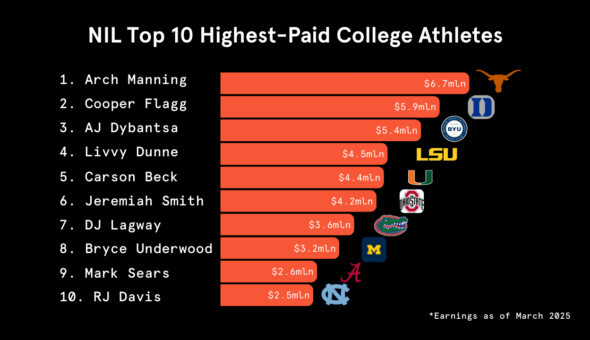
The top NIL earners in the year of 2025. (Photo Credit: Volt EDU)
Bryce Underwood, the number one-ranked football recruit in the class of 2025, initially committed to Louisiana State University. However, he flipped his commitment to the University of Michigan after they offered him $10-$12.5 million over four years to play for them.
Money is a powerful motivator, and big programs use it regularly to their disposal. However, this motivation causes a problem for smaller/Group of Five programs with fewer resources, who are unable to offer recruits large amounts of money to play for them.
Assistant basketball coach Steven Whitley at Norfolk State University discussed how offers regarding exposure, connections and mentorship still don’t always compete with the money bigger schools are offering.
Norfolk State is a member of the MEAC conference, a smaller conference compared to the Power Five. Norfolk State does not have the same number of donors or connections as major programs.
This also has to do with conferences like the MEAC, CAA, Ohio Valley Conference and Big South Conference not having the same television coverage as the major conferences, affecting players’ ability to go pro or gain recognition.
The financial aspect of recruiting also influences players who enter the transfer portal. Smaller schools in lesser-known conferences can develop players into great talents; however, once that happens, those players often seek to transfer to major programs for better opportunities.
An example of this is our very own former Howard University basketball player, Blake Harper.
Harper won MEAC Player of the Year in 2025 as a freshman, averaging about 20 points per game. After the season ended, Harper transferred to Creighton University, a well-known basketball program that competes at the top level every year. He was also recruited by schools including Ohio State and LSU, with rumors of NIL money deals tied to his recruitment.
Many players choose to chase money and opportunities over loyalty, underscoring why NIL is not a friend to smaller schools.
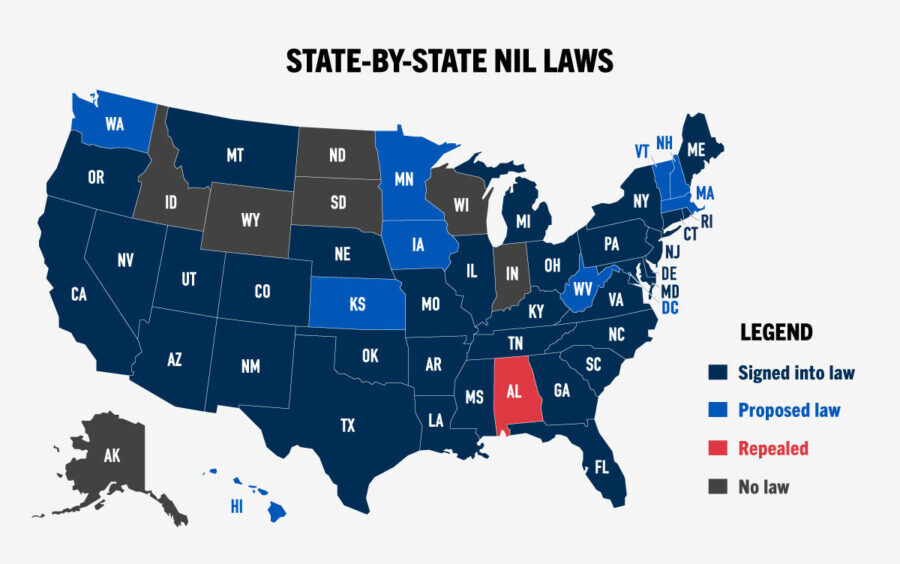
Another negative of the new age of NIL is the lack of a uniform structure or set of rules. Some states allow more NIL involvement from schools than others. This looks like coaches being more vocal about what a player should be worth when figuring out new deals based on their stats, donors being more involved in some states, states not allowing partnerships with specific brands and states changing their NIL rules to stay competitive, giving schools in those states an edge.
President Donald Trump has issued an executive order on NIL, requesting that the system be more nationally based rather than state-by-state. NIL collectives and donors would then be monitored by the federal government.
Texas, California and Florida have all tweaked their NIL laws to keep up and attract top talent. They have adapted their laws to allow more interaction between schools in their states and organizations that bring in money to fund big NIL deals for the athletes. They realized that without the ability to create big-money NIL deals for their recruits, they would fall behind in competition.
(Photo Credit: NCSA)
“You can basically buy players. I don’t think what we’re doing right now is a sustainable model,” said former Alabama and Hall of Fame football coach Nick Saban.
Saban believes that changing laws to allow players to receive more money is not a feasible system.
The world of NIL has also affected locker room dynamics and relationships between players.
Players leaving their teams to chase money at bigger programs can create tension within the team, especially when a player’s decision to leave is announced during the season, when they are still playing with their current team. A player leaving can affect team chemistry and make teammates question their loyalty after the relationships they built.
“For Division I student athletes in 2021, there were 9,806 portal transfers. In 2023, that number was 13,025. That’s a 75% increase in two years,” according to thefrontonline.com.
Some players enter the transfer portal before the season is even over, which signals to the whole team that they are leaving soon. Deciding to already leave while the season is still ongoing makes teammates wonder whether that player is still trying their best to win or can be trusted.
An example of this is Efton Reid, an LSU basketball player during the 2022 season. Reid entered the transfer portal in March, right when his team’s March Madness was about to begin. Roster changes being made public while the season is still ongoing can vastly affect team dynamics.
NIL has completely changed college sports. For the first time, athletes are allowed to benefit financially from their own names, but the wealth, opportunity and exposure are not evenly distributed across divisions, schools or even players. The shift has changed college sports both positively and negatively, but it remains to be seen how else the system will evolve in the coming years.
William Armstead is a reporter for HU News Service