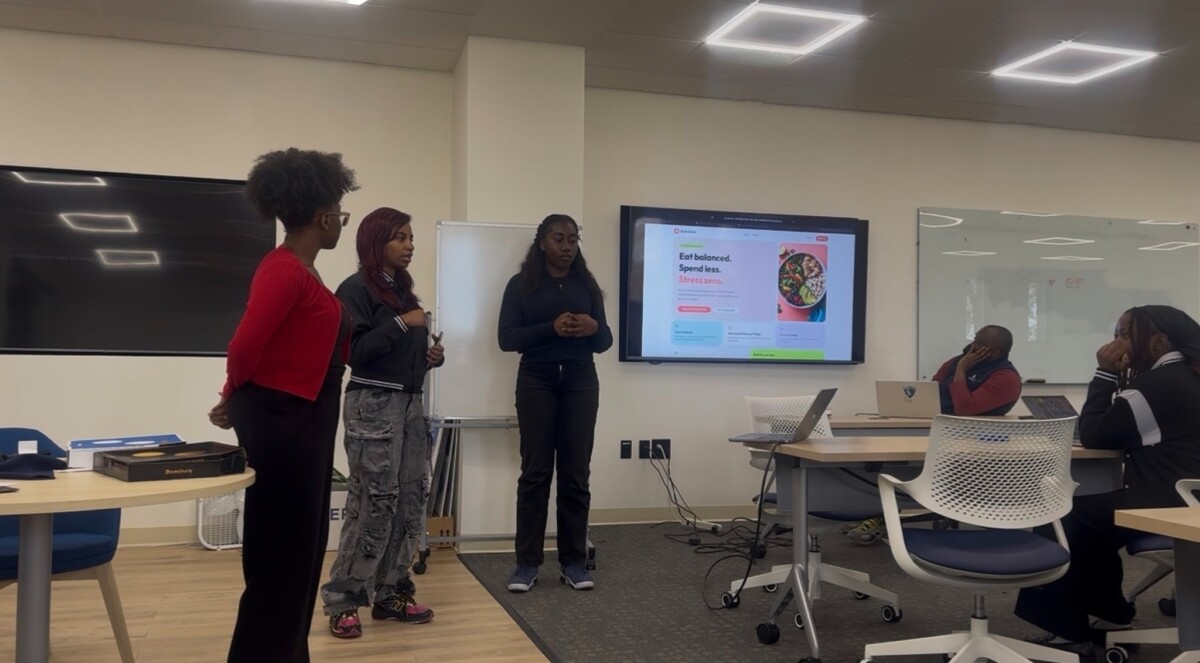
At the end of October, the Center for Digital Business (CDB) welcomed students to the School of Business to participate in their annual Hack Day. Throughout the event, students worked together to present original solutions to a proposed challenge, exploring how different academic backgrounds and perspectives could contribute to an original idea.
Hack Day was organized to prepare interested students for BisonHacks, a larger, 24-hour competition scheduled for February 2027. The “one-day experience” on Oct. 31 aimed to prepare students for the process of developing an original solution, modeled by a real Hackathon competition.
Taya Watson, a junior computer information systems major from St. Albans, West Virginia, serves as the campus partnerships associate on the CDB’s strategic operations team. Watson also assisted students throughout the event, drawing from her experiences participating in the 2025 BisonHacks competition.
Etoulia Salle-Burnett, the executive director of CDB, and Edward Harding, administrative coordinator for CDB, served as the advisors for Hack Day 2026.
Harding says that no advanced technological experience is required, and Watson describes Hack Day as a learning opportunity for students interested in participating in BisonHacks. She encouraged students from different majors to participate.
“It’s a great way to get that knowledge under your belt of what’s expected in the Hackathon,” Watson said.
Watson said she initially experienced imposter syndrome as a business student entering a technical environment. However, participating in the competition helped her recognize that she could contribute to the field.
Through her participation, Watson said she gained “confidence” in her abilities and began to recognize that her background did not limit her ability to contribute to technical spaces.
Before receiving the challenge, students were introduced to multiple formats to deliver their solutions, including a business pitch, digital campaign, website, application concept, visual design, community solution or an interactive experience.
Due to a smaller number of students in attendance, participants chose to collaborate as a singular team.
Pride David, Beyonce Reid and Kitan Akanbi, paired up. Their assigned challenge focused on the theme of “Healthy Eating Made Easily Accessible.”
David, a junior elementary education major from Buffalo, New York, developed the marketing strategy for the team’s solution to accessible healthy eating. She focused on identifying a target audience and determining effective ways to reach them.
“Our target audience is [Generation] Z, Millennials, undergraduate and graduate students as well as working professionals,” David said.
The team planned to develop an online website promoting balanced eating habits through meal suggestions and meal-planning ideas. They also considered how social media could be used to reach their intended audience.
To develop their concept, the group planned to use Lovable, an artificial intelligence-assisted website development platform. The students intended to create a business plan before using the platform to generate a website, which they could then modify to fit their vision.
David identified the spread of misinformation surrounding nutrition as one of the challenges the group wanted to address.
“There are a lot of misconceptions and misinformation about healthy eating, especially when we’re talking about social media because we don’t want to demonize food at all in our platform,” she said.
For Salles-Burnett, her overall goal was to make Hack Day accessible to students across all disciplines.
“What I love about the students who come to participate in Hack Day is that they’re really just open to learning and having a new experience and trying something out,” Salles-Burnett said.
She explained that students often associate hackathon’s exclusively with coding and technical expertise, which can discourage them from participating.
At BisonHacks, participating teams will have three minutes to present their projects, followed by one minute for questions from judges. The closing ceremony will recognize participants through awards, scholarships and first-, second- and third-place announcements.
The Center for Digital Business also hopes to expand participation in the upcoming competition. Salles-Burnett said her goal is to have 200 students attend and compete in this year’s BisonHacks.
Though David was initially intimidated by the idea of participating in a hackathon because of her lack of coding experience she felt that attending Hack Day helped her understand the different ways students could contribute to a project.
“I feel like I want to do BisonHacks now,” she said.
The team worked for about two hours on their website and prepared for their presentation to be delivered to the advisors.
“Having a diverse group is helpful in understanding, from a micro-level, what BisonHacks would look like,” said Harding, referring to there only being three participants which composed the one team. “From this aspect, there would be no real judging, rather, destigmatizing the thoughts surrounding the Hackathon.”
By 3:00 p.m., the team was ready to present their final product. The website titled “GrubGuide” featured two versions: a free and paid demo plan, with perks available to take a picture of current ingredients and receive computerized meal suggestions. The website also takes an individual’s personal cravings and creates healthier options.
“We decided to market GrubGuide towards the Hospitality center, and other partnerships such as Factor and HelloFresh,” Reid said, a senior marketing major from Philadelphia.
The group identified potential ad revenue and sponsors and stated business-related inquiries throughout their presentation.
The event concluded with Salle-Burnett, Harding and Watson offering the team feedback and advice on their final presentation. Their insights reinforced the value of bringing together students with different academic backgrounds and skill sets.
Reflecting on the collaborative nature of BisonHacks, Harding emphasized that technical expertise is not the defining factor of a successful team in the competition.
“It’s not about the code, it’s about the collaboration,” Harding said. “The goal is to find people that will want to compete in BisonHacks that haven’t competed before. They could tell a friend ‘It’s not nearly as daunting a task as we thought.’”
Copy edited by Daryl R. Thomas Jr.