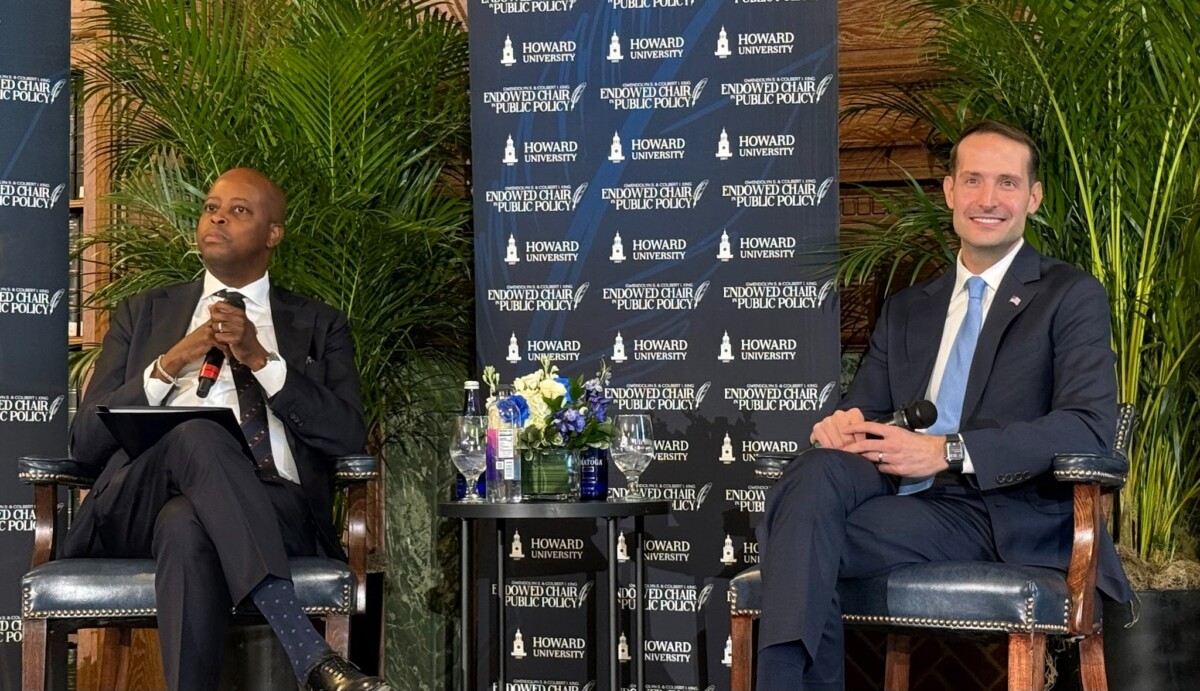
Dozens of administrators, faculty and students gathered in the reading room of Founders Library on Nov. 10, listening closely to the policies outlined by Under Secretary for Education Nicholas Kent. He is charged, in part, with implementing the One Big Beautiful Bill Act (OBBBA) signed into law in July 2025.
Moderated by Howard University President Emeritus Dr. Wayne Frederick, Kent visited Howard for a Nov. 10 fireside chat on higher education affordability. Echoing the Trump administration’s approach, Kent argued that the federal government has contributed to rising college costs by making student loans increasingly accessible without applying “downward pressure” on colleges to cut prices.
As part of his college tour — Howard being his fourth historically Black college or university (HBCU) — Kent is seeking to project stability nationwide as the Department he helps lead is being dismantled. Deep divisions over OBBBA and more than $1.7 trillion in federal student loan debt have further entrenched him in a predicament.
He defended what he called “accountability” measures from the bill — including capping how much a student can borrow in federal loans — as Frederick challenged him to consider whether the changes weigh the distinct problems HBCUs and their students face, such as chronic underfunding.
“[Howard] charges roughly $27,000 less than the peer institutions that we compare ourselves to and yet still, 42% of our students are Pell Grant eligible,” Frederick pointed out at one moment, questioning Kent on whether federal policy acknowledges the unique financial circumstances of HBCUs.
As a first-generation college graduate who relied on Pell Grants, Kent said he believed colleges are out of reach for too many and no longer hold the same role in society they once did.
“We have a crisis of confidence in higher education,” Kent said, noting a “nose dive” in post-secondary education poll approval ratings compared with two decades ago.
The OBBBA capped borrowing for graduate and professional degrees and Parent PLUS loans. It also implemented a lifetime maximum of $257,500 that can be taken out, applying to all federal loans other than Parent PLUS.
According to Kent, the Trump administration believed this would force colleges to price their programs lower.
Frederick expressed unease about the loan caps, especially for students from backgrounds where aid is their only pathway.
“My concern,” Frederick said, “is that those caps would expose those students to the vulnerabilities of loan sharks or of getting loans at an interest rate that they cannot afford.”
The federal government’s high interest rates make it the “largest predatory lender” for graduate students, Kent said in response.
Wanda Johnson, the associate director of operations and customer service for the Howard Office of Financial Aid, said she hoped to hear apolitical answers at the chat. Kent seldom offered overt political views, except to note the Biden administration’s challenges with the 2023 FAFSA rollout.
“This was an extraordinary opportunity to get straight to the source of the many changes that we’ve had to enforce,” Johnson said.
She said the Department of Education needs to recognize students’ problems and that system changes must account for inequalities.
“[The system] should be created to fit every socioeconomic demographic,” Johnson said, suggesting that family incomes in Mississippi don’t align with those of California.
As loans change, Kent said the federal government also reckoned with the status of Pell Grants, adding that the FAFSA Simplification Act, passed in 2021, created new issues for the program.
“It also broadened the eligibility for the Pell Grant, making more students eligible for the maximum Pell Grant, which is awesome,” Kent said. “The challenging part is that the cost of the program is operating in a shortfall now.”
Addressing one of the Trump administration’s most controversial education policy actions, Frederick asked Kent how the unprecedented dismantling of the Department of Education would impact colleges and universities.
Kent described the move as the “winding down” of the Department in an effort to return power to the states.
“We spent about $3 trillion [since 1980], and the outcomes of our children are no better — they’re actually worse,” he said.
He asserted that, for example, the $1.7 trillion federal student loan portfolio should be managed by the Treasury Department.
“I am not a banker and I am responsible for that $1.7 trillion,” Kent said.
Frederick questioned whether agencies assuming Education Department duties will hire field-experienced staff, fearing bankers may undervalue institutional knowledge.
“I do want to have someone with your empathy for the circumstances of the American student,” he said.
Jody Dixon, a third-year doctoral student in the higher education and leadership and policy studies program, was the chat’s student host.
“I think it’s always good to hear and see our institutional leaders engaging with the decision makers,” Dixon said.
She highlighted that her peers should pay close attention to changes in higher education and question who is impacted.
“I think especially as an HBCU, but also as students, there is so much nuance when it comes to policy and how policy is actuated,” she said.
Dixon added that she agreed with the under secretary’s stated mission of bringing down costs, but disagreed on “how that’s being done.”
A former international student, Dixon thinks about education from a global perspective. She noted that low-income status varies significantly across the nation and world and that policy may not account for those intricacies.
“There is copious amounts of information that is not being considered when it comes to actually making higher education accessible,” Dixon said.
Copy edited by Daryl R. Thomas Jr.