By recently holding that a lower court improperly inserted itself into the Texas redistricting process, the U.S. Supreme Court made it highly likely that Republicans will win a large number of seats in congressional districts throughout the country going into the 2026 midterm elections.
Even more critically, the Court’s decision could lay the groundwork for the emaciation of Section 2 of the Voting Rights Act.
The Court essentially revived the Texas’ controversial 2025 map, which would reshape the state’s congressional districts, by overturning a lower court’s ruling in favor of Black and Latino plaintiffs in LULAC v. Abbott. The state of Texas had submitted an application to Justice Samuel Alito for an emergency administrative stay on Nov. 21.
The Supreme Court’s order, approving the stay on Thursday, states that “Texas is likely to succeed on the merits of its claim that the district court committed at least two serious errors.”
The first error was that the district court “failed to honor the presumption of legislative good faith by construing ambiguous direct and circumstantial evidence against the legislature,” and the second error was that the plaintiffs did not produce a “viable alternative map.”
Justices Elena Kagan, Sonia Sotomayor and Kentaji Brown Jackson dissented from the order.
In her dissent, Kagan noted the potential impact of the ruling on voters, stating, “Today’s order disserves the millions of Texans whom the District Court found were assigned to their new districts based on their race.”
President Donald Trump expressed the idea of a new Texas congressional map this summer. “A very simple redrawing, we pick up five seats,” he said in reference to the 2026 midterm elections.
Soon after, in the beginning of July, the Department of Justice (DOJ) sent out a letter to Texas stating that its congressional map contained “unconstitutional coalition districts” or districts without a single race as the majority. Texas Gov. Greg Abbott called a special legislative session, and the new map, passed as House Bill 4 (HB 4), was signed into law on Aug. 29.
Typically, congressional maps are redrawn at the start of each decade following the U.S. census. Either through their legislatures or independent commissions, states use census data to redraw district boundaries to maintain equal populations and fairness. While equity and minority representation are supposed to be the goals, partisanship, race, community boundaries and geographical compactness also influence how maps are shaped. The use of these factors, known as gerrymandering, is legal within certain limits.
Beyond its unusual timing, House Bill 4 raised national concerns for diminishing the minority voters’ voices, such as Black and Latino Texans. NAACP Chief Executive Officer Derrick Johnson said in a press release that “Jim Crow has returned on steroids, giving white voters 80% plus of all Congressional districts in Texas, even though they are only 40% of our population.”
Johnson also said the map “amounts to a return to the Three-Fifths Compromise, where we are used to generate congressional seats but have no influence on them.”
The League of United Latin American Citizens (LULAC), with the support of other civil rights groups, argued that the new map diluted the voting power of Black and Hispanic communities in LULAC v. Abbott. In a 2-1 decision on Nov. 18, a three-judge federal panel in El Paso ruled “substantial evidence shows that Texas racially gerrymandered the 2025 map.”
Manotti Jenkins, attorney and award-winning litigator, explains that the court’s reliance on the DOJ’s letter, which was largely racial based, helped the case to be victorious. Judge Jeffrey V. Brown, a Trump appointee, was among those voting against the map with David C. Guaderrama, an Obama appointee, being the other.
The Texas governor and the Texas State House relied on the letter, Jenkins said. “They tried to make some arguments suggesting it wasn’t racial, but if they were gonna rely on that letter, they were hamstrung. They were limited as to what they could do, because the letter said what it said.”
Civil rights groups hailed the decision as a major victory. The NAACP called it a win for every Texan and a win in their “fight to preserve democracy nationwide.”
However, the ruling was placed on a hold on Nov. 21 when Alito granted the state’s request for an administrative stay, which temporarily pauses the ruling of a court order. Under the new order, Texas’ 2025 map, HB 4, can be used unless there’s a successful appeal. The deadline for candidates to file to run for the Texas congressional primary is Dec. 8.
Jenkins emphasizes that the Supreme Court’s decision could have lasting effects nationwide.
“California, they’ve just had a redistricting adding more Democratic-leaning districts, and you have states like Maryland considering it,” Jenkins explained. “New York would probably consider it.”
He predicts that if the Supreme Court allows most of this redistricting to take place, the country could see a wave of partisan-motivated map changes, calling it “some scary stuff.”
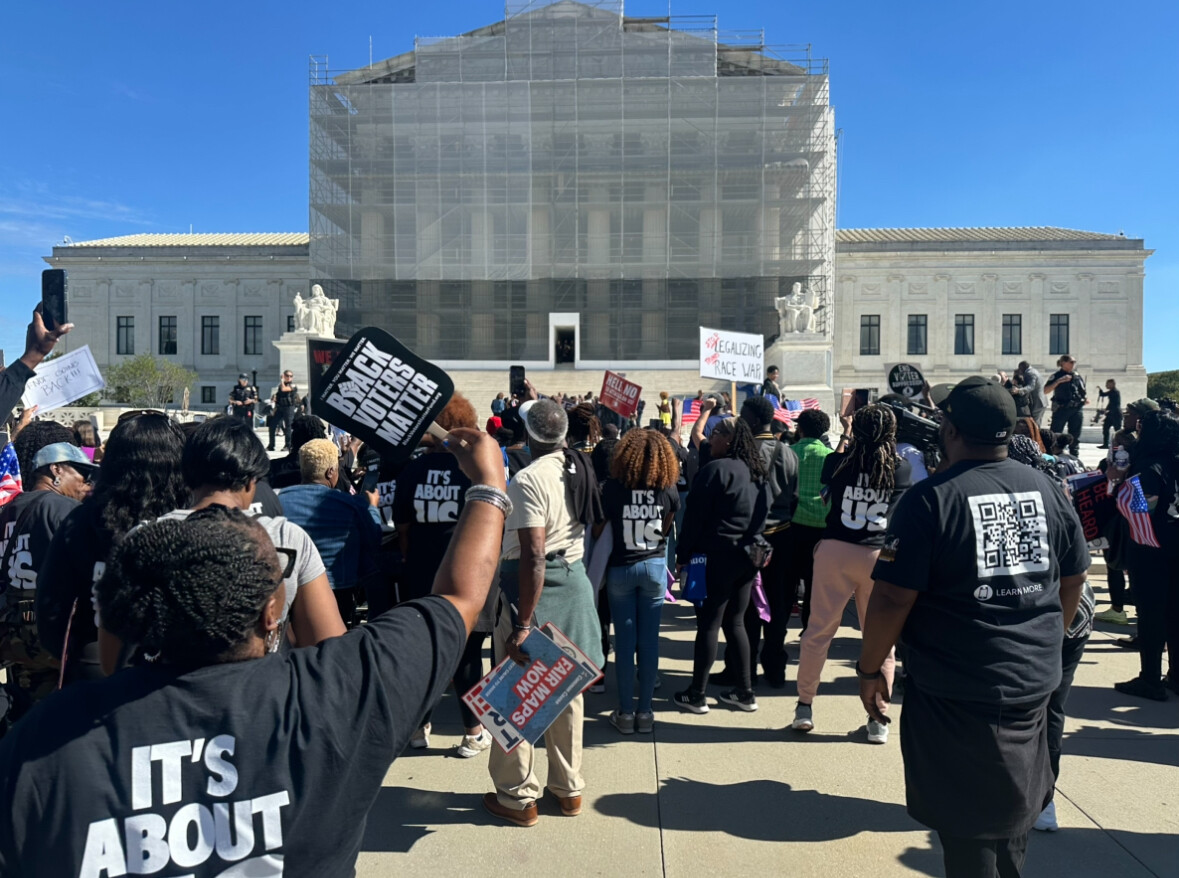
A ruling is also pending in a Louisiana case from October. In Louisiana v. Callais, the Supreme Court heard arguments from a group of Black voters who challenged the state’s new congressional map, saying it diminished the power of Black voters.
Jenkins stressed the importance of staying informed, especially for minority voters.
“Make sure to read and be on top of issues, and that is something you can take personal responsibility for. But after you read, and after you understand, then you need to join an organization,” he said. “I know it sounds cliché, but that’s what it is.”
“Because technically, or realistically, it’s not a lot you can do individually. But when you organize with others, there’s a lot you can do and a lot you can impact.”
Belaynesh Shiferaw, who specializes in politics, is a reporter for HUNewsService.com and host of its forthcoming “Take Note” podcast. She also covered the Louisiana v. Callais redistricting case before the U.S. Supreme Court in October.