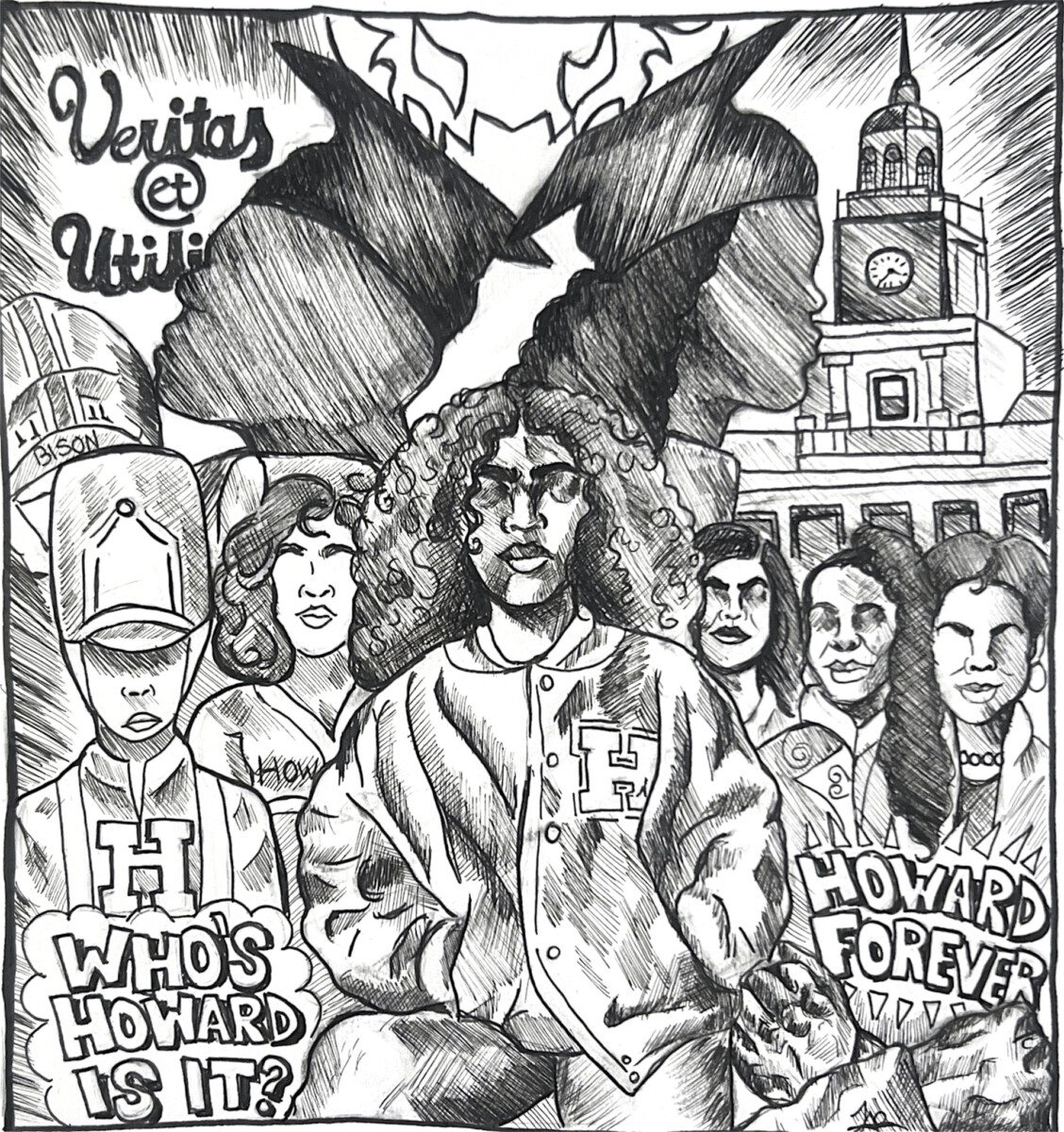
Many Howard University alumni and current students share the same mission: spark change in the world beyond campus.
Clyde Waite, a former Pennsylvania Court of Common Pleas Judge, and Anthony Gittens, the Washington, D.C. International Film Festival director, arrived at Howard sixty years ago. Decades later, students including McKinlee Thomas and Tamyra Fox are drawing on their legacies as they pursue careers in law and the arts.
Waite was born into a low-income family of 11 in McKeesport, Pennsylvania. Within 24 hours of graduating high school, he settled in D.C. and took a job at the Library of Congress.
While searching for housing, Waite applied for an apartment in the Harriet Tubman Quadrangle. He quickly discovered it was a dormitory and that living there meant being a student.
“I didn’t have the academic courses, so I had to go to night school to earn [credits],” Waite said. After three tries, Howard admitted him on academic probation.
“I think Howard University chose me,” Waite said, referring to his unconventional path to The Mecca.
Captivated by the civil rights movement, Waite wrote for The Hilltop, including during the historic 1968 campus protests when students occupied the Administration Building to protest Howard’s leadership and direction.
After graduating from Yale Law School in 1971, Waite returned to his home state of Pennsylvania. He initially fought housing discrimination at the Bucks County Legal Aid before opening his own private legal practice.
In 2003, Waite became the first Black elected official in Bucks County history.
McKinlee Thomas, a freshman political science major from Atlanta, shares Waite’s passion for legal advocacy and community service.
She is also from a large family — the youngest of 12 — and a first-generation student. Reflecting on her journey to Howard, Thomas acknowledged the strong support system behind her.
“There was a part of me that felt like my family was rooting for me to go to school, because I knew that I was smart, and that I had a dream in mind,” she said.
Thomas said once she graduates, she is prepared to return home and give back.
“I want to leave my mark here at Howard…not just academically, but also by helping my community,” she said.
Thomas hopes to achieve these goals by becoming a lawyer.
Beyond law, students of all majors at Howard can draw on legacies for inspiration, including in the arts.
Gittens attended Howard during the same period as Waite. As Waite reported on the student protests, Gittens organized them.
40 years ago, Gittens founded the D.C. International Film Festival (Filmfest). In a journey markedly similar to Waite’s, he attended night school before applying to Howard.
“My parents didn’t have money to send me to college, so I had to work,” Gittens said.
At Howard, Gittens reflected, protesting became a defining part of his college experience.
His refusal to cut his afro for the reserve officer training corps program led him to coordinate protests against the Vietnam War and Howard’s administration. Thinking back on his time as a student, Gittens said Howard was a unique experience.
“I learned about organizing, about working with people and about taking a stand,” he said.
Gittens said he used these lessons when launching Filmfest in 1987. He said he sees the festival as a cultural catalyst.
“The thing I like about the International Film Festival is that it opens up the world,” Gittens said, describing how the films expose attendees to life outside the U.S.
Gittens advised students to pursue their own endeavors, whether creative or advocacy, and Waite emphasized the importance of courage in the current political moment.
“Being brave enough to step off the edge is important,” Waite said.
Tamyra Fox, a freshman nursing student from Binghamton, New York, is taking their advice.
Fox said she selected nursing for financial stability, but her goals lie elsewhere.
“I want to pursue my dream of the performing arts,” said Fox, a first-generation student.
Inspired by Donald Glover, she hopes to become an actress and producer. She said arriving on campus alone was a poignant moment.
“It was just me and a volunteer helping me move in. So it was bittersweet, but it was an understanding that this is who I am now, and I’m gonna succeed at any cost,” she said.
The historical significance of attaining a degree is not lost on her.
“All my ancestors and the people before me could do was dream of what they wanted to do,” Fox described. “But instead…they paved the way for me to be where I am today.”
Copy edited by Sydney Middleton