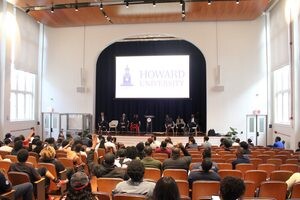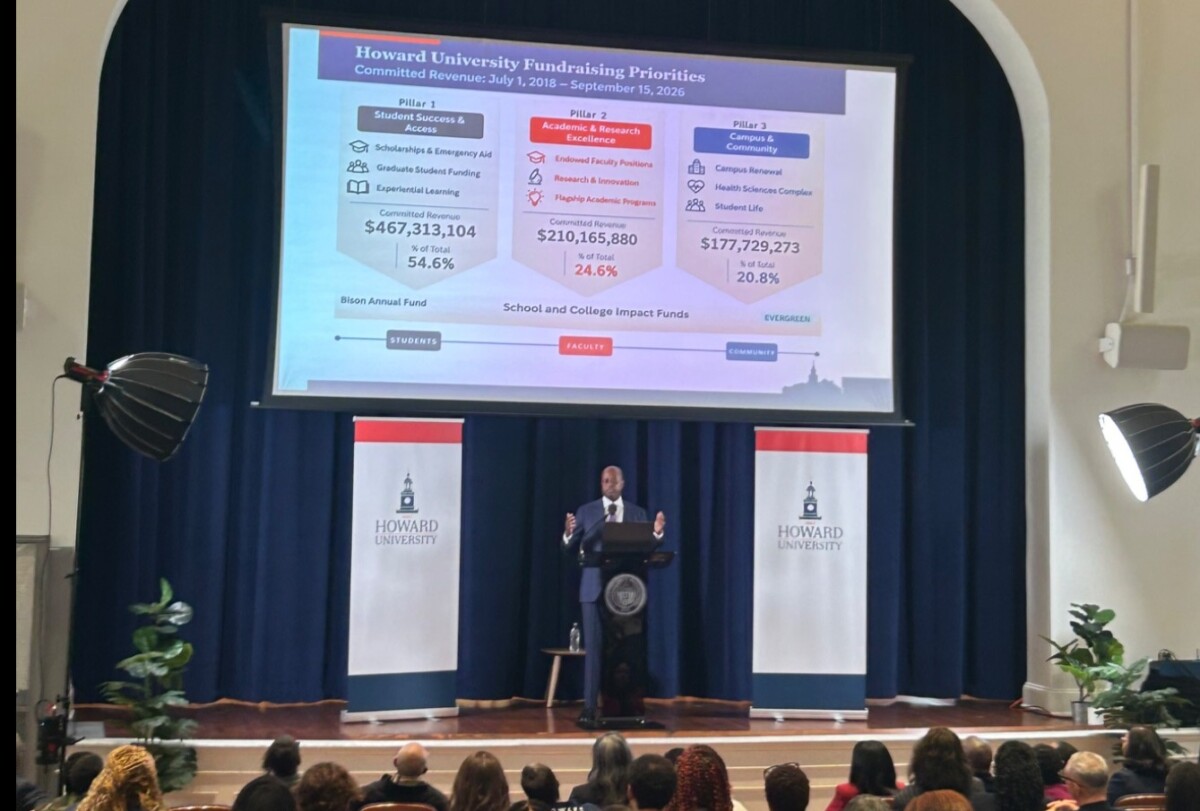
Amid the nostalgia of Howard University’s 102nd Annual Homecoming, Interim President Dr. Wayne Frederick brought forth a reminder that protecting the legacy of the Mecca takes more than just looking back. During his Oct. 16 State of the University address he also said it requires investing in students who will carry the torch forward.
Through personal stories, humor and candid discussion of financial challenges, he outlined how changes to financial aid and greater alumni giving could support students and strengthen Howard’s future. He urged alumni to show their pride in Howard by donating to support its students.
Frederick opened with a personal story connecting Howard’s legacy to his own family. His son, Wayne Frederick Jr., who plays professional soccer, returned home with a tattoo that initially left the older Frederick “distressed about it.”.
However, when the wrap came off, it revealed a quote from Charles R. Drew, a groundbreaking physician, surgeon and former professor at Howard whose research helped advance blood banking.
“Excellence of performance shall transcend all artificial barriers created by man,” the tattoo read.
Frederick said his son heard him repeat Drew’s words many times, but he had not realized how deeply they resonated.
For President Frederick, Drew’s accomplishments despite racial barriers reflected the opportunities Howard continues to create for its students.
“A hundred percent of the students who enroll at Howard in the freshman year get some type of aid from us, and that has to stop, and that is going to stop,” Frederick said.
He said families with substantial financial resources should contribute more, allowing Howard to direct assistance toward students facing housing insecurity and other barriers. He criticized what he described as an expectation among some alumni that their children should receive scholarships regardless of financial need.
“If your parents make three million combined, I feel strongly that we should not be doing that,” Frederick said.
Fredrick said the university covers about half of the tuition it would otherwise collect. He argued that giving aid to families who can afford tuition leaves less money for students who need it most and for improving campus services.
The president also brought humor to the discussion, teasing alumni whose children receive institutional support while they spend Homecoming at the Four Seasons Hotel and purchase bottles of alcohol.
“[Some had a] couple of bottles last night, which is why they’re not here this morning,” he joked.
His proposed approach also included enrolling a smaller proportion of students eligible for federal Pell Grants. Frederick said those students constitute 42% of enrollment and argued that the share should be no more than 30% unless families with greater resources contribute more.
He framed the issue around ensuring Howard can adequately support students through graduation.
Frederick pointed to students from low-income families who earn strong grades and test scores despite difficult circumstances, including some living in shelters.
“As a matter of fact, I think that’s exactly the student we should be supporting, and I’m not gonna apologize to anybody about taking a poor, bright student at Howard,” he said.
Frederick also discussed Howard’s decision to lower the outstanding-balance threshold for registration from $5,000 to $2,500, effective when the fall 2027 registration opens in March. He spoke about a student with a high GPA who owed $95,000, saying repeated registration exceptions had allowed the debt to accumulate.
“That’s our fault. That’s not the student’s fault,” he said.
Frederick encouraged alumni to contribute $500 to a university cause, saying he would not join the Homecoming festivities, so that he could tend to students’ food and housing insecurity. He encouraged attendees to enjoy themselves while remembering student needs.
He also questioned whether alumni criticism was matched by participation. According to Frederick, the medical school dean reported that only four people attended her open house, including two prospective students.
Turning to other deans, he playfully tested whether their attendance had been stronger.
“Anybody had two hundred and fifty people?” he asked. “Don’t put your hands up too quickly.”
The exchange drew laughter before the School of Divinity Dean Kenyatta Gilbert, Ph.D. and College of Nursing and Allied Health Sciences Dean Dr. Christopher Lance Coleman reported approximately 150 and 100 at their open houses.
“You have questions, and you should, but you’ve got to show up,” Frederick said. “It’s easy to sit behind a computer and complain.”
Frederick projected approximately 45,000 applications for Fall 2027’s incoming undergraduate class of about 2,000.
“Our goal here is not to be the biggest [historically Black college or university],” Frederick said. “Our goal is to be the best higher [education]. institution, period.”
Howard reached number 73 among National Universities in the 2027 U.S. News & World Report rankings, its highest placement yet and a 15-position increase from the previous year.
Frederick also emphasized three-year degree plans as a way to lower attendance costs and free aid for others. He highlighted Howard’s R1 research classification, reported $102 million in research expenses and discussed its University Affiliated Research Center focused on technology that can carry out tasks with limited human guidance.
Referencing accreditation, he acknowledged the College of Medicine’s probation and said its team was preparing for a better September 2027 site visit.
During the question and answer portion, alumni brought their own priorities forward. Rhadi Freguson, a 1997 alum and former Howard wrestler who represented the United States in Judo at the 2004 Olympics asked about reinstating wrestling and potentially adding women’s wrestling.
Frederick welcomed the idea while emphasizing, with a joke, to the financial support needed.
“What I would suggest, since I know you, Rhadi, personally, is you could write us a check,” he said, drawing laughter from the audience.
Newly elected Howard Alumni Association President Karen Eccles Shropshire, class of 1979, offered another response, announcing the “Everybody Gives” campaign, encouraging every alum attending Homecoming to donate to the university.
For Frederick, sustaining Howard’s future remained rooted in what the university had made possible in his own life.
“I came here as a 16-year-old with sickle cell,” he said. “This place transformed my entire life.”
That experience, Frederick explained, shapes how he leads Howard and why he feels so strongly about supporting its students.
Copy edited by Daryl R. Thomas Jr.