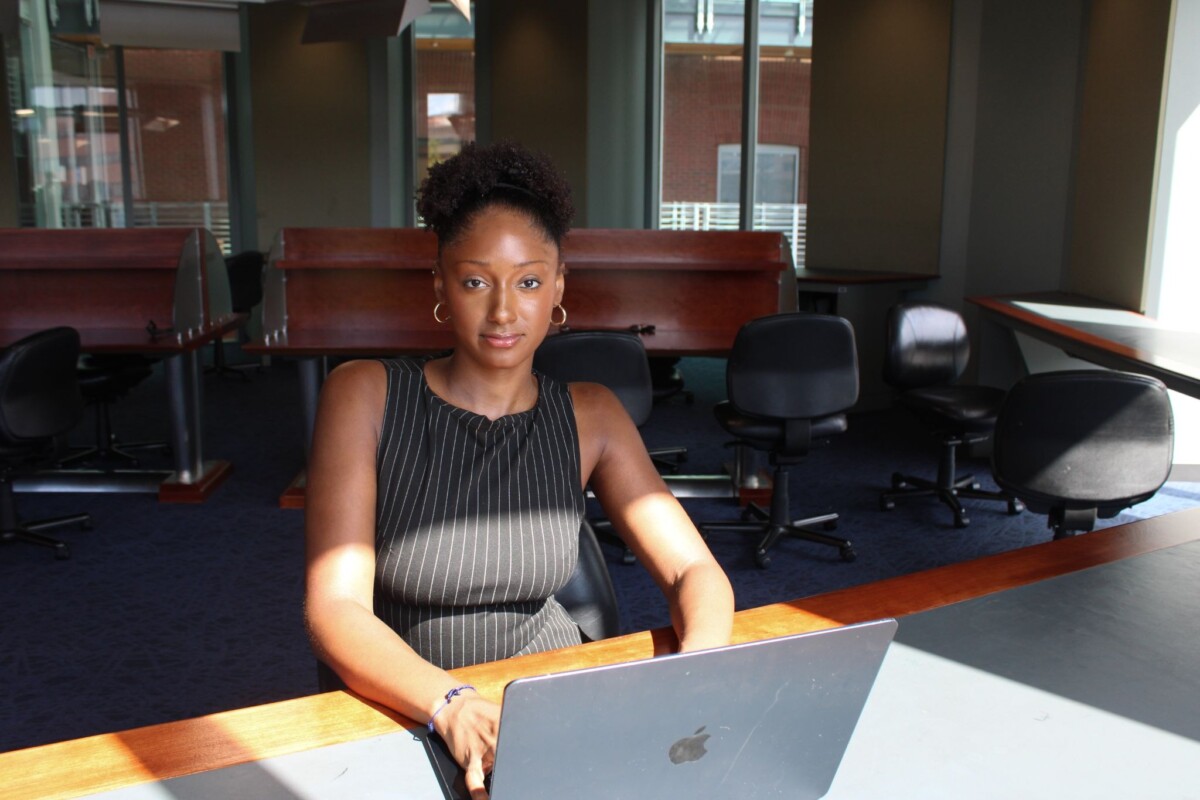
While researching for a history paper in her freshman year, Avery Bernard Johns came across an unsolved case that left her morally shaken. Hattie Yvonne Jackson, a 6-year-old Black girl, was abducted by an unidentified white man while playing in D.C.’s Rock Creek Park in 1961. She has been missing since.
Bernard Johns said she was haunted by one particular line from a 1963 article in The Evening Star: “…there are days, perhaps weeks, when only a few persons think of Hattie Yvonne Jackson.” But Bernard Johns hasn’t stopped thinking about her, and the countless other Black girls and women in D.C. whose cases went underinvestigated and underreported.
The now-junior history and sociology double major with a double minor in data science and criminology from Potomac, Maryland hoped to use her assignment to further Jackson’s dormant case. But with little information available surrounding Jackson’s story, her investigation stalled.
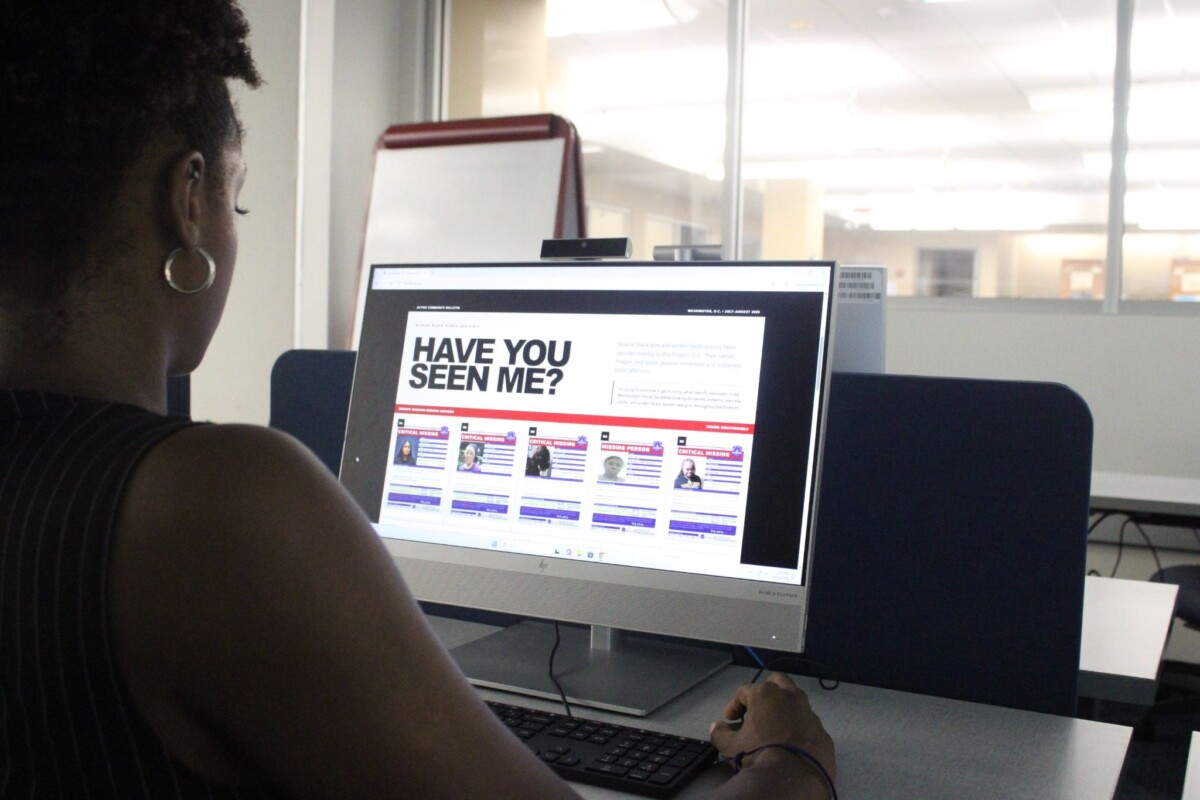
Frustrated, Bernard Johns designed DEADLINING, a database that centralizes information on cases of missing and murdered Black women and girls in the D.C. area.
“This could just be publicly available information, but no one in the government is doing it,” Bernard Johns said. “I knew that I could do it, so I taught myself how to code.”
In addition to its searchable database, DEADLINING offers an interactive map and geospatial analysis that the D.C. Missing Persons website does not.
“I knew I wanted it to be a public-facing database people could interact with,” Bernard Johns said. “Something I don’t like in scientific scholarship is when data is published but the average person doesn’t understand it.”
Henderson Long, a licensed private investigator and CEO of D.C.’s Missing Voice Inc., said that deputizing the public with resources like DEADLINING is critical.
“The community has to be educated on how important they are,” Long said. “You can’t do any of this alone.”
Long’s nonprofit detective agency is dedicated to helping D.C. families find missing loved ones. Sometimes, families call his team before calling the police.
Long said too many people neglect this crisis until it immediately affects them.
While he doesn’t expect civilians to conduct independent investigations, Long encourages people to access resources beyond news outlets and become proactive collaborators with law enforcement — even when it isn’t their loved one who is missing.
Long’s aunt, Allean Logan, went missing from her D.C. home in September 1999. Her remains were not identified until nearly twenty years later, in January 2019. Long said being left in the dark for two decades was “devastating” for his family.
He said reuniting families, or at least affording them closure, is healing.
“It’s an awesome feeling, knowing someone isn’t going to go through what you went through,” Long said. “That’s therapy for me.”
In her research, Bernard Johns noticed cases of missing Black women seemingly concentrating in increasingly gentrified, heavily policed areas with diminishing Black populations.
Similarly, Long’s work addresses the socioeconomic disparities he has observed in the District’s missing cases, specifically an overrepresentation of victims from Wards 7 and 8.
In her 2015 book “You’re Dead―So What?: Media, Police, and the Invisibility of Black Women as Victims of Homicide,” sociologist Cheryl L. Neely credits this gap to systemic neglect.
“What is lacking in research are studies that illuminate racially biased reporting of homicides along the intersections of race and gender,” Neely writes.
While presenting at the Massachusetts Institute of Technology last semester, Bernard Johns recalled being asked, “Why just Black women? When are you going to expand your work to victims of other races?” She said she is resolute in her focus on Black women victims.
“It’s not exclusionary — it’s equitable,” she said. “[Black women] are one of the most murdered demographics within the country. It makes sense for my work to focus primarily on them.”
Despite comprising only 14% of the female population in the U.S., Black women made up 31.4% of women killed by men in single victim/single offender cases in 2023, the Violence Policy Center reported.
Bernard Johns said Black women are often hypervisible as suspects and hyperinvisible as victims. They are often perceived by the public as aggressive, invulnerable and unworthy of victimhood, she described.
And in today’s culture, consumers and creators of true crime content often valorize conspiracy-worthiness, sensationalism and morbid fascination over victims’ humanity, according to a 2025 study in Crime, Media, Culture.
“I think the reason [these cases] are hypersensationalized is because people don’t recognize these are things that happen every single day. These aren’t novel stories. This is reality,” Bernard Johns said.
Violet Spencer, a junior Afro-American studies major from Midwest City, Oklahoma, is developing a research paper titled “Netflix Has a White Victim Fetish: The Disparity of Representation in Netflix’s True Crime Documentaries.” She echoed Bernard Johns’s sentiments, highlighting that true crime is strategically curated by racially-biased market forces.
“Neftlix creates true crime content for an audience of white women,” Spencer said. “They’re scared of making [white people] feel bad about society right now. So it’s white women watching white women, rather than Black or Native women.”
While her work began with a focus on the D.C. area, Bernard Johns imagines justice and liberation for Black women across the diaspora.
“My work started off rooted around the Howard community because I recognized there was a specific problem in D.C.,” she said. “But there’s a problem everywhere.”
Despite the heavy mental load, Bernard Johns said she feels honored to carry the mantle she does.
“If I have the right to be alive, I want to use my vitality to help these women,” she said.
But the dissonance between the scale of Black femicide and public outrage remains devastating to her. Bernard Johns’s anger over this reality is precisely what fuels her work.
“The rage really sustains me,” she said. “When things are depressing and hard, I remind myself that I’m here and they’re not, and that’s not fair.”
Copy edited by Jori Johnson