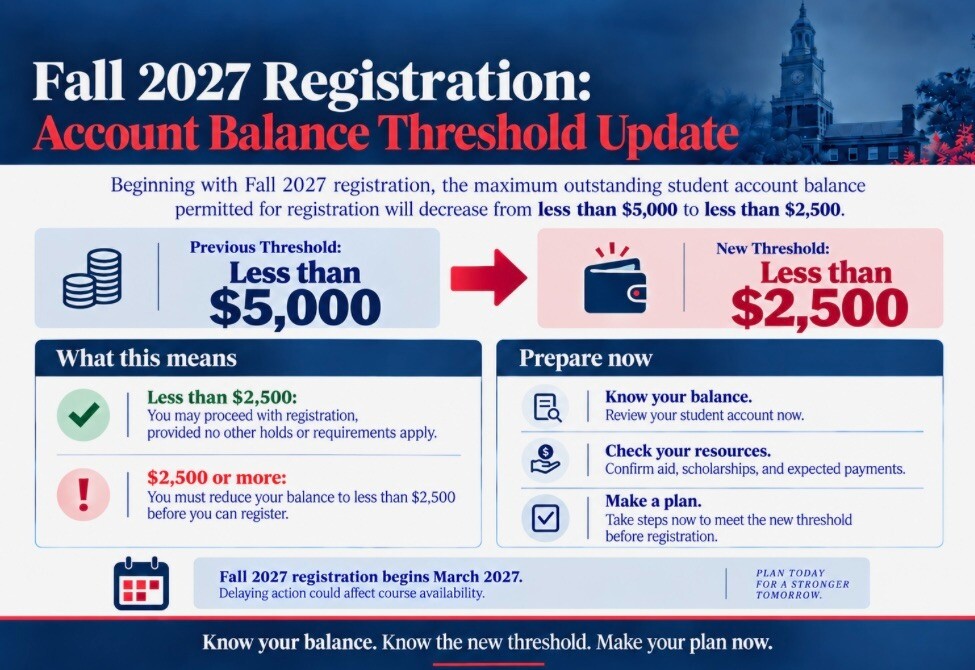
The maximum amount of money in a student’s past-due balance to register for classes will be decreased by 50%, the Howard University Office of the Bursar announced earlier this month.
Starting in August 2027, students will be required to have a balance of $2,500 or less to register instead of the current requirement of $5,000 or less. In a statement, the Office of University Communications said this is to “give students greater clarity and support as they navigate enrollment and financial obligation.”
Beatrice Nji, a senior biology major from Lowell, Massachusetts, who plans to graduate next semester, said she has mixed feelings about the threshold amount decreasing.
“It’s just kind of unfortunate and it’s like every year, there are new rules that keep on changing. I’m like, what’s next?” she said.
Nji said she questions the stability of the university’s financial assets and wonders if these changes will continue to occur.
The reason for the current $5,000 threshold was due to delays in federal aid and “broader uncertainty within the federal funding environment,” according to the statement from the Bursar’s Office.
The Bursar’s Office also says that the $5,000 threshold was “temporary” and past circumstances have now evolved. They said the decrease will provide a financial middle ground, giving students and families flexibility and allowing outstanding balances to be identified.
Registration for the Fall 2027 semester is set to open in March 2027. The Office of the Bursar encouraged students to, “understand your financial obligations, monitor your student account, confirm available financial resources, and meet established payment and registration deadlines.”
Kaiden Craven, a freshman psychology major from Oakland, California, said she is currently on a payment plan of $4,000 a month in order to pay off her balance.
Craven said she doesn’t know how this policy change will affect her given her payment plan and current balance above $2,500. She said that she is frustrated with the decrease.
“It is insane how much I pay to go here and they just keep asking me for more money and more money,” she said.
The Office of the Bursar included a reference to the Student Financial Responsibility Agreement in their released statement. The agreement outlines the financial obligations that Howard students must maintain and states the policy’s override of any prior “understandings, representations, negotiations and correspondence between the student and Howard University.”
The Office of University Communications did not respond to The Hilltop’s questions on what factors contributed to the decision to decrease or if student feedback was considered during the decision-making process, but they did give the following response:
“In recent weeks, the University has also shared registration schedules, readiness
checklists, financial aid reminders, and other resources to help students prepare their
accounts before Spring 27 registration,” they said, adding that the university will continue to aid students through timely communication and guidance as registration approaches.
Blessing Kosia, a freshman biology major from Nashville, said the policy changes raises concerns about how students who rely on financial aid and scholarships will manage their outstanding balances.
“How do you lower the threshold and people are already relying on financial aid and their Pell Grants and their scholarships? It’s the whole enrollment thing all over again,” Kosia said, referencing the unenrollment of incoming freshmen earlier in the year.
Kosia suggested that the “high-prestige” associated with the university does not align with recent actions.
“You go from this positive connotation to this negative connotation sort of thing about the name Howard University,” Kosia said. “I think they need to shift their priorities from trying to take money from students and actually educating and looking at the well-being of our student body.”
Copy edited by Daryl R. Thomas Jr.