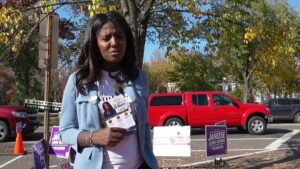
Leah Peterson has held multiple positions in student government at Howard University, and now she is setting her sights on a new campaigning goal: local government.
Peterson, a senior honors economics major from Fort Worth, Texas, who served as the 14th General Assembly Chairwoman for the Howard University Student Association Senate during the 2025-26 academic year, is running for Advisory Neighborhood Commission (ANC) 1E05.
ANC commissioners are elected local representatives who advocate for residents’ concerns and advise D.C. government officials on their neighborhoods. The ANC 1E05 seat represents part of Ward 1, including the neighborhoods Adams Morgan and Columbia Heights, as well as portions of Howard University and the McMillan Reservoir. The seat is currently vacant and will be decided by voters in the Nov. 3 general election.
Peterson’s campaign centers on community engagement, food access and creating more opportunities for residents — including Howard students — to have a voice in decisions affecting their neighborhoods.
Peterson said running for local office is a continuation of the approach to service she learned from women in her family.
“Service is the rent that we pay for our time here on Earth,” Peterson said, quoting former U.S. Rep. Shirley Chisholm.
This belief is reflected in the women who raised and influenced her, she said. Her mother is an educator, her grandmother was a significant figure in her church community and her great-aunt was a civil rights activist.
“All those ladies have just continuously been living as someone that serves and letting that guide me,” Peterson said.
For some young D.C. residents, local government can feel unfamiliar.
Shannel Laws, a sophomore English major at the University of the District of Columbia who recently moved to the city, said she was not familiar with ANCs before speaking about Peterson’s campaign.
Laws said having younger people involved in local politics can bring a different perspective to community issues. She said she would be more likely to support a candidate who demonstrates a consistent presence in the community rather than only appearing during election season.
“I would want someone who’s knowledgeable about the community,” Laws said. “And not just knowledgeable on paper, but someone who spent time with people and listened to issues.”
Peterson’s campus leadership also extended beyond Howard, bringing her into conversations about issues affecting students and the surrounding community. She said she has worked with ANC officials to address concerns such as pedestrian safety and infrastructure around campus.
She pointed to speed humps, signage and crosswalk improvements as examples of the type of local changes that showed her the role ANC’s can play in addressing issues that directly affect residents.
“There’s a lot of ways that you can impact students on campus,” Peterson said. “But I recognized that there’s a lot of power when it comes to community organizing, bringing people together and getting things done on the ground, especially in D.C.”
Peterson’s candidacy comes as she balances her senior year at Howard with her role as Miss Black D.C. USA..
Rather than continuing to take on every opportunity available to her, Peterson said learning to prioritize has become particularly important after experiencing burnout last year. She has since become more intentional about the opportunities she takes on, she said, focusing on commitments that align with her goals while relying more heavily on her support system.
Peterson also said she does not view her candidacy as a short-term project tied solely to her time at Howard. She said she can see herself remaining in D.C. after graduation and wants to continue advocating for the community even after leaving the university.
Peterson’s candidacy also brings attention to the relationship between Howard and the longtime residents who live around it. As a Howard student and D.C. community member, Peterson said her role would be to represent the broader neighborhood while recognizing Howard as part of that community.
“I’m here for the community and their needs, but Howard is still part of that community,” Peterson said. “Even if we are divided, finding ways that we can still best support and make sure that those neighborhood voices are at the forefront of whatever decisions are being made.”
She pointed to construction and transportation changes near Howard, including ongoing construction along Georgia Avenue, as examples of issues that can affect Howard students, residents and local businesses.
Peterson said she wants to create more opportunities for Howard administrators and longtime residents to meet directly through community forums where both sides can raise concerns and discuss issues affecting the neighborhood.
“A lot of times you work in silos,” Peterson said. “So I think just bridging the communities together, having community forums where community members can talk to administrators and other local people in the community.”
For Peterson, that also means making sure longtime residents are not pushed out as development continues throughout D.C., particularly as development changes historically Black neighborhoods throughout the city.
She argued that development and investment do not necessarily have to come at the expense of longtime residents. As an economics major, Peterson said she sees a path toward development while also preserving existing communities by giving longtime residents a larger role in what businesses and providing them with tax relief and subsidies.
“Development can happen without displacing people,” Peterson said. “But we have to have these conversations about what programs we’re going to have in place to also support this transition.”
Peterson also raised concerns about food access.
One of her first-year goals, if elected, is to expand the number of local businesses where Howard students can use Meal Plan Bucks, which she said could connect students with neighborhood businesses which would support the local economy.
She also recognized that some may be skeptical of her experience as she will be completing her undergraduate education while seeking to represent residents who may have lived in the neighborhood for decades.
“You can never be too young to get involved,” Peterson said.
For some Howard students including Chimemerile Amechi, a senior health sciences major from Vernon, Texas, issues such as safety and affordable housing remain concerns as they navigate life both on and off campus.
“I would definitely say there is an issue with safety,” Amechi said. “Despite the police presence or the National Guard presence, it has really not been resolved.”
Amechi also identified affordable housing as a major concern for Howard students, along with fluctuations in energy costs that can affect students. Still, Amechi believes local D.C. politics does not always receive much attention from Howard students.
“I wouldn’t really say it’s at the forefront of people’s minds,” Amechi said.
Amechi said she wants a representative who follows through with their plans while also listening to the experiences of both students and residents.
She also said the relationship between Howard and its surrounding communities could benefit from greater collaboration. While Howard students may face housing and safety concerns, Amechi said long-term residents also have concerns about the impact of student demand on the neighborhood.
“I think just an effort in community engagement on both sides could potentially help fix that — where both of our grievances are heard and it’s not like we’re in direct opposition,” Amechi said.
Beyond specific policy proposals, Peterson said one of her central goals is making the ANC itself more accessible to residents. She said conversations with residents during her campaign have shown her that some people are unfamiliar with what ANCs do or how they can participate.
Peterson added that she has heard concerns from longtime residents who feel candidates and commissioners are more engaged when they need something from voters, such as petition signatures, and after an election, that outreach falls flat.
She said that relationships need to change.
“What is ANC if it’s not the voice for all community members?” Peterson said.
Her campaign ultimately rests on the idea that local government should feel less distant from the people it represents. And for Howard students considering whether to become involved in D.C. politics, Peterson has one message.
“We need you more now than ever to get involved,” she said. “Don’t let fear stop you from being the change that your community needs.”
Copy edited by Daryl R. Thomas Jr.