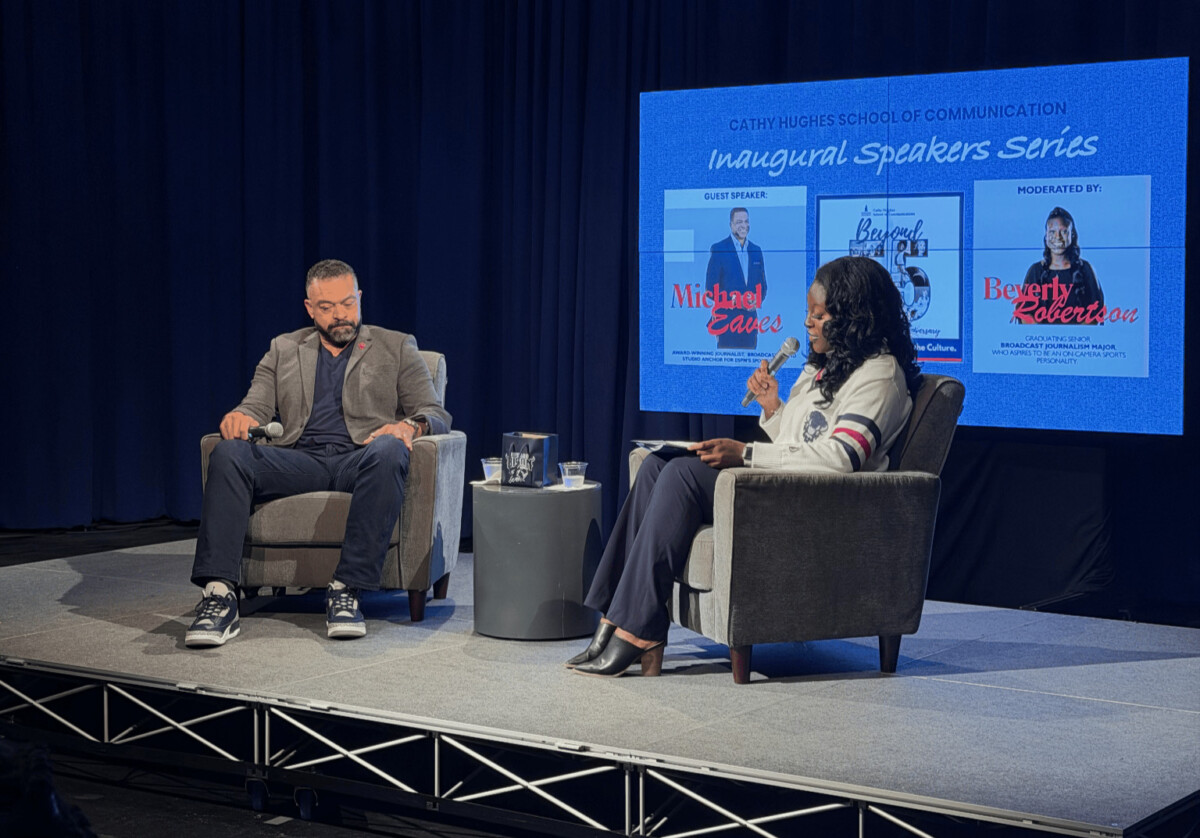
During the third and final fall installment of the Howard University Cathy Hughes School of Communications Inaugural Speaker Series, ESPN SportsCenter anchor Michael Eaves urged Howard students to embrace versatility, strengthen their work ethic and pursue opportunities through self-advocacy in the increasingly competitive media industry.
The Nov. 12 conversation, moderated by senior broadcast journalism major Beverly Robertson, gave students an opportunity to hear Eaves reflect on the experiences that shaped his career.
With more than three decades in sports journalism, Eaves has covered some of the biggest events in sports, including the Olympic Games, Super Bowls, NBA playoffs, The Masters and the PGA Championship. His work has earned him seven Emmy Awards, a Telly Award and induction into the University of Kentucky Hall of Distinguished Alumni.
Robertson asked Eaves about his childhood and the development of his career aspirations, including his upbringing in White Plains, Kentucky, where he was adopted and raised.
“All my ambitions came from television,” Eaves said. “I don’t remember ever not having a TV in my room.”
Eaves was the first Black golfer to qualify for the Kentucky High School State Golf Championship. He recalled always wanting sports in his life.
Eaves applied for a WKYT fellowship program just before his senior year, but was instead hired as an associate producer for the morning show. He recalled sacrificing time with friends to work 5 a.m. shifts, emphasizing the discipline required to prioritize his career.
“I took an athlete’s approach to my career. Those who are the greatest have the most work ethic,” he said.
According to Eaves, talent is a gift, but skill comes from effort. He recalled staying late after shifts, rewriting scripts, recording and reviewing himself and finding ways to learn more even when he is not working.
Deja Roseman, a sophomore film and TV major, said she appreciated the inaugural speaker series for the diverse perspectives and networking opportunities it provides. Her biggest takeaway centered on the importance of perseverance.
“It really doesn’t matter where you start from as long as you have the dedication to finish it,” Roseman said.
Eaves described his career path to illustrate the importance of versatility. Though he wanted to be an on-air sports anchor, his first opportunity was as a news producer. Rather than denying the role, he learned the responsibilities that helped him become a stronger sports anchor.
He encouraged students to make themselves indispensable in the field by developing a strong range of skills.
“The more things you can do, the harder it is for them to eliminate you from the payroll,” he said.
Eaves highlighted his range in writing and reporting, mentioning his ability to cover events from UFC to The Masters.
At one point, he prompted the audience to repeat “possible,” reinforcing his message that expanding their skill set can expand their opportunities.
Eaves also advised students to build professional relationships, explaining that having the best qualifications and putting in the work will not always guarantee advancement.
“I’ve never had an agent give me a job,” Eaves said. “It was always the result of networking that put me onto something, and then someone spoke on my behalf, and that’s how you got the job.”
Eaves described his transition into covering The Masters for ESPN, saying he directly asked his boss for the opportunity and was granted it. Earlier at WKYT, he repeatedly told directors he wanted to be a sportscaster, eventually leading to the creation of a new sports position.
“Don’t be afraid to speak up for opportunities, you have to tell people what you want to do,” Eaves said.
Second-year junior Lyric Saulsberry, a broadcast journalism major from Youngstown, Ohio, attended the event to gain insight on what brings sports production to life and connect with other students. Her biggest takeaway from Eaves was to take initiative.
“I need to open my mouth and speak,” she said. “It’s kind of like, stop being quiet, stop being shy, go and get what you want in a sense.”
Reflecting on the legacy he hopes to leave behind, Eaves emphasized the importance of Black people supporting one another and contributing to the success of future generations.
“What matters to me is helping us help each other because we all we got,” Eaves said.
Copy edited by Daryl R. Thomas Jr.