This is an opinion piece by a Hilltop columnist.
You cannot argue against the death penalty on the grounds that a human life should never be unnaturally ended. Ending a life is its very purpose. The death penalty is therefore a perfectly designed instrument of punishment — the physical embodiment of permanence in a justice system where everything else can be amended or changed.
But the death penalty excelling at its job does not make it ethical, nor does it earn the practice a place in a just society. In every other respect, it is riddled with flaws. From systemic bias and high costs to an ineffective method of deterrence, the system is not suited for our modern society.
Despite these flaws, support for the death penalty is resurging among some policymakers, with executions and efforts to expand capital punishment returning to the forefront of the national debate.
Amnesty International, a global human rights organization that documents and campaigns against human rights abuses, recorded 47 executions across 11 states in 2025, doubling from the previous year. What was once considered an extreme measure is increasingly being normalized as an ordinary instrument of justice.
The revival reflects not renewed enthusiasm for executions, but growing public indifference toward capital punishment. Americans have been fed a steady diet of war, shootings and cruelty until violence has faded into background noise. As the American public becomes more apathetic towards violence, it becomes easier to overlook.
Nowhere is that numbness clearer than in the case of Army Major Nidal Hasan, the psychiatrist who killed 13 people and wounded 30 in the 2009 Fort Hood shooting.
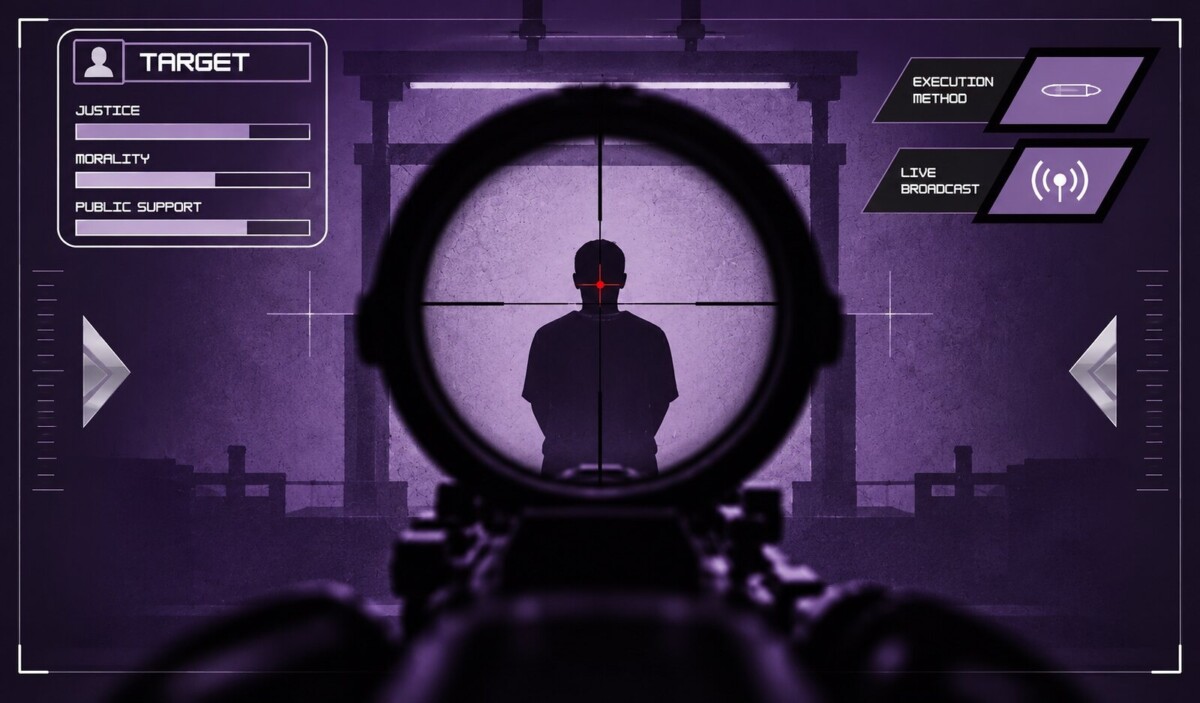
The military, under Secretary of War Pete Hegseth, planned to livestream his firing squad execution. The announcement sparked a national divide: while some condemned the plan as barbaric, others organized watch parties, treating a state-sanctioned killing as a form of entertainment.
Eight days later, President Donald Trump said in a Truth Social post that the livestream would not go forward.
A “lawful” execution is not a lynching, but a crowd gathered to celebrate a killing echoes a darker chapter of American history when spectators watched public executions and called them justice.
The ethical debate is as old as the phrase, “an eye for an eye.” Supporters of capital punishment argue that some crimes demand a proportionate response and that execution is the only way to erase certain evils from the world. Critics see vengeance dressed in a legal robe, a state that kills to prove killing is wrong.
In a country of revolving administrations and shifting judicial interpretations, should any government decide who lives and dies when such absolute authority leaves so little room for error and so much room for corruption?
The National Academy of Sciences, after reviewing research on capital punishment’s deterrent effect, concluded that existing studies could not reliably establish whether the death penalty affected homicide rates. Without reliable evidence that executions prevent future murders, the state cannot justify taking a life on the promise that doing so will save others.
The financial argument is equally difficult to defend. Capital punishment requires substantially more public resources than sentencing someone to life without parole. University of Denver law professor Justin F. Marceau and attorney Hollis A. Whitson measured the cost of capital punishment in Colorado by court days and found that capital cases consumed an average of 147.6 days in court, compared with just 24.5 days for cases resulting in life without parole.
That means death penalty cases require roughly six times as much court time, placing a greater financial burden on taxpayers without clear evidence that the additional expense produces a safer society.
Most fundamentally, courts are human institutions, and humans make mistakes. A system that cannot guarantee absolute certainty of guilt cannot be trusted to impose an irreversible punishment. The National Registry of Exonerations recorded 153 exonerations in 2023, four of them from death row, with official misconduct as the leading cause, and one man, Glynn Simmons, waited 48 years to walk free.
A wrongful prison sentence can be overturned, even after decades lost; a wrongful execution cannot. Once a life is taken, no appeal can restore it.
Disproportionately, those affected by the United States incarceration system are Black. Racial disparities in sentencing are found in almost every crime category. Researchers have repeatedly established that the race of the victim is the greatest predictor of who gets the death penalty in the United States.
A study from the 1980s found that in Georgia, Black defendants convicted of killing white people were almost 22 times more likely to be sentenced to death than people convicted of crimes against Black victims, a racial disparity that the U.S. Supreme Court accepted as “inevitable” in a controversial 1987 case, McCleskey v. Kemp.
Black communities already carry the weight of an uneven justice system, and a growing death penalty adds the heaviest stone of all.
Corporal punishment is not a new practice, but its resurgence should give Americans reason for concern. Those who wield the power of the state seem increasingly interested not in the lives affected by these policies, but in the spectacle they create.
A justice system should be measured not by how harshly it can punish, but by how fairly and reliably it can protect the public. If the goal of the death penalty is justice, an irreversible punishment administered by an imperfect institution is a contradiction in itself.
Rather than expanding the death penalty, lawmakers should be working to eliminate it and invest in approaches that prioritize public safety, accountability and the possibility of correcting injustice.
Justice cannot be built on vengeance, political spectacle or the assumption that the state is incapable of error. A government that claims to value human life should not reserve the right to take it away permanently.
Copy edited by Jori Johnson