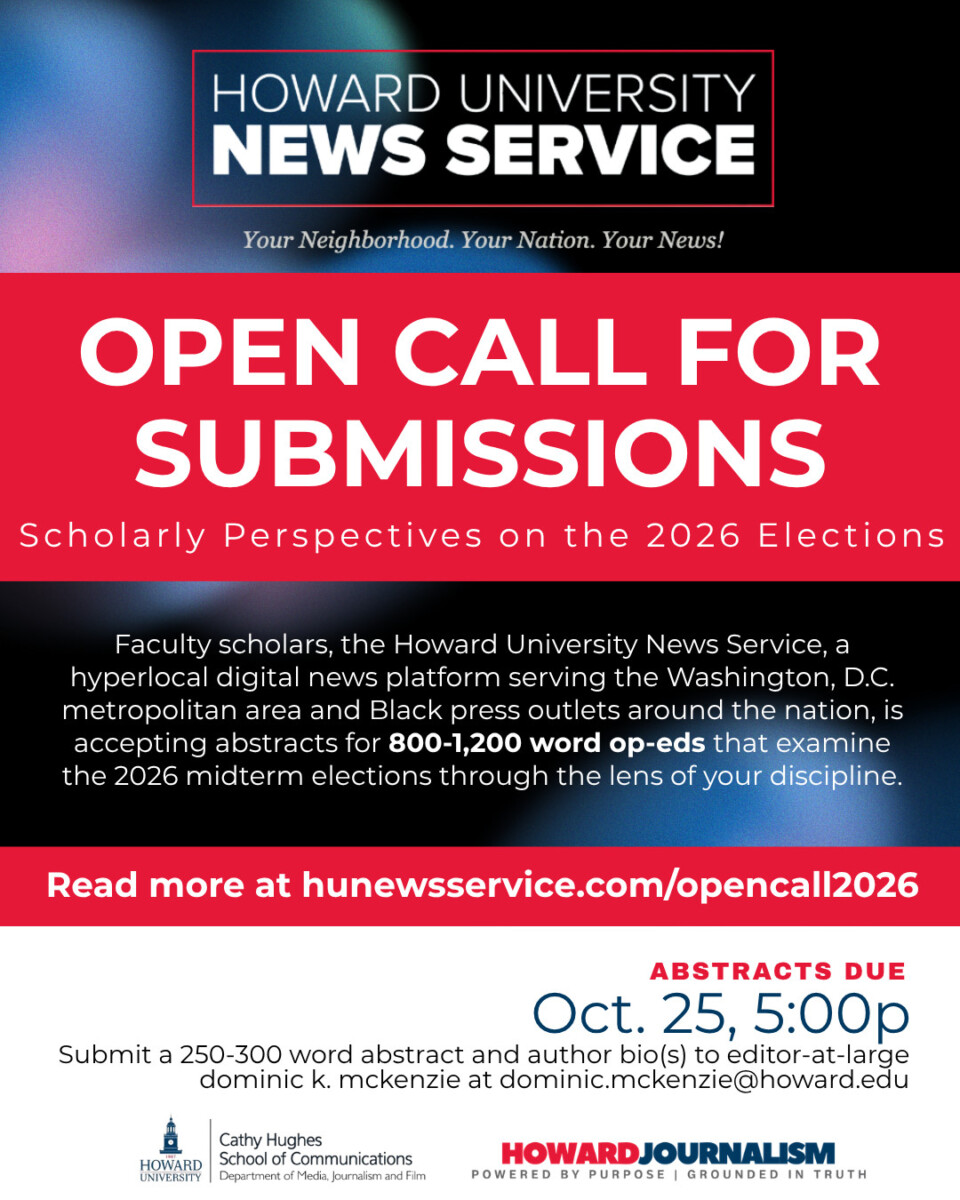
Scholarly Perspectives on the 2026 Elections — a series from the Howard University News Service
Abstracts due Oct. 25, 2026 by 5:00 p.m. ET. Final essays are 800–1,500 words. Co-authored submissions are welcome.
About the Series
The Howard University News Service (HUNS), a hyperlocal news service covering the Washington, D.C. metropolitan area and serving Black press around the nation, invites faculty scholars to submit essays and/or op-eds on the 2026 midterm elections. Each piece should examine the elections through the lens of the author’s discipline.
Results of the midterms on Tuesday, November 3 will further shape decisions on health care, education, the economy, civil rights, climate, public safety, immigration, technology and the future of democratic institutions. We are providing opportunities for our communities to engage with research-grounded analysis, without paywalls, that will live on beyond election day, contributing to a civically informed population.
Public health researchers, economists, historians, engineers, artists, dramaturgs, theologians, educators, social workers, legal scholars and communications researchers all bring expertise that public debate needs. This series asks scholars to bring that expertise directly to thousands of readers across our readership.
What We’re Looking For
We are looking for essays that are rigorous in their reasoning and grounded in research, but written for a broad public audience. They should:
- Make a clear, evidence-based argument about the midterm elections, the policy questions at stake or their consequences for specific communities
- Draw explicitly on the author’s research, methods, theoretical frameworks or professional practice
- Connect national debates to local, regional or community-level effects, including in Washington, D.C., Black communities and other communities often underserved by mainstream coverage
- Offer historical, comparative or interdisciplinary perspectives that help readers understand the stakes of this election
Possible Areas of Inquiry
These, we hope, will prompt ideas, not limit them:
| Discipline | Possible questions |
| Health and medicine | Medicaid, insurance coverage, maternal health, health equity, public health infrastructure |
| Economics and business | Affordability, wages, tariffs, small business, the racial wealth gap, food insecurity |
| Education | K-12 policy, higher education funding, HBCUs, student debt or academic freedom |
| Law and policy | Voting rights, redistricting, the courts, criminal justice, civil rights |
| Communication and media | Misinformation, AI-generated political content, language and dialect bias, news deserts or how communities get election information |
| History and African American studies | Historical precedents for this election and the long arc of Black political participation |
| Science and engineering | Election security, climate and energy policy, research funding |
| Social work and psychology | Civic stress, community mobilization or the effects of immigration policy on families |
| Arts, music and religion | Culture, Black theater and political life, faith communities and the role of creative expression in civic life |
Submission Guidelines
- Abstract: 250–300 words describing the central argument, the disciplinary lens and the evidence the essay will draw on
- Author information: Name, full title, name of department and institution and a 2–3 sentence bio for each author should be included with your abstract
- Final essays: 800–1,500 words, original and unpublished
- Co-authorship: Co-authored submissions are welcome, with special interest in interdisciplinary collaborations
- Style: Accessible to a general audience, with very minimal jargon. Supporting sources should be hyperlinked or briefly cited in the text rather than listed in academic reference format.
- AI Usage: Disclose any AI use, describing tools used and how they were used. Do not use AI to generate the substance of the contribution.
Editorial Process
Accepted essays will go through editorial review for clarity, accuracy and style. As it is offered for a news audience, essays will be edited with Associated Press-style in mind. Please reference apstylebook.com and Purdue Owl for more information. Authors will see edits before publication. Essays will be published on hunewsservice.com and shared for republication with 200 Black press publications around the country through our partnership with the National Newspaper Publishers Association (NNPA). No prior experience writing for a news audience is required.
How to Submit
Send questions, abstracts with author bio (full title and institution) to dominic k. mckenzie, editor-at-large, Howard University News Service and Assistant Professor of Digital Storytelling at Howard University at dominic.mckenzie@howard.edu with the subject line “HU News Service Midterm Election Op-Ed Series Abstract – [Author Last Name(s)].”