Before she was a councilmember, before Howard University School of Law (HUSL) and before President Donald Trump threatened to “take back” the nation’s capitol if she was elected mayor, Janeese Lewis George was a kid growing up in Washington, D.C.
Lewis George, a 2014 graduate of the HUSL, former city prosecutor and self-described democratic socialist, won the June democratic primary for D.C. mayor with over 54% of the vote. If she wins November’s general election, it would make her the youngest D.C. mayor since Adrian Fenty, a fellow HUSL alumnus.
“People always will consider me the first democratic socialist mayor, but really Marion Barry is the first to do it,” she said in an interview with The Hilltop. “He understood that we had to meet people’s basic needs if we’re going to meet any of our other goals as a city.”
As an official member of the Democratic Socialists of America (DSA), Lewis George would join New York City Mayor Zohran Mamdani, who was elected in 2025, as a DSA member leading a major U.S. city.
For some student voters, that is part of the appeal.
Amaya Ford, a freshman political science major from Germantown, Maryland, who is voting in D.C., said a democratic socialist in the mayor’s office would be “a beautiful change.”
“We need that socialist part in order to expand the benefits to those who are part of the working class,” Ford said.
She said she would like to see D.C. follow Mamdani’s lead on making groceries and housing more affordable.
“D.C. needs that,” she said.
Lewis George wants to help citizens meet their basic needs, and she said she believes this starts young. Her plans begin with expanded subsidized childcare and pre-K, then follows families into what she calls D.C.’s “missing middle” — the point when families with school-age children tend to leave the District.
She wants STEM and bilingual immersion programming extended into middle schools. By high school, she wants workforce pipelines, with apprenticeships introduced as early as middle school.
“When they get to high school, they’re thinking about what’s next for them and we want to actually help early on identify[ing] what’s next,” she said.
To make it happen, Lewis George said she plans to work with labor movements and use those relationships to create job opportunities. More than 30 labor organizations have endorsed her campaign, including the Amalgamated Transit Union (ATU Local 689), the American Federation of Government Employees (AFGE District 14) and the Non-Profit Professional Employees Union (NPEU).
AFGE, which represents more than 820,000 federal and D.C. government workers, endorsed her in May.
“Councilmember Janeese Lewis George understands the importance of protecting workers and respecting the voices of labor,” said District 14 National Vice President Ottis Johnson Jr., in a press release announcing the endorsement.
Paired with university partnerships that would allow students to graduate high school with an associate’s degree in hand, the goal, Lewis George said, is to get people the training they need and connect them with “good-paying jobs.”
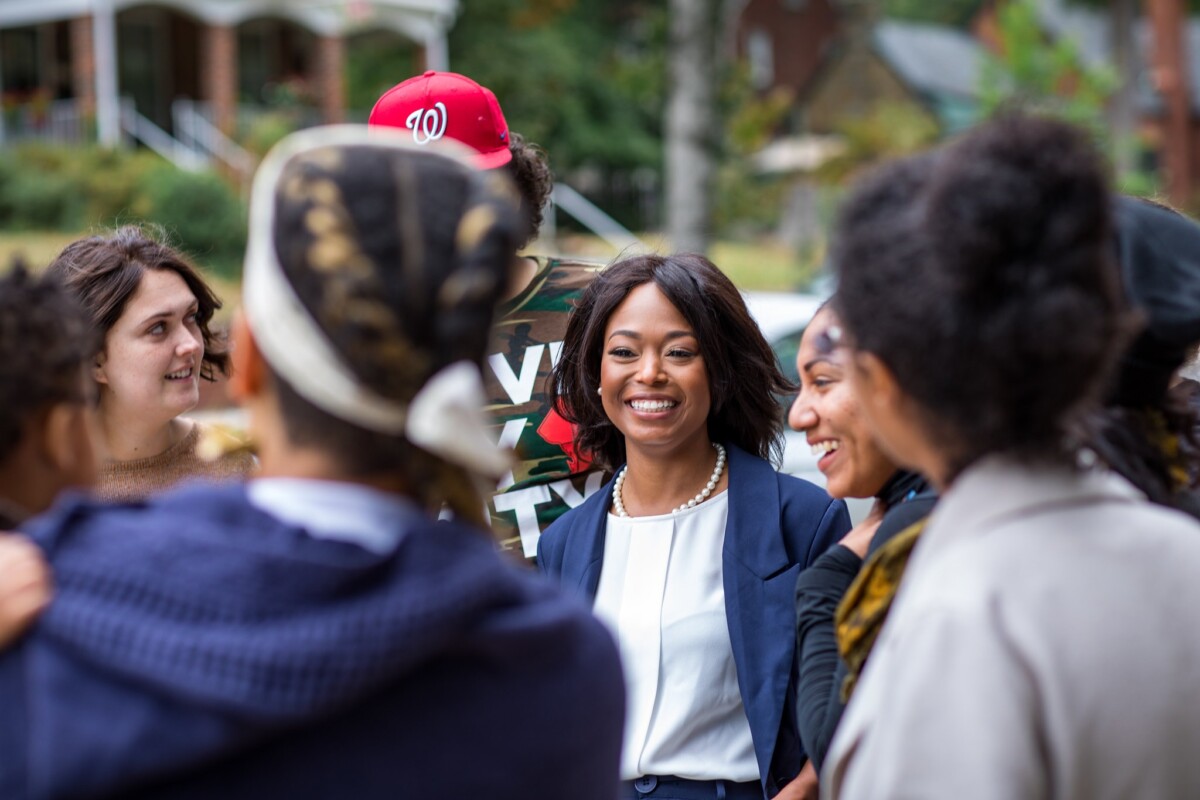
Part of Lewis Goerge’s lead up to the election was holding listening sessions in each of the district’s eight wards to engage with D.C. residents.
“Education, workforce development [and] job training [are] economic development policy too,” she said during a Ward 4 session.
That same thread carries into affordability, where she has identified utility costs as a signature issue, promising to expand community solar and expand programs including the D.C. Green Banks to do “the work that’s necessary to bring down the cost of utilities.”
Eddie Hayes, a retired civil rights attorney and ordained Baptist minister who has lived in Ward 4 for decades, told The Hilltop that he is “glad it has proactive and determined” representation focused on empowering people with the least.
For another Ward 4 resident, Karen Szulgit, the main reason for supporting Lewis George is the fight for D.C. statehood.
“The most important issues for me are D.C. statehood and making sure D.C. has representation in Congress,” Szulgit said.
Szulgit also wants the city’s budget to ensure money is allocated to public services and social programs around the city.
Any D.C. mayor governs alongside a federal government with outsized influence over the city, and Trump has already weighed in on the race.
Days before the June 16 primary, a reporter asked Trump how he would feel if Lewis George won. He said he “wouldn’t like it” and has suggested the federal government would “take back” Washington.
When asked where she would work with the administration and where she would push back, Lewis George gave two answers.
On land and development, she is open to negotiations. Federal land transfers are the clearest openings — the district is “always open” to more green space, parks and housing, she said. She called Union Station “a once-in-a-lifetime opportunity to create jobs and become a regional transit powerhouse.”
Since winning the primary, she said, she has met with developers and housing leaders about building housing with the federal government, including in Southwest and on federal buildings.
Her approach is to “find some common ground” while “preparing for every alternative” of what standing up to the administration might look like.
“When it comes to federal immigration law enforcement, that’s where I draw the line,” she said.
Copy edited by Daryl R. Thomas Jr.