WASHINGTON (HUNS) — On his first day back in the Oval Office last January, President Donald Trump signed a slew of executive orders, including one that questions who can claim to be an American. The U.S. Supreme Court heard arguments on both sides of this question in Trump v. Barbara, as the president listened in the audience on Wednesday.
Trump’s executive order, “Protecting the Meaning and Value of American Citizenship,” reinterprets the 14th Amendment’s citizenship clause, which grants birthright citizenship to most born in the United States. Justices will decide whether the order complies with the citizenship clause if presidential power can limit birthright citizenship. The order seeks to deny citizenship to children born after Feb. 20, 2025, to undocumented parents who are neither U.S. citizens nor lawful permanent residents. It also denies children born to mothers with temporary legal status if the father is not a citizen or lawful permanent resident, further complicating how immigration status affects citizenship in this country.
“This is one of the most consequential arguments in a Supreme Court case in a number of years,” said Sherrilyn Ifill, former president and director-counsel of the NAACP Legal Defense Fund.
“It is huge and paramount for the integrity of the 14th Amendment to our constitution, which really is kind of the centerpiece of democratic promise in this country,” said Ifill, founding director of the 14th Amendment Center for Law & Democracy at Howard University. As part of his policy efforts, this case pushes forward President Trump’s efforts to restrict or eliminate birthright citizenship. According to the government, the stakes are high.
Making the Case: Arguments on Both Sides
The proceedings began with U.S. Solicitor General D. John Sauer‘s arguments expressing the importance of one’s domicile in relation to their citizenship.
Sauer noted the government’s stance that unlawful domicile creates citizens with no meaningful connections to their country.
“For aliens, lawful domicile is the status that creates the requisite allegiance, and the text of the [citizenship] clause presupposes domicile,” Sauer said.
The morning’s arguments continued with the respondent’s representative, , arguing that the decision made during the 1898 United States v. Wong Kim Ark, 169 U.S. 649 (1898), helps trump the necessity of the domicile allegiance theory presented by the United States government.
In the Wong Kim Ark case, a boy born in the U.S. to parents who were citizens of China was considered to have birthright citizenship. The court directly applied the citizenship clause to this case because the clause does not explicitly state parents must have permanent residence in the U.S.
Wang used this example as well as the Immigration and Nationality Act (INA) to reinforce the 14th Amendment’s historical context and stability in defining the growth within the nation. The act specifies that “a person born in the United States, and subject to the jurisdiction thereof shall be [a] national citizen of the United States at birth” 8 U.S.C § 1401(a).
Wang also used this argument to dismantle the rationale of the executive order.
“Swaths of American laws would be rendered senseless, thousands of American babies will immediately lose their citizenship and, if you credit the government’s theory, the citizenship of millions of Americans— past, present and future — could be called into question.”
Sauer, too, used Wong Kim Ark’s case to argue in favor of his side, stating that the boy’s parents had domiciled and became permanent residents of the United States even though they lacked citizenship.
This raised concerns from Justice Neil M. Gorsuch, who worked to better understand how to determine what domicile is in a state and if it’s defined by historical or current contexts. He also raised concerns about the legitimacy of the implications of domicile when it was in reference to the parents instead of the children affected.
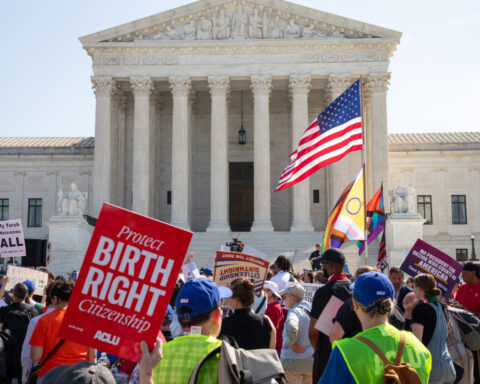
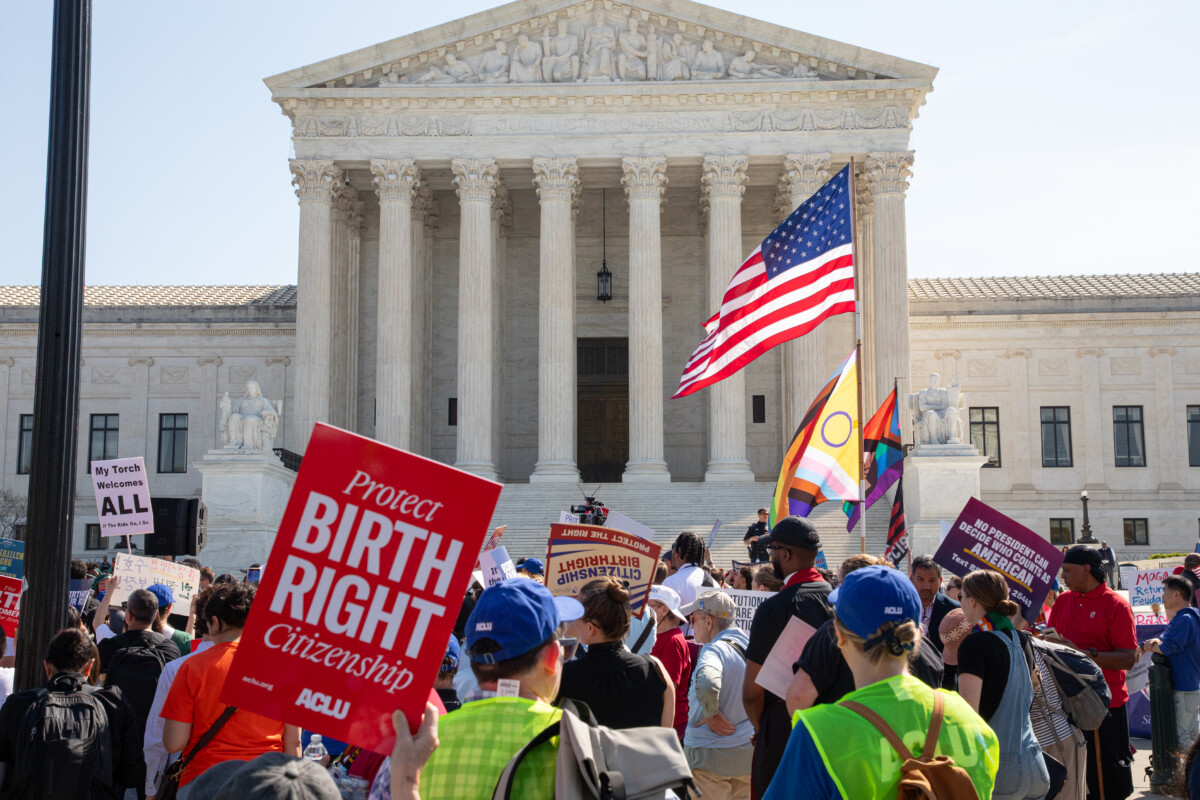
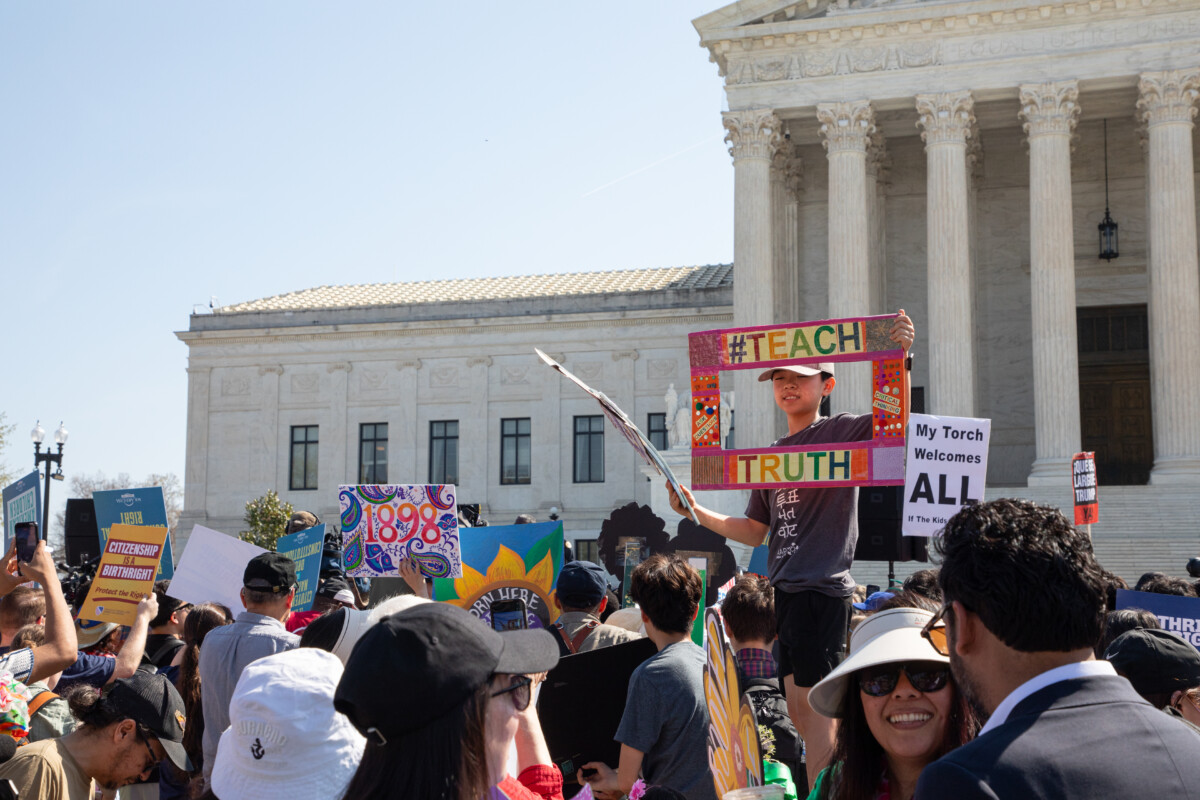
“It’s striking that in none of the debates do we have parents discussed,” Gorsuch told Sauer. “We have the child’s citizenship, and the focus of the clause is on the child, not on the parents.” In front of the building’s steps, during and after the hearing, many gathered to express their opinions, hoping their disdain would breach the marble walls and reach President Trump, who sat in on the first half of the arguments. A decision on this case is yet to be made.
Beyond the Bench: Voices Defending Birthright Citizenship
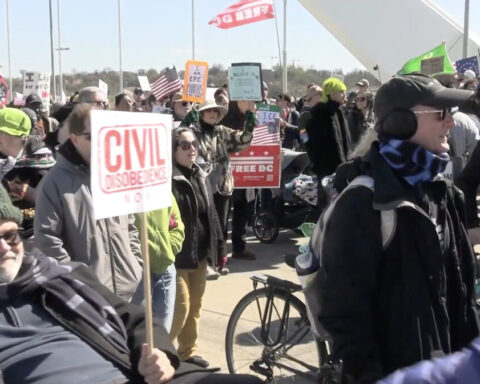
Outside of the courtroom, hundreds gathered with one message: Defend the 14th Amendment. Voices overlapped in chants, signs waved above the crowd and speakers rotated at podiums as cameras and phones pointed in every direction, capturing what many believed to be a defining moment.
The crowd was not uniform. It stretched across states, professions and perspectives — all tied together by a shared concern over what redefining birthright citizenship could mean.
For Monica Payne, who traveled from Wichita, Kansas, the moment carried both pride and urgency.
“It makes me feel proud to be an American citizen. All the unity that’s out here, the difference, the diversity — it’s a beautiful thing to see,” Payne said, pausing as she looked across the crowd.
As a lead organizer with Sunflower Community Action, Payne said her understanding of citizenship is rooted in both law and lived experience.
“Being born here or coming here, going through the process and getting their citizenship, getting their legalized papers. And sometimes it is kind of a process for people that can’t afford it or don’t know what actions to take,” she said.
Her concern, however, extended beyond immigration policy. She pointed to the 14th Amendment’s origins and what challenges it could signal for others in the Black community.
“They’re going to probably try to come after us next. Some people don’t think it’s about them, but it is. So, we all need to be together,” Payne said.
Immigrants make up almost 15% of the U.S. population, according to a study from 1850 to 2024 by the Migration Policy Institute. This translates to just over 50 million people as of 2024.
That sense of interconnected impact echoed across the crowd.
Mark Smith said his presence at the protest was grounded in the people he serves as a senior management workforce developer with CASA, a community service and advocacy organization for immigrant and working-class families.
“Birthright citizenship is important,” Smith said. “We work with so many men and women across the state and across the nation who are looking for an opportunity. It’s not fair to hold them back from opportunity.”
For Smith, the definition of being American is inseparable from the country’s ideals.
“The law says that no matter what your race is, no matter what your ethnicity is, you’re protected,” he said. “This is supposed to be the land of the free, home of the brave. If we are to act upon that, we need to accept everybody for who they are, what they do and embrace them. That’s the only way.”
Still, he acknowledged the climate of fear surrounding the issue.
“We’re consistently looking over our shoulders,” Smith said. “We’re checking to make sure we’ve got our driver’s license; our registration up to date. Because we live in a time right now where fear has to stop. We have to be able to walk, talk, breathe and do everything that we want to do.”
Smith emphasized that immigration runs through the culture of what America is — citing the immigrant background of most individuals in the country.
“All of us have immigrants inside of our family; there’s no such thing as a pure American.”
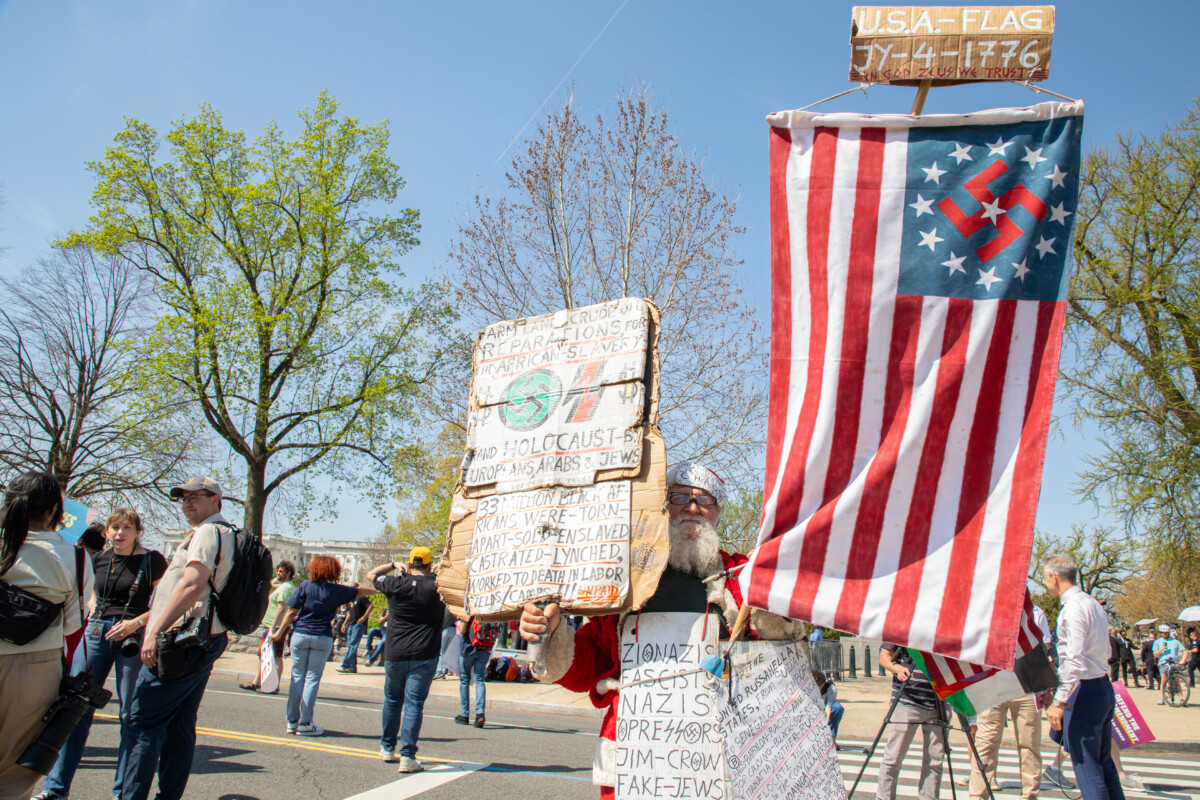
The founders of Jamestown, the first permanent English settlement, were Englishmen from Europe as well as some Dutch, Irish, German and Scottish individuals. Then, the Transatlantic Slave Trade brought over 10.7 million enslaved Africans. The Homestead Act of 1862 meant that any man over 21 could be given government-issued land. That created an influx of British immigrants, Italians and Eastern European Jews seeking refuge in cities like Chicago and New York, showing that this country was built on the foundation of the melting pot.
Among the crowd were students stepping into advocacy.
One of those students is Elyssa Montgomery, a junior philosophy major and political science minor at Howard University, who said the stakes feel generational.
Montgomery, founder of the school’s ACLU club, tied the debate directly to the 14th Amendment’s original purpose and warned about the precedent its reinterpretation could set for Black individuals.
“It kind of sets a precedent that if you can say immigrants have to get out, it’s furthering the idea that Black and Brown people don’t belong here,” she said. “It’s putting them down and telling them it’s the white people’s land.”
Still, Montgomery emphasized that disagreement itself is not the issue; it’s the denial of others’ rights. “You have the right to disagree, but that doesn’t mean that you have the right to impose on other people’s rights to be here.”
The Moment Reveals Deeper Fractures
Not all voices in the crowd were framed by policy alone. Some focused on the deeper fractures they believe the moment reveals.
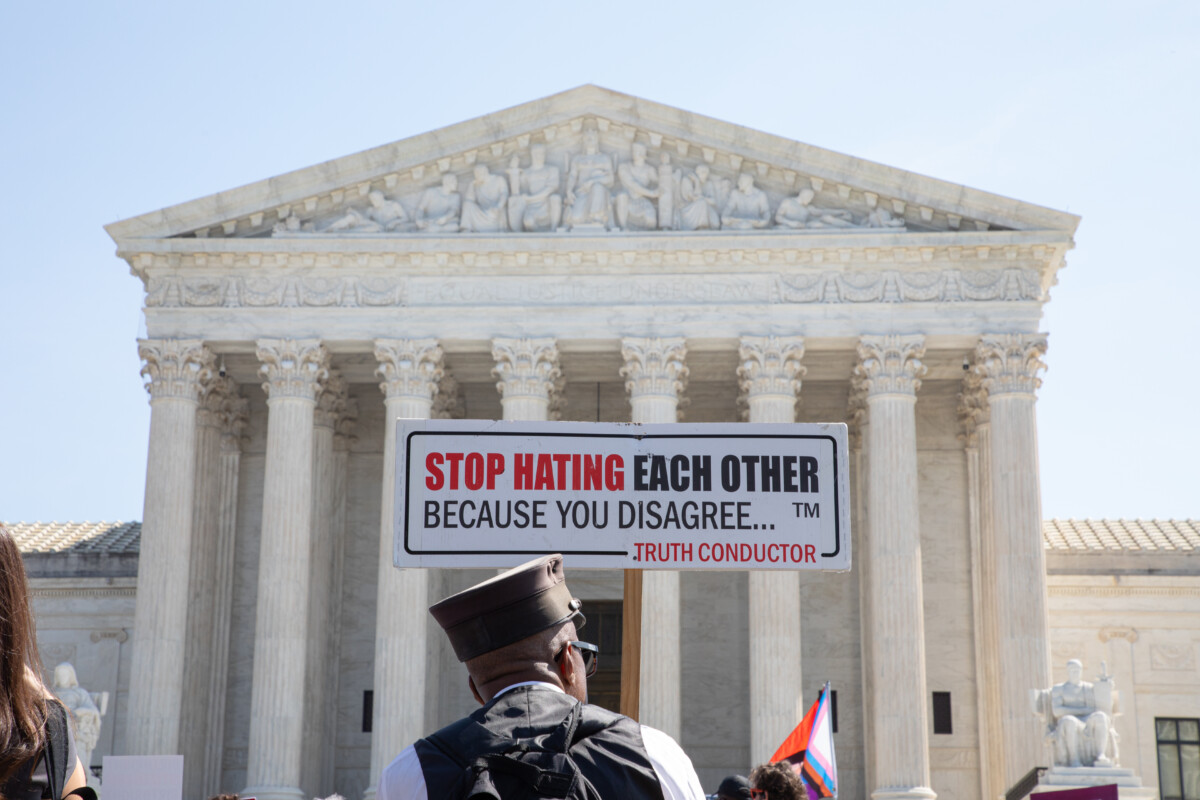
Don Folden, who calls himself “The Truth Conductor,” has spent years advocating for dialogue over division.
“Somewhere along the way, we’ve gotten hate and disagreement to mean the same, and they don’t,” Folden said. “If we don’t learn how to talk to each other and stop talking at each other, we all gonna suffer. It’s just that simple.”
Standing near the Supreme Court, he pointed to history — both visible and buried beneath it.
“This country was built on immigration, period. Immigrants of all — Africans, Irish. There is immigrant history all over this country. It’s just dying on the vine, because the only thing we want is white history. And white people didn’t do it by themselves.”
Folden gestured toward the building behind him, referencing a past many passing by may not realize.
“A lot of people don’t know this building right behind us used to be the Black prison where the Supreme Court sits,” he said. “That used to be the prison where Black folk were kept. And they got paid. When we were arrested, judges and police officers got paid money. So there are immigrants, the immigrant history, all over this country.”
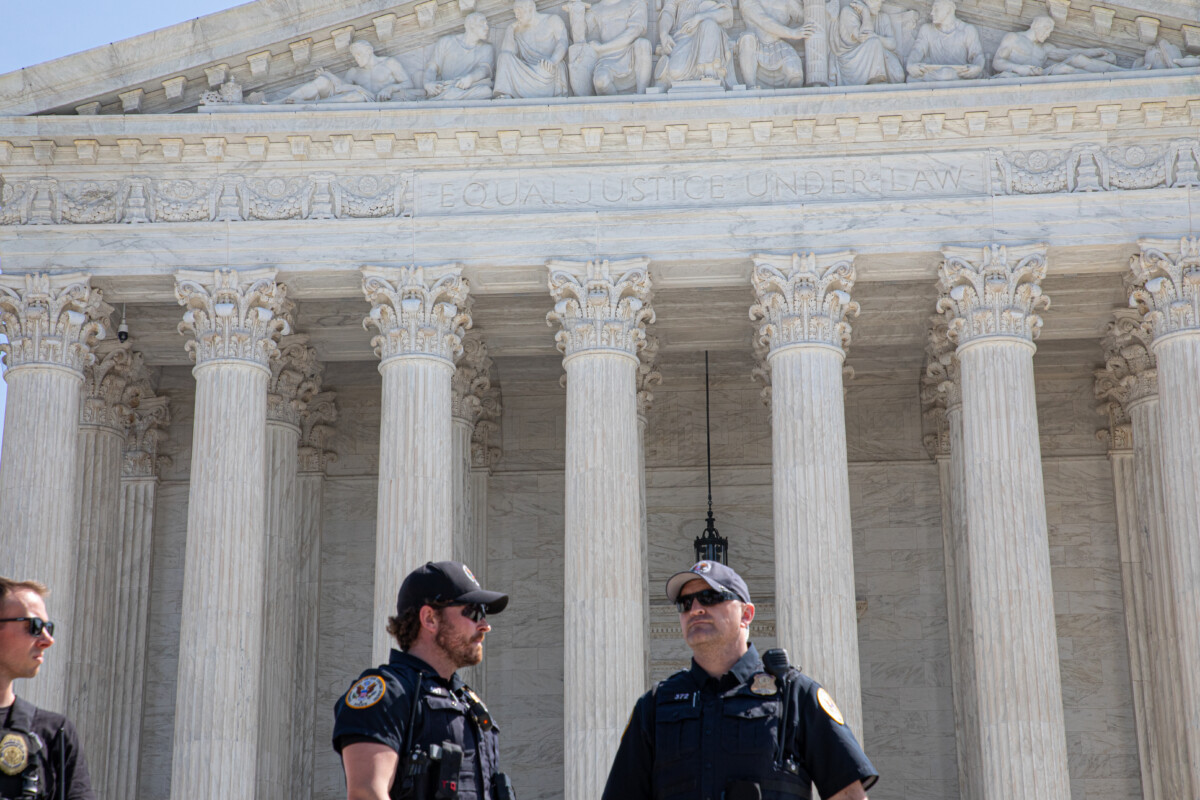
The modern U.S. Supreme Court Building, completed in 1935, stands on land that once held earlier government structures — including a site later used as a Civil War-era prison called Old Capitol Prison. While the court itself has never operated as a prison, the history of the ground beneath it reflects the layered and often overlooked narratives Folden described.
To Folden, that history is not just symbolic — it is instructive.
“The problem is good people of all races are afraid of other good people,” he said. “If we could just get good people to start recognizing other good people, all this madness would cease overnight.”
Within the crowd stood a man wearing a clerical collar.
Kevin Vandiver, senior pastor at the Lutheran Church of the Reformation, said the issue raises both constitutional and theological questions.
“It means not having to worry about whether you are a citizen if you’re born on these shores,” Vandiver said. “It entitles us all to equal rights, equal justice under the law and under the Constitution, where there is no stratification between some having and some having not.”
From his perspective, the current political climate reflects a deeper ideological tension.
“We are witnessing the pressing in of Christian nationalism, which suggests that everything is in worship to the country and the homogenization of people,” he said. “But from my theological perspective, we are supposed to love and embrace all. All are made in the image of God, and all have the right to be cared for and to care for.”
Vandiver said he believes the foundation is simple, even if the politics are not.
“The ethic of love is what should be in the minds and hearts of people as we are making decisions about how we live together as a community,” he said.
Others in the crowd spoke from a place of personal lineage.
Aaron DeJesus and Dulce de la Cruz said the 14th Amendment is not abstract — it is generational.
“For me, it’s my bloodline. A lot of my family comes from Puerto Rico. Without this amendment, my bloodline might not be here,” DeJesus said. “I wouldn’t be here if it wasn’t for the 14th Amendment. I think it’s something that we should fight for, not just us but everybody around us, even future generations and past generations.
De la Cruz described the uncertainty surrounding the case as unsettling.
“It’s a little worrisome, especially since in any country, you’re automatically a citizen once you’re born there,” she said. “The fact that this amendment is being challenged right now, it raises questions for future generations and whether or not they’re going to be protected.”
Together, they framed their presence as both resistance and responsibility.
“If our birthright is being affected, imagine what else is being affected,” DeJesus said. “We’re thinking this is the start of a downfall. Because how are you going to challenge us being born here and try to take that away from us?”
Across the crowd, one question repeated itself in different forms: What makes someone an American?
The answers varied — birth, belief, law, community. But the underlying tension remained the same.
For some, the protest was about protecting a constitutional guarantee. For others, it was about preserving identity, opportunity or history.
Outside the courtroom, the debate was no longer confined to legal arguments.
It was personal, spoken and felt.
Morghan Langston, Keith Golden Jr. and Faith Harper are reporters for HUNewsService.com. Golden is also visuals editor.