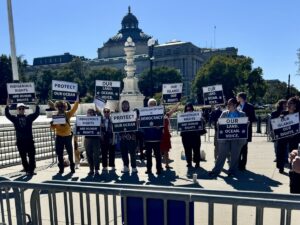
The U.S. Supreme Court on Wednesday, March 25, considered whether Keathley v. Buddy Ayers Construction Inc. should prevent debtors from pursuing their lawsuits when they do not list them in bankruptcy proceedings, even if they were unaware they were supposed to. At issue is whether courts should balance the need to maintain judicial integrity with the need to protect citizens from disproportionate punishment.
The case stems from a lawsuit filed by Thomas Keathley against Buddy Ayers Construction (BAC) over a 2021 auto accident involving a company vehicle. When he filed for Chapter 13 bankruptcy, he did not list this lawsuit. Buddy Ayers Construction believes that they should be barred from pursuing the claim.
Appearing for Keathley, attorney Gregory G. Garre said that the lower courts had applied the doctrine too stringently.
“The narrow but important question in this case is how to determine when a party’s position was inadvertent or intentional in the context where a debtor fails to update a form to reflect a new cause of action outside of bankruptcy,” Garre said.
He explained urgently that, in the plaintiff’s circumstances, there should be some understanding of his mistake.
Garre continued, “If the failure to update the form was simply a mistake, then there’s no intentional inconsistency and no basis to invoke judicial estoppel.”
Chief Justice John Roberts asked Garre about the general purpose of judicial estoppel, a legal doctrine that prevents someone from taking a position in court that conflicts with a prior position.
“All that you’ve been talking about is between the two parties… Where does that factor in? I thought that was the primary basis for the whole doctrine of judicial estoppel,” Roberts said.
Garre argued that the court’s integrity is only at risk when parties deliberately take conflicting positions to gain an advantage. “If the individual didn’t intentionally adopt that first position and correct it, as happens here… there is no threat to the integrity of the court.”
Justice Sonia Sotomayor was also concerned about the realities of bankruptcy.
“I’ve been having trouble trying to fit in our New Hampshire principle to the bankruptcy context…the bankruptcy court is well equipped to take any action it determines is appropriate to protect other creditors,” Sotomayor said.
Justice Ketanji Brown Jackson asked Garre whether intent or mistake should control in applying judicial estoppel. Garre replied, “The key is that the court has to determine that the debtor has made an intentional position that no cause of action exists. In this case, the debtor simply made a mistake.”
Justice Neil Gorsuch was concerned about weakening disclosure incentives, and Justice Samuel Alito was concerned about creating uncertainty by attempting to assess intent.
“That intentional inconsistency doesn’t arise where a debtor simply makes a mistake in failing to update a form. In that situation, the debtor isn’t adopting any position that he has no cause of action. He’s simply making an honest mistake,” Garre said.
Furthermore, Frederick Liu, appearing for the United States as amicus curiae, stressed that a balanced approach is necessary. Amicus curiae means “friend of the court” and refers to someone who is not part of a legal case but helps the court by giving information or expertise.
“Judicial estoppel should apply only if the balance of equities supports it,” he said, cautioning against a rigid application that disregards the interests of creditors and the bankruptcy court.
Justice Elena Kagan noted the complexity of bankruptcy for ordinary people.
“Bankruptcy is not intuitive for most people. We should be careful about assuming that every omission reflects an intent to mislead,” she said.
Chief Justice Roberts spoke about the wider ramifications of this ruling.
“We’re establishing a framework that others will apply,” he said, implying that lower courts nationwide would look to this decision for guidance.
The Court’s ruling could have significant consequences for both bankruptcy and civil proceedings. If BAC wins, it would reinforce strict judicial estoppel, effectively denying a claim in the absence of evidence of bad faith. If Keathley wins, it would be a more flexible standard, requiring courts to assess intent.
A decision is expected later this term.
Tanaija Kee is a reporter for HUNewsService.com