WASHINGTON — Agencies like DC’s Child & Family Services investigate reports of abuse and aim to protect the well-being of children, but some believe it might be instilling fear of separation into the families it is obligated to protect.
“It was very stressful, very embarrassing. I felt like I was under a microscope and judged,” says Amy Wilkins-Allen, single mom of three, who was placed under investigation for educational neglect of her youngest child in February 2025 and later in March 2025.
Her youngest daughter began to exhibit symptoms of mental health issues, such as agoraphobia and anxiety disorder, at the age of seven. It became difficult for her to stay outside for a long time or enter a mobile vehicle. By 2020, the COVID-19 lockdown worsened those conditions to the point where she didn’t wish to return to school.
At the time, Wilkins-Allen’s daughter was assigned to a temporary psychiatrist, to whom she explained her daughter’s mental health conditions to. Due to excessive school absences, Wilkins-Allen requested that the psychiatrist approve online learning.
The psychiatrist refused the request, she said. After the 20th day of absence, the school was forced to report the incident to CFSA, and her daughter was involuntarily taken off.
When an investigation was opened in February, a case manager visited the home, and no sign of abuse or neglect of the child was found. Her case remained closed until an anonymous report was made claiming that Wilkins-Allen was convincing her daughter that she had mental health issues and was purposely causing educational neglect.
However, the fact that was truly neglected throughout her process was that Wilkins-Allen was actively providing for her child with limited medical resources, and removal was not the answer.
The District of Columbia’s Child & Family Services Agency is responsible for seeking permanency for children who are removed from their homes. These removals can account for a child suffering an immediate danger or a lack of safety within their home environment. It is unclear if families who are greatly impacted by poverty and mental health issues are given great care before a removal takes place.
The reality sets in for parents like Wilkins-Allen that they can be placed under investigation while not being able to afford assistance to win their cases. Ward 8 has a rate of child removal that is more than four times greater than the rest of DC.
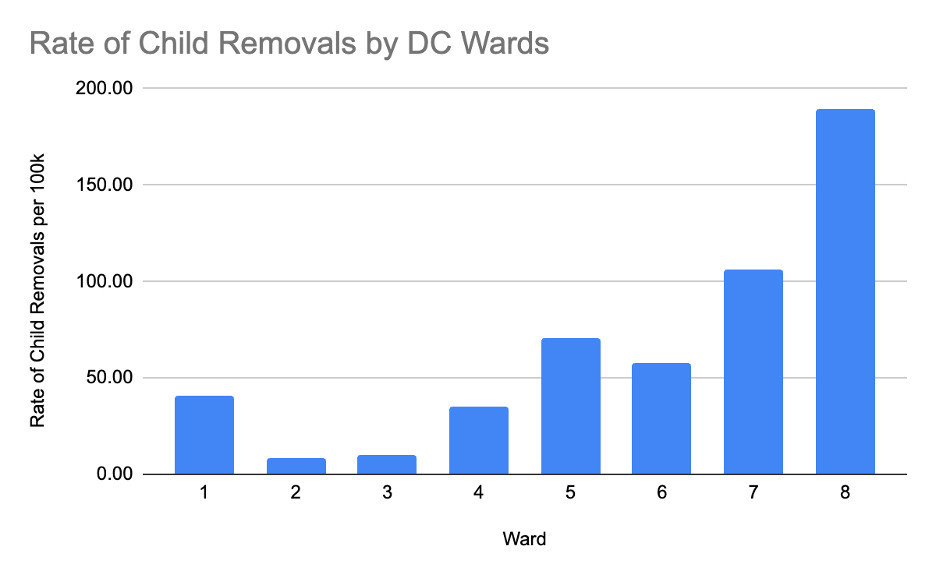
In addition, Ward 8 families are suffering a higher rate of removals in comparison to their demographic counterpart, Ward 7.
Data provided by the District’s family services agency placement dashboard shows that as of December 2025, Ward 8 has experienced the highest number of removals out of the entire district, with 166 children removed from their homes and only 47 children were placed under the care of a provider in the ward. Compared to Ward 7, which experienced 96 children removed from their homes.
In 2021, Wards 7 and 8 had a similar number of removals, with a difference of 11 children. Yet, a shift began in 2022, with Ward 7 having 92 removals by December, compared to Ward 8’s 114 removals.
Further, children in Ward 8 are more likely to be placed outside of their home ward once removed. At the end of 2025, only 47 out of 166 children removed remained in Ward 8, compared to 63 of the 92 removed children in Ward 7 being placed with a provider in the same ward.
Keena Blackmon, Director of Communication for the DC Child and Family Services Agency responded to questions about the data in an email, writing the low number of separated children remaining in Ward 8 “highlights a critical challenge: there are not currently enough licensed foster homes in Ward 8 to accommodate the number of children entering care from that community. This capacity gap is consistent with broader District trends, where most entries into foster care originate from Wards 5, 7, and 8, but the distribution of licensed resource homes does not align proportionally with that need.”
DC Child and Family Services agreed that Ward 8 consistently has higher family separations than Ward 7, despite having a similar population of children under the age of 18. Yet, she notes a slight decrease in the population within Ward 7 from 2023 to 2024.
Based on the agency’s previous reports, this leaves cases of child neglect to be caused by child poverty, physical or substance abuse.
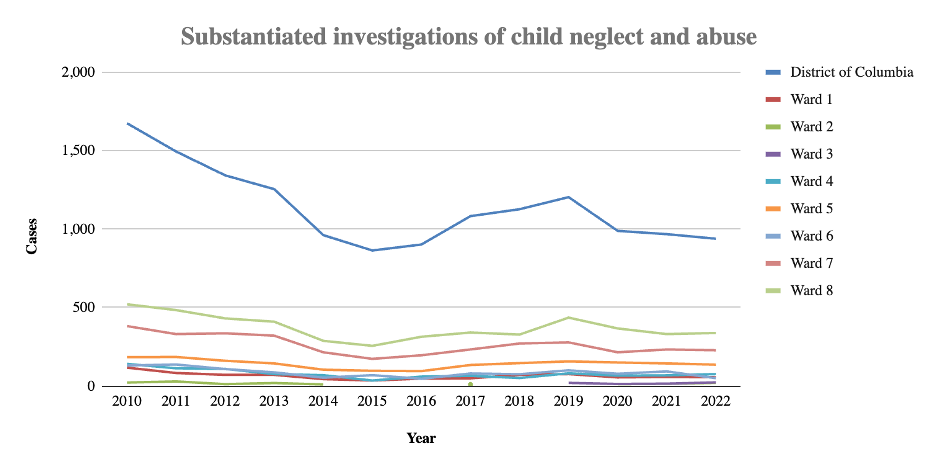
During the agency’s Performance Oversight Hearing Fiscal Year 2021-2022, it was found that 166 investigations for child abuse and neglect were open in Ward 7 and 253 investigations in Ward 8. Of those, 34 cases in Ward 7 and 50 cases in Ward 8 were proven to have evidence of neglect. The top three types of neglect that led to investigations being substantiated involved substance abuse, domestic abuse and physical abuse.
According to data provided by DC Action, they found in 2022, there were 228 substantiated investigations of child neglect and abuse in Ward 7 and Ward 8, with 338. These findings contradict the records presented at the oversight meeting.
DC Action confirmed the data was collected by the fiscal year, using information provided by the DC Child and Family Services Agency.
The process of an investigation involves an assigned social worker identifying the referral, allegations, and the circumstances of those allegations. Social workers are encouraged to see the child in or outside of the home to allow the child to share information in a safe place.
If the investigation is substantiated and the family is identified as high risk, removal and family separation are meant to be the last resort. Yet, beyond this initiative, testimonies are saying otherwise.
One of these testimonies includes Maka Taylor, a single mom of three who resides in Ward 4, who had an investigation opened in 2011 shortly after she was admitted to George Washington Hospital.
Taylor told HU News Service, “I was just having a nervous breakdown and needed a minute. And I was hit with a neglect charge. That’s still on my record.”
Taylor had given birth to twins the year before and claimed to have suffered from a self-diagnosed breakdown.
As a DC resident originally from Missouri, she had no family throughout the time she was being investigated by Child & Family Services.
During the initiation of her investigation, two social workers visited her home to question her 10-year-old son.
“[They] asked my son, ‘Has your mother ever left you alone?’ My son responded, ‘Yes.’ They then asked, ‘Why did your mama leave you alone?’ He said, ‘To go to the store to get my sister something.”
She wasn’t given any legal resources and couldn’t afford them during the time of her trial, and represented herself in a court impeachment.
Thereafter, several investigations were opened up on Taylor and her twins until 2020. Her case with the Child & Family Services presents a question of how a parent can actively advocate for themselves and receive service at no disadvantage to their standing as a parent.
DC Child & Family Services Agency invests in preventive programs through family success centers that are a part of the agency’s 20-year partnership with the District’s five neighborhood-based Healthy Families/Thriving Communities Collaboratives.
The East River Family Strengthening Collaborative serves families in Ward 7 and the Far Southeast Family Strengthening Collaborative serves those in Ward 8. The initiative aims to reduce child neglect and youth entrance into the foster care system.
The DC Child and Family Services Agency reported in their Four Pillars Performance Report for FY2023 that families served by the East River Family Strengthening Collaborative were more likely to return to the attention of the Child & Family Services Agency than those served by the Far Southeast Family Strengthening Collaborative. Ward 8 had fewer substantiated cases for a larger number of open investigations.
The Far Southeast Family Strengthening Collaborative didn’t respond to requests for an interview by the time of publication, and the East River Family Strengthening Collaborative declined an interview to discuss these findings, as well as their services to assist families in Ward 7.
If the services provided by these community centers and Child and Family Services prove to be ineffective in protecting the child within the home or community, then, under DC law, a child can be removed from their home by police for the agency to determine alternative placements.
Within 48 hours of a removal, a Family Team Meeting is called to further ligate the placement of the child, and the case is brought to the attention of a judge within 72 hours to see if that child should be under the temporary custody of Child & Family Services Agency or their primary caregivers.
Under an informal arrangement, an investigation can be diverted in the cases of child maltreatment, court involvement, or removal.
In 2021, the DC Children’s Law Center testified before the DC Council that the Child & Family Services Agency wasn’t tracking at the time whether designated caregivers or parents were able to access services by the family agency or follow a safety plan shortly after an investigation was diverted. The agency today continues not to systemically track whether families are given access to those services.
In recent years, there has been an increase in incomplete investigations. There was a gap increase between FY 2023 and FY 2024 in incomplete investigations from 525 to 1,442. By the end of FY 2025, 63% of the investigations were found to be incomplete, while only 18% were substantiated, according to the agency’s investigations data.
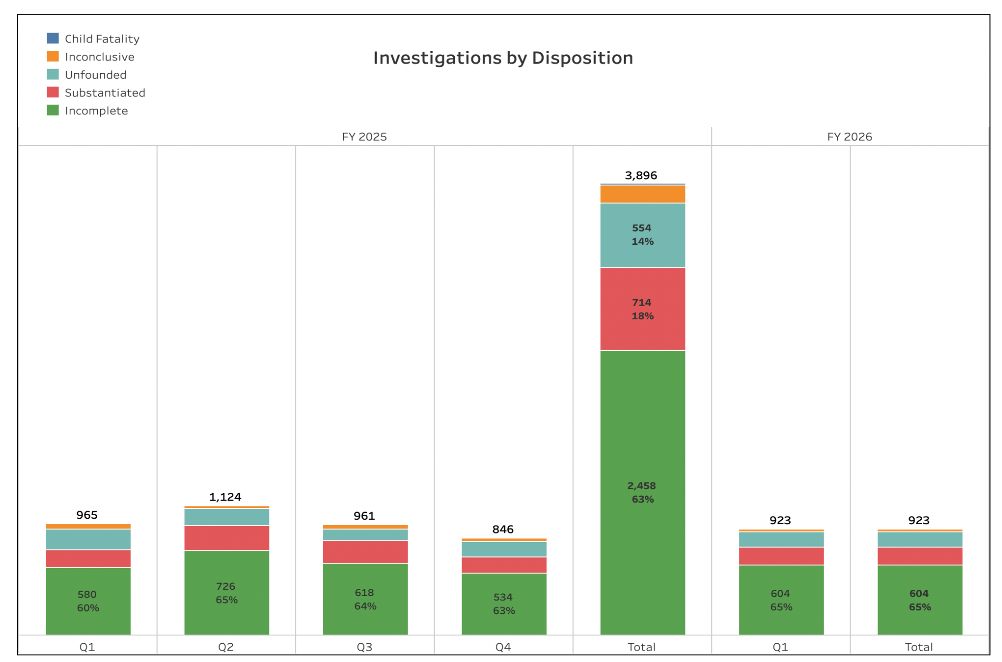
When investigations are opened but remain incomplete, it can often be due to limited staff. If limited staff are available to look after the substantiated investigation, then parents may not get the necessary assistance they need. This includes legal assistance to uphold themselves in court.
In October 2025, Councilmember Zachary Parker of Ward 5 introduced the bill, Empowering Parents in CFSA Investigations Amendment Act of 2025, which would require Child & Family Services to inform caretakers of any available legal resources and their right to counsel at the initiation of an investigation.
According to the Racial Equity Impact Assessment, they note anti-Black racial bias within the process of reporting and removing a child from their family. Black children are disproportionately overreported and wrongfully separated from their families, even when abuse or neglect hasn’t occurred. Circumstances and actions reported can be due to limited resources accessible to them.
It also noted that Black District residents are five times more likely to experience poverty than white residents, further increasing their visibility to mandated reporters. The DC KIDS COUNT 2026 ward snapshot shows that Ward 7 has a child population of 23,044 with a 35% rate of child poverty. Ward 8 has a child population of 24,619 with a 45% rate of child poverty.
Melody Webb, lawyer and Executive Director of Mother’s Outreach Network, aims to help mothers with legal and financial assistance when being under investigation by Child & Family Services. Melody notes poverty as a probable cause for the initiation of investigations.
“Poverty alone is not supposed to be the basis of it. [In] 80 to 90% of the cases, poverty is at the root of the reasons the investigations and the cases materialize.”
Mother’s Outreach Network has provided legal assistance to mothers like Wilkins-Allen in high-stakes moments of an investigation, resulting in the permanent removal of a child. She explained that parents are only provided legal representation until after their children enter the foster care system.
In cases of facing allegations of abuse, parents have the right to a court-appointed legal counsel once a neglect petition is filed in family court. Family court assumes the responsibility to provide an attorney to protect the interests of the caretaker throughout the court proceedings.
According to the Child and Family Agency, if caretakers are facing issues regarding domestic violence, child custody disputes, and child support, then they are referred to the legal services of the Children’s Law Center.
The written statement of legal resources that the bill requires can likely improve the legal and case outcomes for families of color within Ward 7 and 8.
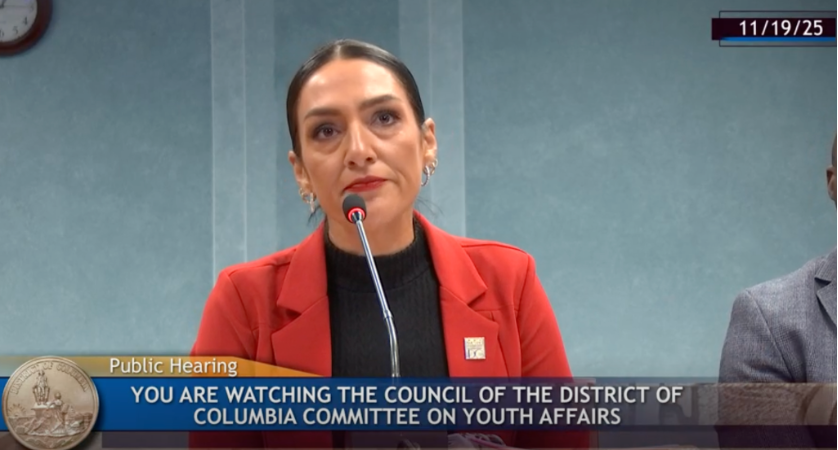
During the first hearing of the bill last November, several individuals from advocacy organizations and the agency spoke out about the process of an investigation.
According to D.C. Child & Family Services’ Director, Tanya Torres Trice, the agency only notifies parents through a written notice that they are no longer under investigation if the case proceeds to court.
If the case isn’t taken to court, then they should be notified by their case manager that their case has been closed.
Although Wilkins-Allen was notified that her first case was closed, a woman appeared at her house, not identifying herself, but clearly wearing a government badge, she said. It was then that she came to find out that she was under a second investigation.
She sought to have legal representation when speaking with Child & Family Services, but was told that such external involvement was not needed in the initial stages of her investigation.
The bill has been enacted under the mayor’s review and is projected to become law on June 17, 2026. For now, parents and children may continue to seek representation on their own terms until it is fully in effect.
Organizations catered towards representing the child, like Court Appointed Special Advocate for Children of DC, have a partnership with the DC Superior Court that assigns a court-appointed volunteer to a child within the foster care system.
Advocates are trained to provide a level of support to speak for the child’s well-being with judges, school staff, social workers, and assigned guardians. Their contracts are typically 18 to 24 months to provide stability for a child, but if cases aren’t closed within that time, volunteers are more likely to extend their services.
“We’re serving fewer youth, but I will say that the cases are a lot more complex, if that makes sense. So while we’re serving fewer youth, what we are seeing is that we’re spending more time,” says Barry Brinkley, Executive Director of Court Appointed Special Advocate for Children of DC.
At this time, all of the young children they serve are Black between the ages of 12 and 18, whose circumstances involve a level of poverty.
Brinkley, who has served as a DC educator for over 20 years before receiving his position at the Court Appointed Special Advocate for Children of DC, discusses how oftentimes the efforts of parents to still show up can go unaddressed.
“Even though those families weren’t able to provide in that moment, they provided how they could,” Brinkley said. “They were fighting to get there, and doing the work to get back there.”
Tatiana Allen is a journalism student at Howard University with a passion for local news reporting and international affairs.