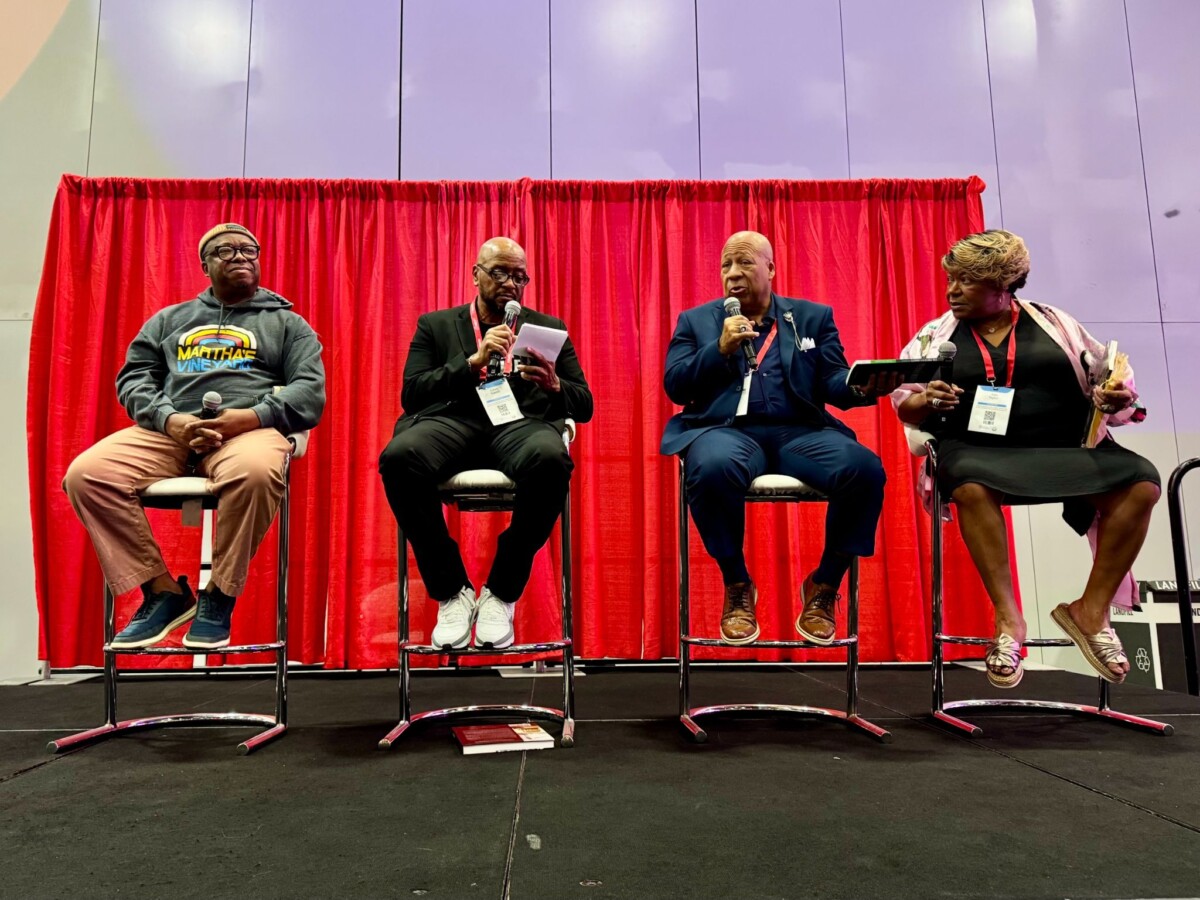
WASHINGTON (HUNS) — Supporting Black-owned businesses requires more than asking Black consumers to change where they spend their money, say authors on Black success , arguing that corporations and institutions also must expand access to capital, supplier opportunities and other resources that allow Black businesses to grow.
The 30-minute discussion, “How to Keep the Black Dollar Bolstering our Communities,” examined how Black consumer spending can translate into business ownership and long-term wealth during the Congressional Black Caucus Foundation’s Annual Legislative Conference on Friday.
Four panelists sat on the Authors’ Stage at the back of the Walter E. Washington Convention Center’s Exhibit Hall, beyond rows of vendors, loud music and other panels competing for attendees’ attention, with copies of their books pressed to their chests or resting on their laps.
Among them was Victor Simmons, author of “The Presence-Driven Leader: Lead With Presence, Not Position,” who pointed to a problem that has long complicated efforts to grow Black-owned businesses.
“Access to capital. That’s always been the problem,” Simmons said.
Black-owned companies remain a relatively small share of U.S. businesses with employees. About 201,000 Black-owned employer firms operated in the United States in 2023, accounting for 3.4% of employer businesses and generating about $249 billion in receipts, according to the U.S. Census Bureau.
But Simmons said the responsibility extends beyond entrepreneurs and consumers. Drawing on his corporate experience, he said companies should examine who gets access to their supply chains and whether the rates, credit and terms offered to vendors give Black-owned businesses a fair opportunity to grow.
“We’ve got to be asking those kind of questions and hold these corporations accountable to making it easier for vendors to be able to get in — to be able to build their business within this particular community,” Simmons said.
How much of this money in putting together the conference went to Black businesses?” — Phill Branch, Emmy Award-winning director and author of “The Double Dutch Fuss: A Memoir”
Phill Branch, Emmy Award-winning producer and director of “Hampton University: One of the Wonders of the World” “The Double Dutch Fuss: A Memoir,” shifted the focus from individual consumers to Black institutions, challenging organizations serving Black audiences to examine how much of their own spending goes to Black-owned businesses.
“If you use the example of where we’re sitting right now, how much of this money in putting together the conference went to Black businesses?” Branch said.
Branch argued that keeping money within Black communities can also require organizations to accept trade-offs in how they operate.
“Sometimes that conscious choice means you have smaller events, but you have smaller events that the money stays targeted and stays within the community,” Branch said.
The discussion took place amid a broader racial wealth gap. The Federal Reserve’s most recent Survey of Consumer Finances, conducted in 2022, found that the median Black family held about $44,900 in wealth, compared with $285,000 for the median White family. Although median wealth among Black families increased substantially between 2019 and 2022, the gap in wealth between Black and White families remained large.
Moderator Calvin Stovall, author of “Hidden Hospitality,” pushed the discussion beyond where individual consumers shop, saying responsibility for strengthening Black economic power could not rest solely with them. He asked what roles Black-owned businesses, corporations, financial institutions, policymakers, community organizations and consumers should each play.
Simmons said consumers can begin by asking who owns the businesses they patronize and who holds equity in them. He also said Black business owners could strengthen their position by collaborating instead of treating every similar business strictly as competition.
“If I have a Black-owned business and I’m collaborating with others, I think we could find better deals out there,” Simmons said. “We could maybe share some opportunities that give us better opportunities.”
That emphasis on collaboration echoes the Congressional Black Caucus Foundation’s own research on cooperative economics. In its “Black Dollar” series, the foundation has explored how Black communities have historically pooled resources, built businesses and created economic systems designed to keep value circulating within their communities.
Financial education and investment emerged as another strategy for building wealth. Ada Taylor, known as Lady Ada and author of “From the Concrete Reservation to the Crown Jewel: From Ground Zero to Multi-Millionaire,” emphasized financial education and investment as another part of building wealth.
Taylor described teaching young people about investing and told the audience about a student who used his own investment to purchase a larger tow truck to expand his business rather than borrowing the money.
The panel also returned repeatedly to the difference between getting money into Black communities and creating systems that allow it to remain there. Stovall described the challenge as building businesses, institutions, supply chains and financial ecosystems that allow dollars to circulate and create additional economic value.
In an interview after the discussion, Stovall said Black-owned businesses also have a responsibility to strengthen their own operations.
“Black-owned businesses must develop better business practices,” Stovall said.
He said that Black consumers should not be expected to accept subpar service simply because they want to support a Black-owned business, adding that stronger customer service could help businesses retain customers and remain open longer.
For aspiring Black business owners seeking financing, Stovall offered one final piece of advice: Build a team before approaching a bank. He said entrepreneurs can weaken their position by trying to manage every role themselves instead of showing that the business has the support needed to operate and grow.
“When you go into a bank, make sure you have a team,” Stovall said. “Sometimes we want to do all of the roles in our business, but that isn’t always the best way to do business.
La Tetra Metts-Owens is a reporter for HUNewsService.com. She covers Prince George’s County.