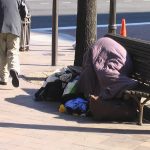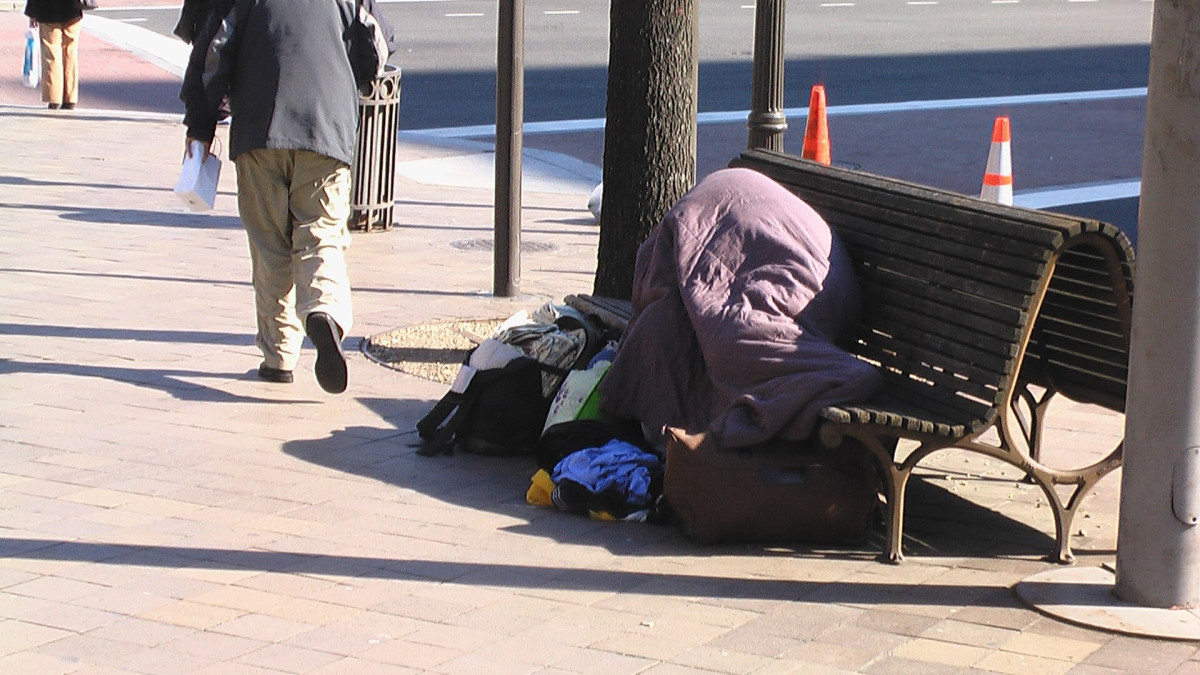
John has been unhoused for nearly 13 years. A Maryland resident who has been no stranger to law enforcement, he prefers a few nights in jail instead of risking a night in a shelter.
John would plant himself at the bus stop across the street from a McDonald’s and Dunkin’ Donuts and near a grocery store. People would call and complain about him. But according to Maryland law, unhoused individuals are allowed to engage in “life-sustaining activities” such as moving, resting and eating so long as they’re not an “obstruction” to others. John refused to accept any assistance from officers even in the most inclement weather conditions.
Felix Martinez, former police officer in Riverdale Park, Maryland, who turned in his badge to earn a doctorate, had regular interactions with John and explained the cultural differences between jail and a shelter.
“Culturally, a jail has a different code of conduct than a shelter,” Martinez said. “John believed that in a shelter he would be exposed to sexual assault and violence. However, in jail he would receive special treatment because of his swollen foot, placing him in a ‘safer’ ward than being amongst the general population like he would be in a shelter.”
One night after over an hour of convincing, John went with Martinez to the D.C. line where he called the Homeless Hotline and got placed in a shelter. Nov. 1 to March 31 is hypothermia season, and D.C. has transportation to shelters available 24 hours a day, seven days a week.
These services have been available since 2005 because of the Homeless Services Reform Act. Martinez said no shelters were available in Prince George’s County, and Montgomery County wouldn’t pick up John, but he was able to contact D.C.’s weather-related transportation service.
“We called 911 in D.C., and they had to accept him and they came to pick him up.” Martinez candidly divulged that sometimes as police officers, “you’re going to make some very interesting, rash decisions that other people won’t understand, but you know you’re doing what’s best.”
John’s experience reflects the imbalance in services for the unhoused throughout the region that advocates say leave them underserved and underfunded.
The District of Columbia, which takes up a land area of 61.1 square miles, had 28,662 shelter beds as of 2025, according to the U.S. Department of Housing and Urban Development. The number of beds in the district is on par with those in states that are much larger such as New York with a square mileage of 47,124 and Hawaii with 6,423 square miles, according to data from National Alliance to End Homelessness.
“There’s an expectation to do more with less.”
Jennifer Boston, senior director of housing at N Street Village in Washington
Despite a large concentration of unhoused or housing-insecure people residing in D.C., the District’s proposed FY27 budget detailed a 7.5% reduction to the Department of Human Services. These funds came from a combination of local and federal reserves. There is a freeze on new Permanent Supportive Housing vouchers and a $3.2 million cut to the Rapid Rehousing program, which bars new families from entry.
Jennifer Boston, senior director of housing at N Street Village, a non-profit organization that provides temporary and private housing to unhoused women at its seven locations, takes note of the growing strain. “There’s an expectation to do more with less,” Boston said.
Housing providers such as N Street Village offered “supportive services and housing programs to 1,625 women and 57 families who were extremely low income or experiencing homelessness in Washington, D.C,” according to its FY 2025 report.
The Patricia Handy Place for Women was built as a result of Mayor Muriel Bowser’s initiative to place a shelter in each of the eight wards. Bowser had closed the D.C. General Family Shelter in 2018, describing it as “too big, too old and too isolated to serve families.” The shelter used to be D.C. General Hospital with the capacity to hold 250 families, according to the Department of General Services.
While ensuring that each ward has an operating facility that can provide short-term and speciality services, the issue of homelessness is deeper than physical instability.
Boston explains the overlapping factors that may drive someone to be without housing.
“There’s intersectionality — mental health, trauma, access to resources, education, familial support and dynamics,” she said. “The rent is ridiculously high in D.C.”
The District of Columbia spends significant municipal capital managing immediate, high-volume emergency needs through institutional shelters while Maryland’s legislative framework attempts to intervene before low-income residents enter a state of absolute housing crisis.
Under Gov. Wes Moore, the state administration has prioritized high-impact, preventative land-use and zoning reforms. Moore’s legislative strategy focuses on reducing the regulatory authority of local municipal governments to block high-density housing developments, particularly near high-capacity transit hubs.
In Virginia, the policy debate manifests as a strategic, capital-intensive struggle between competing institutional frameworks.
As housing advocate Brian Koziol notes, a growing policy divide is active within the state. “We spend a lot more money to house people in prison than in communities,” Koziol said, explaining that Virginia spends $1.6 billion on the Department of Corrections and $250 million a year on housing.
The Virginia Housing Alliance, a statewide coalition of developers, nonprofits and policy advocates, directs substantial resources into long-term housing stability. Koziol said the alliance prioritizes “housing-first solutions,” focusing organizational efforts on expanding the affordable housing supply, protecting existing tenants and securing dedicated funding streams to treat instability at its root.
Conversely, these efforts face well-funded opposition from groups like the Cicero Institute, a conservative public policy group that supports projects centering on public safety, healthcare and homelessness and that seeks to criminalize public sleeping. Joe Lonsdale, a billionaire venture capitalist who helps manage Cicero initiatives, claims the institute has “made it easier to civilly commit those who are mentally ill and need treatment.”
However, research suggests that ordinances did not lead to a decrease in the number of people who qualified as homeless in 100 U.S. cities. In addition, advocates for the unhoused sargue that Lonsdale is putting the 700,000 unhoused in danger.
“I just can’t imagine having that much wealth and power and using it to kick people when they are down instead of lifting them up,” Jesse Rabinowitz, campaign and communications director at the National Homelessness Law Center, told the Washington Post.
Koziol identifies the Cicero Institute as a primary ideological adversary that lobbies lawmakers to codify enforcement-based policies, including strict regulations on public encampments and expanded criminal justice involvement to manage unhoused populations.
“Both sides are investing heavily — not just financially, but strategically — to influence lawmakers and shape public perception,” Koziol said, noting that these investments ultimately dictate which proposals gain traction in the state legislature.
Sheba Williams, an advocate for the No Left Turns initiative, a Virginia-based advocacy non-profit organization, argues that local municipal budgets demonstrate an analytical misalignment between public safety expenditures and real social infrastructure. The Department of Corrections receives close to $2 billion, while direct social infrastructure and housing supports receive only a fraction of that allocation, according to the Commonwealth Institute.
Williams notes that these funded systems lack essential “health elements” and active rehabilitative support. Upon institutional release, individuals encounter restrictive policies on sealing criminal records. These policies legally permit discrimination against applicants with criminal records in both employment and housing eligibility.
“Public safety encompasses far more than enforcement,” Williams stated, calling on the state to “put more money” into the social infrastructure that secures community stability rather than permanently penalizing vulnerable populations. To break this loop, the initiative is actively organizing behind a 2027 legislative bill to dismantle discriminatory barriers.
Arrests continue to play a role in how mechanisms operate in the district area, underscoring a pattern of criminalizing homelessness by targeting unhoused populations.
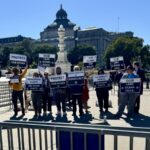
At the start of last year, a federal mandate initiated an aggressive sweep of unhoused encampments. “We actually arrested a total of well over 1,000 people,” Donald Trump stated in a CNN broadcast, noting that “49 encampments have been removed.”
Metropolitan areas nationwide are drafting legislative frameworks to address housing instability, yet national metrics highlight a distinct disparity within the district. Data from the National Alliance to End Homelessness indicates that D.C. reports about 80 unhoused individuals for every 10,000 residents.
0
Shelter Beds in D.C.
While the district commands the highest concentration of municipal shelter beds, it continues to grapple with a persistent population of unhoused residents. This paradox raises a critical question: If the institutional capacity for emergency housing is so vast, why does the state of absolute homelessness in D.C. remain so high?
Certain homeless shelters are decent living for unhoused people, while “some of them are very old and very dirty,” observed Kate Coventry, director of legislative strategy at the D.C. Fiscal Policy Institute, recounting the harrowing experiences of individuals within the institutional system. She noted that the environment often forces residents into close proximity with those navigating severe mental health crises, compounding the personal trauma of instability.
According to the Protocol for Responding to Homeless Encampments on Public Space, specific guidelines direct the government of D.C. to coordinate with all available agencies in the area to support the homeless and clean up the encampments. These localized protocols likely provided the operational foundation for the broader federal initiative to clear the District’s public spaces.
The displacement resulted in some people losing personal and sentimental items, including essential identification documents.
“They are stealing our property,” said Barbara Ellen Wilson, a district resident experiencing homelessness. Wilson argued that the enforcement actions constituted a systemic violations of the Constitution — the First Amendment’s freedom of speech and the Fourth Amendment’s protection of privacy and property.
Without a permanent residence, individuals are forced into a cycle of migration across the metropolitan region until they are processed into the institutional shelter system.
In the current political climate, federal and municipal resources have seemingly faltered, failing to mitigate the steady expansion of the district’s most vulnerable demographic.
Without a permanent residence, individuals are forced into a cycle of migration across the metropolitan region until they are processed into the institutional shelter system.
“We have so many people in front of MLK Library,” Coventry emphasized, noting that a large group of unhoused people congregate there specifically because they have no place to go. The encampment grew to a point of stress for the library to ban people from sleeping outside their building.
The central policy debate remains: Should municipal capital prioritize emergency bed capacity or long-term housing stability? In Maryland, Moore has championed a preventative strategy centered on high-impact zoning reforms.
His administration seeks to curb the regulatory power of local governments that block high-density developments near transit hubs, representing one of the most substantial shifts in state land-use policy in recent memory.
Mayor Bowser’s recent reduction to the Department of Human Services and total freeze on Permanent Supportive Housing vouchers reflect this strain. Bowser’s $21.8 billion FY 2026 proposal even included a provision that would have permitted D.C. to place unhoused families temporarily in congregate shelters where multiple people share a room.
Comparatively, the Moore administration appears to be integrating more effective, preventative measures to secure community stability for its housing-insecure residents, according to state data from the Governor’s Office in Maryland.
Moore signed landmark legislation, including the Marly Transit and Opportunity Act and the Maryland Housing Certainty Act as of May 2026. This framework is projected to unlock over 7,000 new housing units and yield $1.4 billion in state and local tax revenue. Both acts took effect Oct. 1.
The urgency of this shift is heightened as national pushback grows against punitive policies backed by groups like the Cicero Institute.
Rabinowitz emphasized the direct overlap between local lobbying and federal protocol: “I don’t actually think you can separate Trump’s Executive Order 14321 from Cicero. I think they’re so embedded in this administration. When you look at Trump’s executive order or the HUD funding, it is not a coincidence that it is parroting Cicero.”
While the district manages the symptoms of instability through high-volume shelter capacity and policy, neighboring jurisdictions are increasingly focusing on systemic root causes via housing-first reforms.
As Williams observed, “Public safety encompasses far more than enforcement.”
Aniyah Genama, Israel Johnson, Ella Gilbert and Elle Sawyer are reporters for HUNewsService.com.