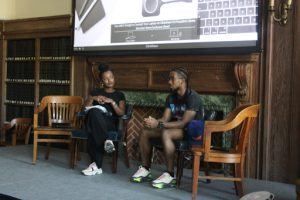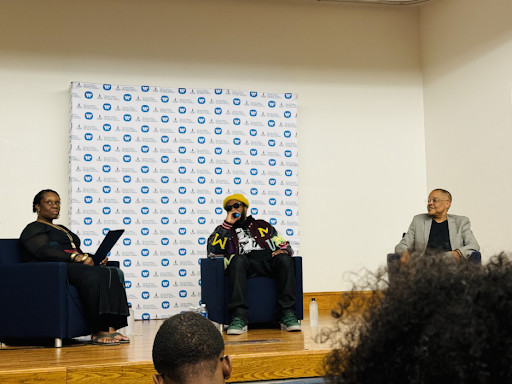
Affirming claps permeated the Blackburn Digital Auditorium at Howard University as Raheem DeVaughn provided an abbreviated masterclass on navigating the music industry. Leveraging years of expertise, the Grammy award-winning artist got candid about the business of being independent.
The fireside chat, held on April 13, featured intimate details about his humble beginnings in his career. Al Payne later contributed to the dialogue. As WHUR’s senior director of programming, Payne discussed the pair’s enduring professional ties and expounded upon other shared sentiments.
While Payne currently manages the radio station’s daily operations, DeVaughn is the host of its iconic late-night program, “The Original Quiet Storm.”
Director of the Warner Blavatnik Center for Music Business, Jasmine Young, joined the gentlemen on stage. She is known as Howard’s “Hip Hop Professor,” and served as the moderator on Monday afternoon, casually implementing light-hearted sidebar commentary.
The music entity hosted the event. Yet, the Office of Corporate Relations at the University was sponsoring.
Before delving deep, Young asked DeVaughn about the moment he realized his true musical potential. The former New Jersey native, now a D.C. resident, recalled early DMV open mic night appearances. He particularly credits the now-closed Bar Nun as one of the places where he first got his start. Breaking through the night scene on U Street NW, DeVaughn harnessed his stage presence and ability to connect with audiences.
Such exposure further prepared him for his deal with Jive Records back in 2002. DeVaughn said, “That’s when I knew that I jumped off the porch.”
Raheem’s discography encompasses over 8 studio albums, where songs such as “You,” “Woman” and “Guess Who Loves You More” are notable fan favorites.
Young later shifted gears, encouraging the singer to shed light on the value of building long-lasting relationships within the business.
“Your name is your credit. You are as good as your reputation, the word you keep,” DeVaughn said.
During this time, Payne also chimed in. He exemplified how the statement applied to Raheem’s career by suggesting that his professionalism, let alone character, never posed a significant issue.
“I have never in [the] 21 years I’ve been dealing with Raheem, had other artists that could find bad things to say about [him],” Payne said.
He followed up by insisting that emerging artists follow DeVaughn’s lead, since the example is already set.
Among those who began to take notice was senior international business major Morgan Davis. Prior to the conversation, she alluded to a similar message when considering the state of artist development or the lack thereof.
“Nowadays with social media, the work and stuff that goes into [building] an artist is being lost or not put into the conversation,” Davis said.
She also recognizes that social media notoriety can overshadow the work an artist must put into improving their craft.
“Knowing that it’s more than just having a catchy hook or something that goes popular online is important, especially for people who want to be an artist and take it seriously as a career,” she added.
Freshman biology major Anaya Phillips agreed and took everything from the fireside chat at face value. She was more prone to doing so, given that both panelists had their share of firsthand accounts.
“It’s pretty [special] to get a perspective on what it’s like to get into the music industry, [directly] from someone’s that’s already in it,” Phillips said.
To round out the event, DeVaughn reflected on what he calls the “direct consumer” era. He used the term to describe the current state of the music industry in relation to certain supply and demand principles. He acknowledges that technology influences fan loyalty.
Using himself and his career as examples, he stated that he’s “200% artist, 200% business.”
Being an independent artist for nearly 16 years, DeVaughn said he prides himself on being immersed in his management endeavors and prioritizes financial literacy above all else.
Because independent artists tend to face more adversity than those signed to major labels, this event highlighted the importance of securing long-term career longevity.
For those like Ashlyn Merced, this experience spoke volumes. The senior psychology major testified to its reliability, even though this was not her specific area of interest.
“These events give everybody a wide perspective.” Merced said. “Even if you don’t want to intern in music, it [leaves] everyone [with] something.”
DeVaughn’s presence proved to be a teachable moment for everyone in the room. While he could have been anywhere else, he chose to pour into those who are just as tenacious as he is.
Jaiden Thomas is a reporter for HUNewsService.com