
Christopher Banks grew up in Bauxhall, New Jersey, a tiny town where his childhood was shaped by its peaceful streets and tight-knit community. As a young boy, Banks was observant – a reflective, curious individual.
Sadly, tragedy was an inevitable part of Banks’ formative years. Multiple relatives died while they were under 60 years old, and both of his parents passed away at relatively young ages: his mother while he was in college, and his father at a later date. Such losses left him with emotional scars that remained with him for the rest of his life. He learned to keep silent about his anguish.
In college, Banks was conscientious and introspective. He showed potential as an academic and friends considered him a reserved guy with laughter that was always gentle, but rarely frequent.
Unlike other students, he kept his thoughts and anxieties to himself rather than sharing them with others. His relationship with his cousin Miriam, who was very close to him, like a sister, helped him through the turbulent years of growing into adulthood.
Both changed their ways of life, adopting healthier habits in light of the illnesses and deaths around them.
The time spent in college at Virginia State University in the 1990s played an important role in shaping Banks’s personality.
At an educational level, he was quick-witted and actively participated in studies requiring critical thinking. On the social side, he had an attitude of doing a lot of listening and developing deep friendships, although he was not very talkative.
Nevertheless, the passing of his mom while Banks was still studying at college broke pieces of his soul that he never managed to mend.
Banks carved out a place for himself in Maryland after finishing his education, developing a new life marked by responsibility, unobtrusive kindness and the diligent performance of all the duties he found important as an employee, lover, husband, parent and friend.
He was married twice before meeting Candice Willie. The experiences gained in both of his previous relationships provided some useful lessons on intimacy.
By the time Banks met Willie via the Internet, he already understood the meaning of opening up to another person and trusting them in some ways, while remaining cautious about disclosing too much of himself. Banks and Willie built a happy marriage full of love and hope, with a beautiful daughter.
In her eyes, Banks could be perceived as a considerate and caring man. He was polite in his speech and loving towards his family members. However, something more was going on underneath all this perfection.
On several occasions throughout her years with Banks, Willie observed events that revealed his internal struggle.
These events were initially easy to overlook: subtle hesitations during discussions, periods of defensiveness, silent moments when conversations turned to self-evaluation. But patterns eventually became clear.
“I knew that he needed therapy,” Willie said. “I knew that because he was very deflective and defensive. If you talked about him as a focal point, he could sit and tell you all about your issues, tell you all about resolutions and recommendations, things you’re doing, right, wrong, indifferent.”
This kind of behavior certainly did not align with the impression that most people had of Banks. He usually appeared to be a composed person, ready to lend a hand whenever needed.
What Willie witnessed and learned about was a type of behavior known as functional depression. Banks was able to successfully perform his tasks, but he was simultaneously emotionally disturbed.
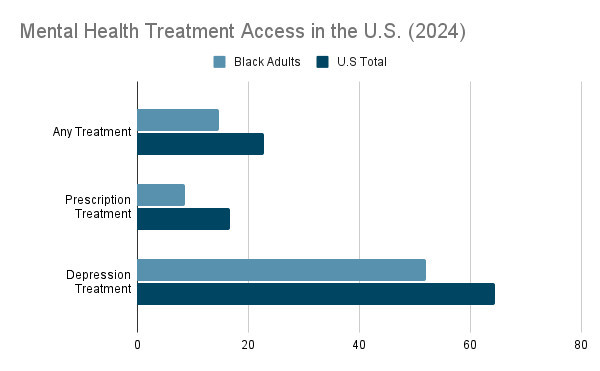
Black people are less likely to seek out treatment even when they have severe symptoms of mental health issues, according to the U.S. Department of Health and Human Services Office of Minority Health (OMH).
Numerous adults live with undiagnosed mental disorders who function normally. They can perform all their duties in terms of work, family and society despite having depression or anxiety. Black men also face specific barriers to receiving treatment, and they are often underdiagnosed for disorders like anxiety and depression, according to the National Alliance on Mental Illness (NAMI).
In the last few years before his passing, Banks’ inner conflicts started mixing with his anxiety and fears of being watched. According to Willie, his worries steadily began seeping into their lives after
their daughter was born in 2021. “So maybe in 2022, he started to talk about people following him and being possibly under surveillance,” she said. “He worked for the government and had a security clearance.”
At first, Willie did not pay much attention to what Banks said because she took it as temporary anxiety. However, over time, Banks’ worries increased and became apparent to her.
She recalled what Banks had said about some cars around the neighborhood spying on him.
“There was a car one time that pulled up to the right of our house,” Willie said. “He accused it of being another watchful individual or individuals.”
But this fear grew even more when Banks found an Apple AirTag on his car, which disturbed him considerably despite there being nothing to substantiate any surveillance.
“He took it in to have it checked. No one could find anything. And he was, of course, taken aback by it.”
Banks was becoming increasingly obsessed with the idea that he was being monitored. It sucked his attention and inner peace, drawing him into loops of fear from which even Willie could not unravel him.
The weeks leading up to his death were marked by the growing weight of his fears of surveillance. Willie noted that on a trip to New Jersey to see family, Banks spoke of being followed more intensely than ever. His mood changed radically in the final week before his death.
She remembered events that next Christmas that marked the transition — times of sorrow, emotional turmoil and isolation. On Christmas Eve, he divulged memories, stories, finances and secrets from his past that he had never divulged. He did not disclose intimate information like this, but he was opening up and pouring out his heart.
The evening before he took his life, he was unable to rest. Wille said he was pacing back and forth in the dark, struggling with things that were weighing on his soul. The following morning, on Christmas Day, she found him dead by suicide.
Since then, Willie has had to grapple with her sorrow and shock, as well as numerous unanswerable questions.
She mentioned having felt “completely lost” and managing to hold herself together, because she had to be there for their child. The underlying theme was the silent burden Banks carried, which became evident only at the very end.
“I probably cry once a week, and I just let that be my moment,” Willie said. “And then I hook myself up, and I’m going to continue to clean up our lives, because I have a child that I have to take care of. I can’t imagine what she would think if she sees me crying and just not being productive.”
According to the U.S. Department of Health and Human Services Office of Minority Health (OMH), Black people are less likely to seek out treatment even when they have severe symptoms of mental health issues.
Those close to Banks described him as generous, sincere and humble. Even when faced with internal struggles, he always managed to share laughs, listen to music and make insightful comments with those who were close to him.
His loss has created a void in Willie’s life and especially their daughter’s; she now has to move forward without her father.
The story of Banks’ life is not only a personal drama. It is a reflection of how complicated it can be to deal with mental health challenges and the many barriers people encounter in societies like ours where mental illnesses are shrouded in stigma and misconceptions.
Banks was a man who had everything. He could show kindness, wisdom and compassion, and he loved his family fiercely and unconditionally. At the same time, he struggled with a great deal of sorrow, and he tried to conceal it from everyone around him.
Tanaija Kee covers health for HUNewsService.com.
Where to Turn
If you just need to talk, know someone who is suffering from depression or suspect that someone is at risk of suicide, help is available at any time by calling 988, the national suicide and crisis lifeline.