In Maryland, third-party candidates are rather uncommon.
Democrats in the state hold a 2:1 voter majority, making up about 51.5% of registered voters, with 23.5% Republicans and 23.5% Independents. Democrats control all levels of government, with majorities in the General Assembly, Senate and Governor’s office.
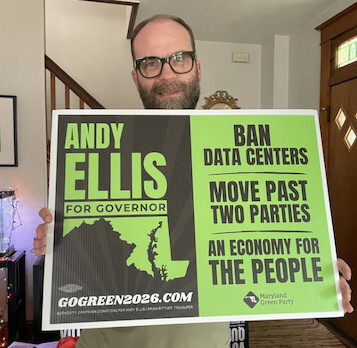
That setup, according to Green Party gubernatorial candidate Andy Ellis, locks out a lot of independent candidates causing them to have to redefine what success looks like.
“I’ll be pretty clear; I know I’m not likely to be the next governor, but we think that there’s power in the protest,” Ellis explained outside of the Barclay Elementary/Middle School voting center in the Charles Village neighborhood of Baltimore City.
“The corruption needs to be protested; the duopoly needs to be protested,” he said. “Too often we look at protest votes, and we see them as throwing votes away as opposed to making a very clear statement that we want something different.”
Ellis explained that some of what redefining success means is looking at the potential for political party change in local races like in Baltimore City.
“If we get 1% in this race, that means the Green Party gets to stay on the ballot and that means that we can run Baltimore City races in 2028,” Ellis said. “Some of our most successful races have been run in Baltimore City.”
He explained that 1% of the vote has proved to be challenging because of things like Maryland Public Television keeping the Green Party out of gubernatorial debates. MPT, in a Maryland Matters article, said that it requires candidates to have 10% in the polls even though many polls don’t ask voters about more than the two main parties.
This is the type of “two-party” corruption that Ellis’ election signs and campaign have focused on ending. But also emblematic of that control is Maryland’s “question three” on gerrymandering, which asks voters to allow or deny Democrats to change the constitution to allow the redrawing of district lines to be more in their political favor.
It is a move that a veteran political analyst, Patrick Gonzalez, said would have a hard time making it into legislation.
“They sure are dumping a lot of money, and a lot of former presidents and advertising are coming to the state to try and push for it,” Gonzalez said. “But the polling I’ve seen suggests it’s going to have a difficult time passing.”
He mentioned a few different polls from varying sources that supported and opposed question three. But the independent poll released by UMBC at the beginning of October was the one to look for.
According to that UMBC poll released Oct. 7, “57% of likely voters either think that drawing district lines to favor one party over another shouldn’t be done (49%) or that it’s the wrong thing to do (8%).”
With this interest by the Democratic party being unaligned with the majority of Maryland voters, Ellis aims to focus on the collective interest of the people of Maryland, which he has found to be their opposition to data centers.
“We think we can channel the anger people have against the data centers into a coherent symbol that says people are voting because of data centers,” he said. “It’s one of our key issues.”
Ellis said he’s reached people from the most historically segregated areas of Maryland and has found common ground against data centers.
“People across the political spectrum are voting with us on the data center question. In Frederick, in Calvert County, in Baltimore City and in Prince George’s County, because we’ve been on the ground fighting with them against their county councils and the most powerful corporations in the world.”
The power of the Green Party, Ellis said, was in the historic mission it adopted as an independent political party to be a force on politics.
“In 1970, James Clyburn was a part of the United Citizens Party in South Carolina, and he used the ability to run outside the Democratic Party to force the Democratic Party in South Carolina to start nominating and electing Black candidates,” Ellis said.
Clyburn graduated from South Carolina State University, which is the state’s only public HBCU.
“He got the first three Black people elected to the South Carolina state house since Reconstruction, because they ran outside of the two-party system,” Ellis said.
That is the tradition and history that he hopes to call on to fuel the Maryland political fight.
Elijah Pittman is a senior reporter for HUNewsService.com.