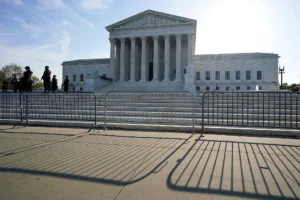
As technology advances, more crimes are being committed remotely, raising a key legal issue: where does a crime occur? The U.S. Supreme Court is now being asked this important question.
This case, Abouammo v. United States, questions whether a defendant can be prosecuted in a place where they were never physically present, solely based on the impact of their actions there.
The criminal case involves a former Twitter employee, Ahmad Abouammo. He falsified a document during an ongoing FBI investigation into whether he worked with the government of Saudi Arabia to access private user information (emails, IP addresses, phone numbers) in California.
Although Abouammo committed the crime and created the fake document in Seattle, Washington, he was charged in the Northern District of California. He was charged there because he sent the fake invoice to agents working in California in an attempt to mislead them.
At issue is whether he was prosecuted in the proper venue.
Attorneys for Abouammo argued that the crime was completed entirely in Seattle, where the document was created, and that it should not be considered a “continuing crime” spanning multiple locations.
Prosecutors only have to prove that he knowingly prepared a false document to interfere with an investigation to convict him, even if the document was never sent to anyone or used in any way.
Attorney Tobias Loss-Eaton reinforced that point during the hearing.
“He was guilty and his offense was complete the moment he finished creating the false invoice,” Loss-Eaton said.
The court then turned to whether prosecution should occur in the place where Abouammo committed the crime or in the place where the effects of the crime occurred.
Loss-Eaton believes it should occur in the place where the crime was committed.
“Venue has always turned on the location of the offense’s essential conduct,” he said.
General Anthony Yang offered the opposite perspective.
“That conduct directed at and having a direct effect in the Northern District of California makes the district a locus of his crime,” Yang said.
With today’s modern technology, the question arises of how the location of a crime should be determined when crimes can be committed across state lines with a click of a button.
Justice Ketanji Brown Jackson brought up the idea of “fairness” when it comes to deciding the location of a trial. Jackson raised concerns about fairness in trying a suspect when the government chooses to investigate, rather than where the crime was committed.
Courts now must face challenges between traditional law and the present-day digital landscape. Nowadays, actions taken in one location can have immediate effects elsewhere, making it harder to pinpoint where a crime begins and ends.
The Court has not yet issued a decision, but a ruling in favor of Abouammo could result in defendants solely being tried in locations where they directly acted. A decision in the United States favor could allow cases to be tried where the effects of a crime are felt, even if the defendant never physically entered that location.
William Armstead is a reporter for HUNewsService.com