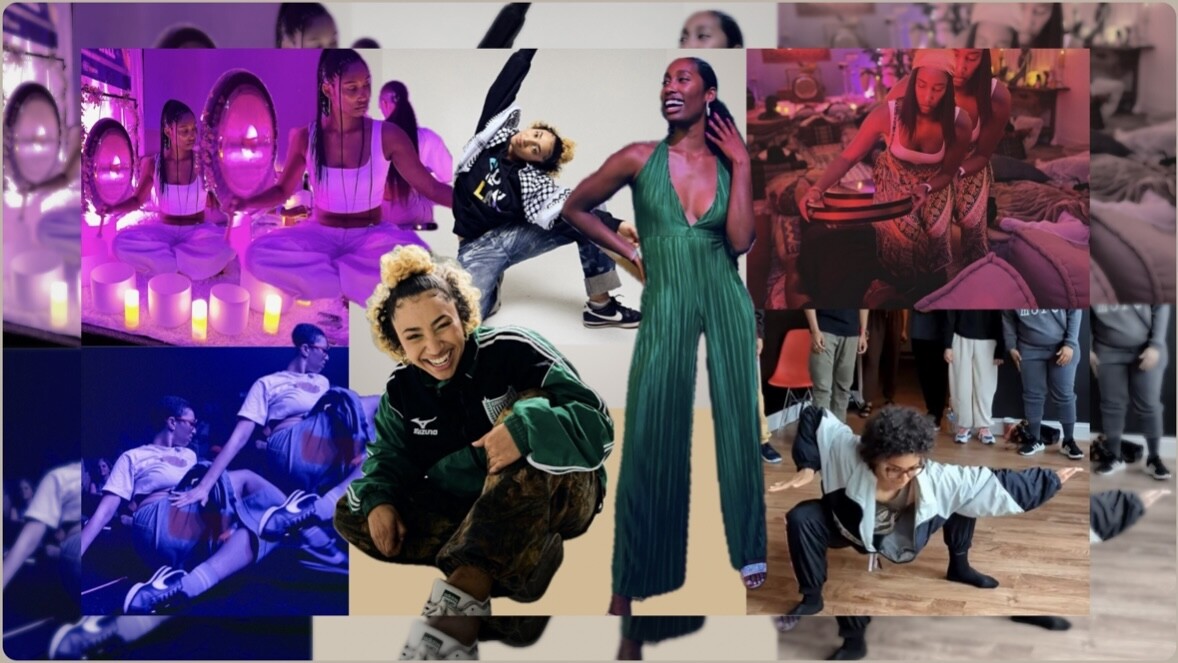
From stillness to kinetic, from crystal sound bowls ringing and the sounds of ocean drums, chimes and gongs, to body-thumping basslines, horns, claps and “Aye!” wellness is practiced in the Black community in many ways.
A certified sound healer in Los Angeles with a background in healthcare and a dancer in Brooklyn, New York, with a background in social justice community organizing are using their current practices to find liberation and resistance through healing.
Seven years ago (2018), in a small yoga studio in South Central, Janelle Ross packed into a room for a sound bath with about 35 other people.
A sound healer played crystal sound bowls as sage and incense burned to create a relaxing atmosphere. Everyone was lying down, and despite some people dozing off, Ross was awake.
“I had more of a visual experience where I would start to see colors and different shapes. It was a very relaxing experience, but I wouldn’t say life-changing,” she said.
It was the eighth sound bath, not the first, that changed things for Ross.
About two years later, in 2020, Ross had just started a wellness company and was merging it with her best friend and co-founder, Jasmine Amirah.
Though they were both unsure what exactly the wellness company would do, they agreed to host a free sound bath in a local park.
“We just did one for free in the park, for the culture, because it was really like the spotlight on Blackness at the time. And [with] the protests and the isolation from the pandemic, a lot of people’s mental health was tanking,” Ross said.
A study from 2011, “The Relationship Between Perceived Discrimination and Generalized Anxiety Disorder among African Americans, Afro Caribbeans, and non-Hispanic Whites,” revealed that race-based discrimination is linked to generalized anxiety disorder for African Americans.
When the study was released, it expanded on past research by “demonstrating that the experience of racial discrimination is detrimental to the mental health of African Americans.”
Now, 14 years later, it’s been cited by nearly 200 other studies exploring topics like healing for racialized communities and the impacts of racial discrimination in adolescence.
In 2023, the Centers for Disease Control and Prevention reported that Black Americans are nearly twice as likely as white Americans to seek mental health care in emergency departments.
This trend not only reflects higher levels of psychological distress but also highlights the systemic barriers many Black Americans face in accessing consistent, culturally affirming mental health care.
Practices like sound healing, which are often free, community-centered and rooted in cultural expression, can offer critical support where traditional resources fall short.
Ross and Amirah had no idea that a few years later, they’d go from hosting 40 in a local park to support and combat some of the anxiety and stress in their community, to having 500 attendees pay for their sound baths at festivals.
Today, Sol and Sound is a Black women-owned business with wellness at the forefront of their mission.
“We were like, well, who’s healing us? We’re fighting, we’re surviving, but who’s healing us?” Ross said. “And so we wanted to create space for that, and that is how Sol and Sound was born.”

Despite organizing these events, Ross hadn’t gotten a chance to experience another sound bath for herself.
“That sound bath, that eight sound bath, it was our last sound bath of the season. And that one was so transformative,” she said. “It was the first time that I felt like I heard God’s voice directly speaking to me in that moment, and my life has changed ever since that day.”
Ross believes that her background in healthcare influenced her practice as a certified sound healer and wellness leader.
Her background includes one in which she studied anatomy, physiology, biology and microbiology. She also participated in research studies for methamphetamine addicts, worked in fertility clinics and volunteered at UCLA in their NICU and cardiothoracic units.
“And because I understand [sound] on a scientific level, I’m able to comprehend how vibration, how sound can impact the cells. I can understand exactly what elements of the cell are vibrating, like the cytoplasm, and what that does inside the cell,” she said.
According to Sound Healing Academy, sound healing engages the parasympathetic nervous system to reduce stress hormones and shifts the body from a state of stress to a state of relaxation.
“On a macro level, once you understand science, I think you really realize that the fact that you exist in the way that your body functions is so spiritual,” she said. “It is no coincidence that these elements came to be in this way. And so when I take that foundation of science and I apply it towards sound healing, I think it allows me to understand my work on a full spectrum.”
Ross has had people share how relieving their experience with Sol and Sound baths and sound healing has been.
“‘Hey, I just had to work today. And I saw that this was going on at this event. And I want you to know that during your sound bath, for the first time in over a decade, the pain in my stomach is gone, and I had not felt this pain relief ever,” Ross said someone once shared with her.
“And tears [were] in their eyes. I didn’t even know they were in the room, and they just [came] up to me afterwards. And so to be that for someone, in that space, it’s their first introduction [to sound healing], it’s really just an honor to be there, ” she said.
With this understanding, she’s able to relate to those from a spiritual and scientific place, whether it be understanding how sound healing affects the nervous system, how it alleviates pain and discomfort, or gets rid of depression and anxiety.
With jazz, house, street dance and hip-hop as their foundation, Isha Clarke, who uses they/them pronouns, has danced, freestyled and cyphered all the way from the Bay Area to BK (Brooklyn).
Raised in Oakland, home to the Black Panther Party and other social movements, both their family and environment led to Clarke’s political and social consciousness.
The same can be said for their connection with music and movement.
Though Clarke’s grandfather was a civil rights activist, their grandmother is a modern dancer. And though Clarke has aunties who are academics in Black feminism studies and lawyers in unions, and even a mom who works at the public defender’s office, their dad is a musician.
Clarke grew to be a recognized community organizer and activist themself. Highlighted in local California news, they advocated for environmental and social change, as well as collective liberation, fighting for all people to thrive.
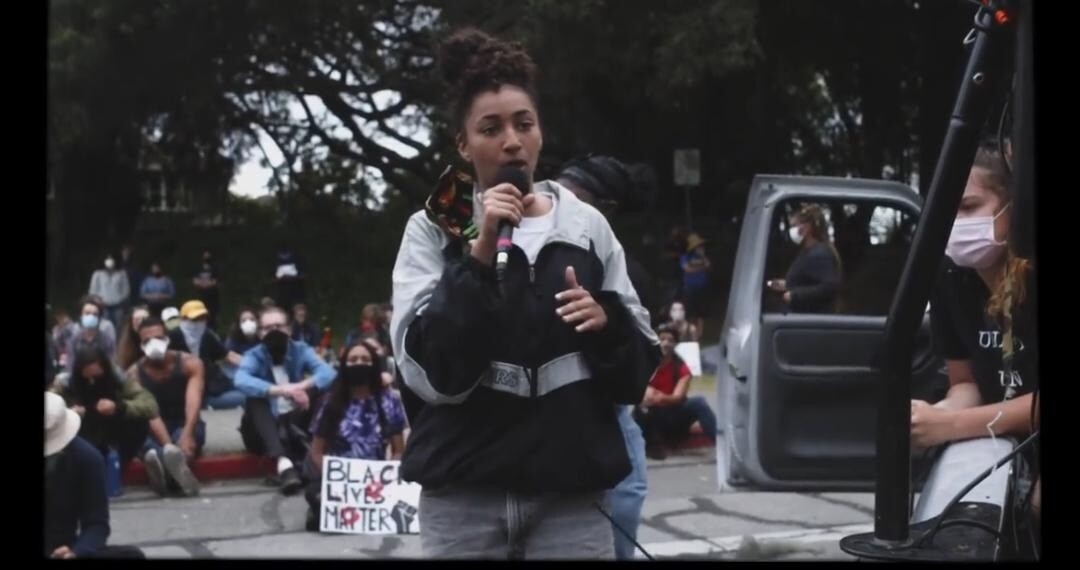
“Joy is revolution,” Clarke said during a speech at a protest in 2020. “When we dance in the streets, when we party, when we listen to our hard-ass music that we like to function to, that’s revolution when Black people are expressing Black joy in the streets, we have to uplift that we have to show that that is a form of protest.”
Despite a decade with a dance company, over five years as a community organizer and co-founding Youth vs. Apocalypse, Clarke walked away from both organizations and started over.
Freestyling, which they were intimidated by before, became liberating during the COVID-19 pandemic.
“I really became so enamored with freestyling, which was always something that I was so afraid of because I was used to choreography. And when you’re dancing with choreography, you’re thinking about movements placed in a sequence very intentionally.”
Clarke described freestyling as a relationship and a process.
“It’s a relationship between choice and impulse,” they said. “And that is what really creates the freestyle atmosphere, which is so deeply spiritual and healing, and is when I feel most free. Being in a constant process, and relationship with that process, and relationship period to myself, that has been so much of the therapy and the healing and the discovery and the exploration that I really needed to bring me to who I am now.”
Although Clarke didn’t explicitly refer to “conscious dance,” their reflections on freestyling mirror its essence—movement as spiritual practice, personal exploration and healing.
Conscious dance, defined as unchoreographed, non-evalative mindful movement done in group settings for self-expression, growth and connection, has been shown to reduce psychological distress, increase mindfulness and enhance quality of life.
Like conscious dance, Clarke shared that their dance styles are rooted in community, self-expression and a commitment to showing up authentically in the moment.
For the sake of pursuing their most authentic self, in 2023, Clarke decided not to continue pursuing their degree at Howard University and began on a journey of discovery and new beginnings as a professional dancer ever since.
This February, Clarke had a week-long developmental residency at the REACH at the Kennedy Center in Washington, D.C. There, they invited dance friends to freestyle and workshop an idea for one of Clarke’s projects.
During that time, they started materializing a piece that they’re still working on back in New York City. It’s something they’re feeling excited and inspired about.
“It’s been the way that I’ve been doing the healing and the discovering,” Clarke said, describing the relationship between their artistry and healing. “Movement is such therapy for me, I think, for humans, period. But I particularly experience movement and dance as being a therapy, a meditation, a way to really release and connect with yourself and find out what is true, and be able to sit in what is true.”
Outside of dance, they shared that every morning, they stretch, meditate, eat and hydrate. They also mentioned therapy and taking ashwagandha supplements.
Healing looks different in the body for dance than it does in sound healing. One is founded in movement and the other is based in stillness. Yet, both have vibrations and sound in common.
With sound as the foundation to Ross and Clarke’s practices, both see it as not only a form of healing but resistance as well.
“Ultimately, I think any healing for Black and brown people is a form of resistance because this system is built to oppress us,” Ross said. “Anything that nourishes us is not what the intended design of this system is. So the moment we start tapping in, and we’re able to heal ourselves and support ourselves, we’re resisting.”
Ross expanded her thoughts outside of sound healing and into music.
“If you look at the music that targets Black people specifically, it’s hip-hop. You look at what they say, what BPM they’re using, what the lyrics are saying,” she said. “It’s usually very toxic. It’s usually very degrading. It’s separating the man and the woman. It’s usually celebrating destructive lifestyles, right?”
Ross sees the work she and her partner Amirah do as something to combat the narrative of sound as a destructive mechanism.
“To be a sound healer and to use sound to allow people to release that tension, to release that generational pain that’s within them, that is celebrated in these negative vibrations of hip-hop music, it is a resistance,” Ross said. “So I feel like modern-day activists through the work that I do, you know. Even if that’s not what my deliberate mindset is, that is the result of the work.”
For Clarke, there were a few reasons they left organizing and Howard behind. It came down to the fact that it’s not that Clarke couldn’t do it, they refused to do it.
Clarke explained that they were missing the human experience and what they called a pre-colonial, Indigenous way of knowing.
“Majority of the world was living and thinking and being one with the earth and being in community and relying on each other as a system, you know what I mean?” Clarke said. “That is what’s missing from our political consciousness and our political drive. We can’t use the same way systems and ways of knowing that were used for repression [and] are used for repression, to be in a space of liberation.”
Street dance, a big part of Clarke’s dancing profile, is a style founded in community and emerged from and served as a form of self-expression, social interaction and cultural identity, according to Alliance Arts. The evolution of street dance experienced in the 70s gave rise to various street dance styles, including breaking, popping, locking, house and vogue.
“My practice now is so much about how can I live how my ancestors [knew] to live?” Clarke said. “How can I live in a way that is fully human, alive, thriving, joyful and full? How can I create that space with the people around me, and how can I reflect that in the body of my work so that it can ripple into the world and create that cultural shift?”
What began in a local park years ago in California evolved into a business that they expanded to reach more people.
Ross said she’s currently developing a project to help more people; it combines what she’s learned about spiritual and physical wellness as a sound healer and in Western medicine.
“Through this foundation of physiology and anatomy, and the human microbiome and our digestive system, how our body works, how our muscles work, how those movements occur, I want to combine it with spiritual elements and the energetic blocks, or the energetic flows of the chakra system,” she said.
Ross couldn’t speak to the full vision and future of Sol and Sound completely without Amirah, but she plans to continue to do the work they do.
“I want to continue to do this work and continue to uplift my people, uplift my community, to provide them with the tools and resources to heal spiritually, physically, on a personal level,” Ross said.
Clarke is currently working with the Ladies of Hip-Hop Dance Collective, a professional Black women’s dance team based in New York City.
“[I] have really been seeing a lot of the things that I was envisioning before come to life, like the residency,” they said. “Then I came back to New York and got into the Ladies of Hip Hop Dance Collective, which is like the cream of the crop, the most amazing opportunity. It’s exactly what I’ve been wanting too — to be in a professional touring street dance company with all Black women.”
They’ll be working on performances and traveling over the next few months to performing arts centers and venues in New York, Milwaukee and even Nebraska.
While preparing for the tour and performances, Clarke said they plan on continuing their daily habits and prioritizing their wellness, because there was a time when they struggled to.
“So this time around, I’ve been developing a relationship with myself,” Clarke said. “That relationship has allowed me to know and hear myself, like when it’s time for me to be done, when I can give a little bit more [and] when I can’t. And just listening to that ebb and flow of my energy, my needs and continuously asking myself the question in every single moment: What will make me happy? You know?”
Anijah Franklin is a reporter for HUNewsService.com.
Black Wellness Through Sound and Movement to Heal and Resist
By Anijah Franklin
A graphic displays images of Isha Clarke, a professional dancer and creative, and Janelle Ross, a certified sound
healer and co-founder of Sol and Sound. (Graphic created by Anijah Franklin)
From stillness to kinetic, from crystal sound bowls ringing and the sounds of ocean drums,
chimes and gongs, to body-thumping basslines, horns, claps and “Aye!” wellness is
practiced in the Black community in many ways.
A certified sound healer in Los Angeles with a background in healthcare and a dancer in
Brooklyn, New York, with a background in social justice community organizing are using
their current practices to find liberation and resistance through healing.
Seven years ago (2018), in a small yoga studio in South Central, Janelle Ross packed into a
room for a sound bath with about 35 other people.
A sound healer played crystal sound bowls as sage and incense burned to create a relaxing
atmosphere. Everyone was lying down, and despite some people dozing off, Ross was
awake.
“I had more of a visual experience where I would start to see colors and different shapes. It
was a very relaxing experience, but I wouldn’t say life-changing,” she said.
It was the eighth sound bath, not the first, that changed things for Ross.
About two years later, in 2020, Ross had just started a wellness company and was merging
it with her best friend and co-founder, Jasmine Amirah.
Though they were both unsure what exactly the wellness company would do, they agreed
to host a free sound bath in a local park.
“We just did one for free in the park, for the culture, because it was really like the spotlight
on Blackness at the time. And [with] the protests and the isolation from the pandemic, a lot
of people’s mental health was tanking,” Ross said.
A study from 2011, “The Relationship Between Perceived Discrimination and Generalized
Anxiety Disorder among African Americans, Afro Caribbeans, and non-Hispanic Whites,”
revealed that race-based discrimination is linked to generalized anxiety disorder for
African Americans.
When the study was released, it expanded on past research by “demonstrating that the
experience of racial discrimination is detrimental to the mental health of African
Americans.”
Now, 14 years later, it’s been cited by nearly 200 other studies exploring topics like healing
for racialized communities and the impacts of racial discrimination in adolescence.
In 2023, the Centers for Disease Control and Prevention reported that Black Americans are
nearly twice as likely as white Americans to seek mental health care in emergency
departments.
This trend not only reflects higher levels of psychological distress but also highlights the
systemic barriers many Black Americans face in accessing consistent, culturally affirming
mental health care.
Practices like sound healing, which are often free, community-centered and rooted in
cultural expression, can offer critical support where traditional resources fall short.
Ross and Amirah had no idea that a few years later, they’d go from hosting 40 in a local park
to support and combat some of the anxiety and stress in their community, to having 500
attendees pay for their sound baths at festivals.
Today, Sol and Sound is a Black women-owned business with wellness at the forefront of
their mission.
Janelle Ross and Jasmine Amirah play sound bowl during a sound bath event partnered with Afro
Tech in 2023. (Screen capture taken by Anijah Franklin, courtesy of Janelle Ross)
“We were like, well, who’s healing us? We’re fighting, we’re surviving, but who’s healing
us?” Ross said. “And so we wanted to create space for that, and that is how Sol and Sound
was born.”
Despite organizing these events, Ross hadn’t gotten a chance to experience another sound
bath for herself.
“That sound bath, that eight sound bath, it was our last sound bath of the season. And that
one was so transformative,” she said. “It was the first time that I felt like I heard God’s voice
directly speaking to me in that moment, and my life has changed ever since that day.”
Ross believes that her background in healthcare influenced her practice as a certified
sound healer and wellness leader.
Her background includes one in which she studied anatomy, physiology, biology and
microbiology. She also participated in research studies for methamphetamine addicts,
worked in fertility clinics and volunteered at UCLA in their NICU and cardiothoracic units.
“And because I understand [sound] on a scientific level, I’m able to comprehend how
vibration, how sound can impact the cells. I can understand exactly what elements of the
cell are vibrating, like the cytoplasm, and what that does inside the cell,” she said.
According to Sound Healing Academy, sound healing engages the parasympathetic nervous
system to reduce stress hormones and shifts the body from a state of stress to a state of
relaxation.
“On a macro level, once you understand science, I think you really realize that the fact that
you exist in the way that your body functions is so spiritual,” she said. “It is no coincidence
that these elements came to be in this way. And so when I take that foundation of science
and I apply it towards sound healing, I think it allows me to understand my work on a full
spectrum.”
Ross has had people share how relieving their experience with Sol and Sound baths and
sound healing has been.
“‘Hey, I just had to work today. And I saw that this was going on at this event. And I want
you to know that during your sound bath, for the first time in over a decade, the pain in my
stomach is gone, and I had not felt this pain relief ever,” Ross said someone once shared
with her.
“And tears [were] in their eyes. I didn’t even know they were in the room, and they just
[came] up to me afterwards. And so to be that for someone, in that space, it’s their first
introduction [to sound healing], it’s really just an honor to be there, ” she said.
With this understanding, she’s able to relate to those from a spiritual and scientific place,
whether it be understanding how sound healing affects the nervous system, how it
alleviates pain and discomfort, or gets rid of depression and anxiety.
With jazz, house, street dance and hip-hop as their foundation, Isha Clarke, who uses
they/them pronouns, has danced, freestyled and cyphered all the way from the Bay Area to
BK (Brooklyn).
Raised in Oakland, home to the Black Panther Party and other social movements, both their
family and environment led to Clarke’s political and social consciousness.
The same can be said for their connection with music and movement.
Though Clarke’s grandfather was a civil rights activist, their grandmother is a modern
dancer. And though Clarke has aunties who are academics in Black feminism studies and
lawyers in unions, and even a mom who works at the public defender’s office, their dad is a
musician.
Clarke grew to be a recognized community organizer and activist themself. Highlighted in
local California news, they advocated for environmental and social change, as well as
collective liberation, fighting for all people to thrive.
Isha
Clarke gives a speech during a protest in 2020. (Video captured by Yoram Savion, screen capture
taken by Anijah Franklin, courtesy of Isha Clarke)
“Joy is revolution,” Clarke said during a speech at a protest in 2020. “When we dance in the
streets, when we party, when we listen to our hard-ass music that we like to function to,
that’s revolution when Black people are expressing Black joy in the streets, we have to
uplift that we have to show that that is a form of protest.”
Despite a decade with a dance company, over five years as a community organizer and co-
founding Youth vs. Apocalypse, Clarke walked away from both organizations and started
over.
Freestyling, which they were intimidated by before, became liberating during the COVID-
19 pandemic.
“I really became so enamored with freestyling, which was always something that I was so
afraid of because I was used to choreography. And when you’re dancing with
choreography, you’re thinking about movements placed in a sequence very intentionally.”
Clarke described freestyling as a relationship and a process.
“It’s a relationship between choice and impulse,” they said. “And that is what really creates
the freestyle atmosphere, which is so deeply spiritual and healing, and is when I feel most
free. Being in a constant process, and relationship with that process, and relationship
period to myself, that has been so much of the therapy and the healing and the discovery
and the exploration that I really needed to bring me to who I am now.”
Although Clarke didn’t explicitly refer to “conscious dance,” their reflections on freestyling
mirror its essence—movement as spiritual practice, personal exploration and healing.
Conscious dance, defined as unchoreographed, non-evalative mindful movement done in
group settings for self-expression, growth and connection, has been shown to reduce
psychological distress, increase mindfulness and enhance quality of life.
Like conscious dance, Clarke shared that their dance styles are rooted in community, self-
expression and a commitment to showing up authentically in the moment.
For the sake of pursuing their most authentic self, in 2023, Clarke decided not to continue
pursuing their degree at Howard University and began on a journey of discovery and new
beginnings as a professional dancer ever since.
This February, Clarke had a week-long developmental residency at the REACH at the
Kennedy Center in Washington, D.C. There, they invited dance friends to freestyle and
workshop an idea for one of Clarke’s projects.
During that time, they started materializing a piece that they’re still working on back in
New York City. It’s something they’re feeling excited and inspired about.
“It’s been the way that I’ve been doing the healing and the discovering,” Clarke said,
describing the relationship between their artistry and healing. “Movement is such therapy
for me, I think, for humans, period. But I particularly experience movement and dance as
being a therapy, a meditation, a way to really release and connect with yourself and find
out what is true, and be able to sit in what is true.”
Outside of dance, they shared that every morning, they stretch, meditate, eat and hydrate.
They also mentioned therapy and taking ashwagandha supplements.
Healing looks different in the body for dance than it does in sound healing. One is founded
in movement and the other is based in stillness. Yet, both have vibrations and sound in
common.
With sound as the foundation to Ross and Clarke’s practices, both see it as not only a form
of healing but resistance as well.
“Ultimately, I think any healing for Black and brown people is a form of resistance because
this system is built to oppress us,” Ross said. “Anything that nourishes us is not what the
intended design of this system is. So the moment we start tapping in, and we’re able to heal
ourselves and support ourselves, we’re resisting.”
Ross expanded her thoughts outside of sound healing and into music.
“If you look at the music that targets Black people specifically, it’s hip-hop. You look at
what they say, what BPM they’re using, what the lyrics are saying,” she said. “It’s usually
very toxic. It’s usually very degrading. It’s separating the man and the woman. It’s usually
celebrating destructive lifestyles, right?”
Ross sees the work she and her partner Amirah do as something to combat the narrative of
sound as a destructive mechanism.
“To be a sound healer and to use sound to allow people to release that tension, to release
that generational pain that’s within them, that is celebrated in these negative vibrations of
hip-hop music, it is a resistance,” Ross said. “So I feel like modern-day activists through the
work that I do, you know. Even if that’s not what my deliberate mindset is, that is the result
of the work.”
For Clarke, there were a few reasons they left organizing and Howard behind. It came
down to the fact that it’s not that Clarke couldn’t do it, they refused to do it.
Clarke explained that they were missing the human experience and what they called a pre-
colonial, Indigenous way of knowing.
“Majority of the world was living and thinking and being one with the earth and being in
community and relying on each other as a system, you know what I mean?” Clarke said.
“That is what’s missing from our political consciousness and our political drive. We can’t
use the same way systems and ways of knowing that were used for repression [and] are
used for repression, to be in a space of liberation.”
Street dance, a big part of Clarke’s dancing profile, is a style founded in community and
emerged from and served as a form of self-expression, social interaction and cultural
identity, according to Alliance Arts. The evolution of street dance experienced in the 70s
gave rise to various street dance styles, including breaking, popping, locking, house and
vogue.
“My practice now is so much about how can I live how my ancestors [knew] to live?” Clarke
said. “How can I live in a way that is fully human, alive, thriving, joyful and full? How can I
create that space with the people around me, and how can I reflect that in the body of my
work so that it can ripple into the world and create that cultural shift?”
What began in a local park years ago in California evolved into a business that they
expanded to reach more people.
Ross said she’s currently developing a project to help more people; it combines what she’s
learned about spiritual and physical wellness as a sound healer and in Western medicine.
“Through this foundation of physiology and anatomy, and the human microbiome and our
digestive system, how our body works, how our muscles work, how those movements
occur, I want to combine it with spiritual elements and the energetic blocks, or the
energetic flows of the chakra system,” she said.
Ross couldn’t speak to the full vision and future of Sol and Sound completely without
Amirah, but she plans to continue to do the work they do.
“I want to continue to do this work and continue to uplift my people, uplift my community,
to provide them with the tools and resources to heal spiritually, physically, on a personal
level,” Ross said.
Clarke is currently working with the Ladies of Hip-Hop Dance Collective, a professional
Black women’s dance team based in New York City.
“[I] have really been seeing a lot of the things that I was envisioning before come to life, like
the residency,” they said. “Then I came back to New York and got into the Ladies of Hip
Hop Dance Collective, which is like the cream of the crop, the most amazing opportunity.
It’s exactly what I’ve been wanting too — to be in a professional touring street dance
company with all Black women.”
They’ll be working on performances and traveling over the next few months to performing
arts centers and venues in New York, Milwaukee and even Nebraska.
While preparing for the tour and performances, Clarke said they plan on continuing their
daily habits and prioritizing their wellness, because there was a time when they struggled
to.
“So this time around, I’ve been developing a relationship with myself,” Clarke said. “That
relationship has allowed me to know and hear myself, like when it’s time for me to be done,
when I can give a little bit more [and] when I can’t. And just listening to that ebb and flow
of my energy, my needs and continuously asking myself the question in every single
moment: What will make me happy? You know?”