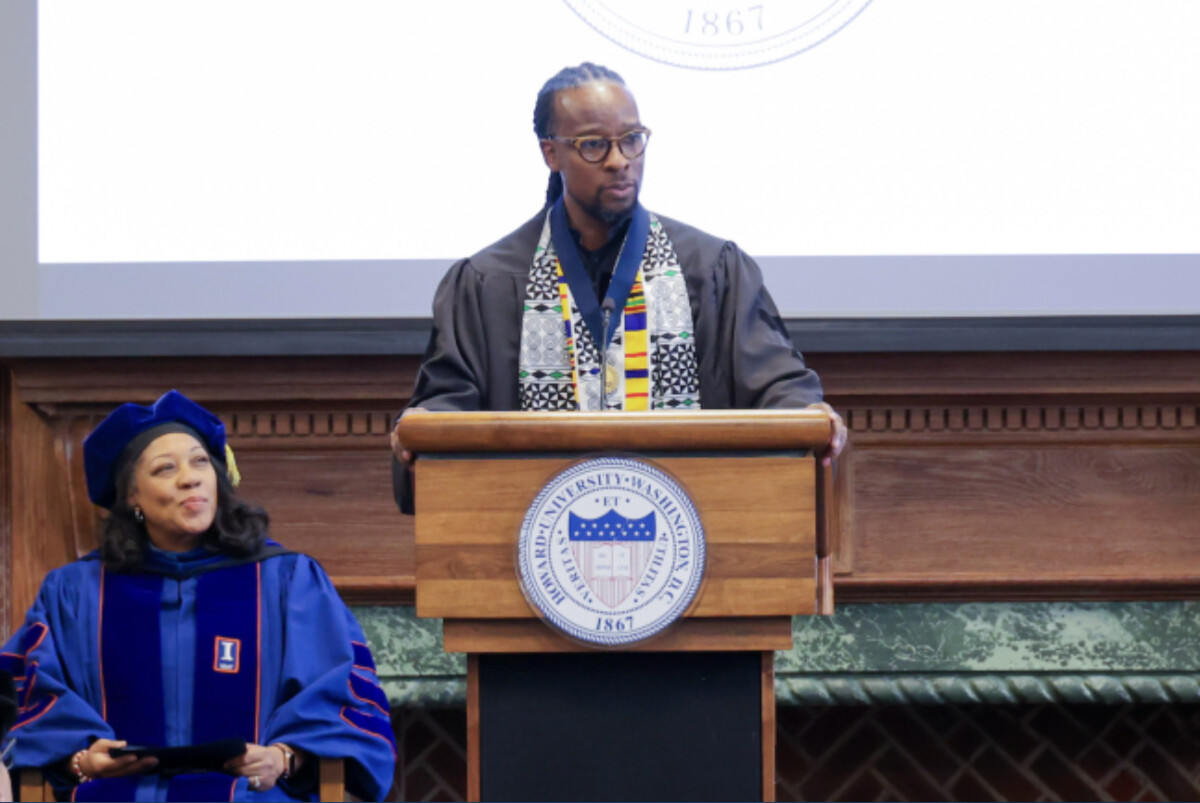
As “Pomp and Circumstance” played through the speakers, the first floor of Founders Library fell quiet. A line of university officials entered in academic regalia, followed by Ibram X. Kendi, Ph.D., and his wife, Sadiqa, in coordinated kente cloth. As they took their seats on the dais, the crowd followed a motion to be seated, marking the beginning of the ceremony.
One year after Kendi’s hiring at Howard University was announced in January 2025, a move that reportedly shocked faculty and drew national attention, Kendi was formally installed as the inaugural Carter G. Woodson Endowed Chair in the College of Arts and Sciences. The bestselling author of “How to Be an Antiracist,” rose to be a leading voice during the 2020 racial justice movement sparked after the murder of George Floyd. Since then, his scholarship has inspired both praise and criticism, becoming shorthand in political debates over what opponents call “woke” ideology. Now, his work finds a home at Howard, a move that Kendi hopes will bring donors, researchers and a renewed focus on history and scholarship.
During the investiture, which the Interim Provost and Chief Academic Officer Dawn Williams called “an affirmation of legacy and declaration of values,” speakers framed the appointment as a roadmap honoring both Howard’s intellectual legacy making clear the mission going forward. Each speaker was more assured than the last. In speech after speech, Woodson’s life and scholarship framed the moment, serving as a reminder of the standard Kendi now inherits. It culminated with a fiery speech from Kendi reminiscent of a pastor on Sunday.
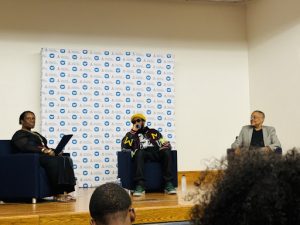
Earlier that morning though, Kendi sat in a corner surrounded by books feeling slightly unsure.
“I’m really excited that Dr. Woodson’s legacy and his scholarship is going to be recognized permanently at Howard University, a place where he was a professor and a dean,” Kendi said. “But also, frankly, there’s also a level of nerves because sitting in his chair, you want to do right by his legacy.”
It’s a legacy that means something. Woodson is known as the father of Black History Month. He authored “The Mis-Education of the Negro” and founded the Association for the Study of Negro Life and History in 1915, laying the groundwork for what would become Black History Week in 1926. Born in 1875 to formerly enslaved parents, Woodson later earned a Ph.D. from Harvard University, becoming the second Black American to do so after W.E.B. Du Bois and the first descendant of enslaved people to receive a doctorate in history there.
Throughout the ceremony, Woodson’s warning about historical control was invoked repeatedly. His arguably most cited line from “The Mis-Education of the Negro” was quoted again and again: “When you control a man’s thinking, you do not have to worry about his actions. … He will find his proper place.”
That theme anchored much of Kendi’s remarks:
“How do we reestablish the foundation of thinking at a time when history is under attack? When historical memory is being bombarded with lies, when history books are being snatched off shelves, when historical institutions are being compelled to close their doors, when historians are being framed as overly political for challenging the propaganda that masquerades as history? Well, we can look to Dr. Woodson.”
His remarks come during a time when debates over how race and racism are taught have intensified in America. PEN America has documented thousands of book bans across U.S. school districts since 2021, many involving titles that address race or systemic inequality, including Kendi’s own text. Several states have passed or proposed legislation restricting how educators discuss racism and American history. In that climate, an endowed chair in Black history at the nation’s leading Historically Black University carries political weight beyond campus boundaries.
Kendi, an HBCU graduate from Florida Agricultural and Technical University, recognizes the significance of his presence, not just for his work, but also for the attention his work brings.
“As an academic, the more I recognize my platform gives me the ability to bring resources to a university, the more I realized that I wanted to bring resources and build an institute,” Kendi stated.
Prior to his appointment at Howard, Kendi served as founding director of the Center for Antiracist Research at Boston University, an initiative launched in 2020 to address what the university described as the “seemingly intractable problems of racial inequity and injustice.”
In 2023, the center came under scrutiny following staff layoffs and public questions about the management of its $55 million budget. Some former employees alleged financial mismanagement, though Boston University later released a statement saying it found “no issues” with how the center’s funds were steered. Kendi attributed much of the backlash to racial bias and resistance to antiracist work.
Now at Howard, Kendi is positioning his next chapter as both a continuation and an expansion of that mission.
His appointment coincides with the launch of Howard University’s Institute for Advanced Study, which he will direct. The institute will house a residential fellowship program aimed at supporting scholars and creators engaged in race-based research. In addition to mentoring fellows, Kendi plans to teach graduate courses, host campus-wide events and coordinate content for The Emancipator, a digital platform he co-founded that, as he describes it, “seeks to cover the scourge of racism and the anti-racist efforts to ameliorate it.”
Together, the roles signal Howard’s investment not only in Kendi as a scholar, but also in the broader infrastructure of antiracist research and public scholarship.
Halimah “Lima” Abdullah, managing editor at The Emancipator who has been involved in the magazine’s transition to Howard, described the work as grounded in historical framing.
“We’re looking forward to doing the first wrap of history, which I consider the to be the news with a through line towards history. That’s how we best understand what’s happening now,” she stated, adding gleefully,
“We are so excited.”
Along with excitement, is a worry from some in the Howard community concerned that Kendi’s platform and controversial past will bring unwanted attention to the university in a time when higher education has come under vicious scrutiny for DEI-based practices.
To those concerns Kendi’s response is simple. “I’m a scholar,” he stated. “I’m going to continue to produce research-based knowledge that oftentimes has political implications, which may not always be particularly liked by those in positions of power.”
Kendi’s appointment as an endowed chair represents the university’s confidence and backing of his ideas and scholarship. Endowed chairs are among the highest academic distinctions, often accompanied by dedicated funding and long-term support. In his remarks, Kendi called explicitly on donors to make broader investments in faculty research.
“Yes, to support scholarships to students,” Kendi stated, emphasizing, “but also to support the scholarship of faculty.”
Interim President Wayne A.I. Frederick described endowed chairs as “a statement of confidence, permanence and purpose,” adding that they affirm a scholar’s work as shaping “the future of knowledge, inquiry and leadership.” He called Kendi “one of the nation’s foremost historians” and argued that his presence strengthens Howard’s historic mission to produce “truth, leadership and solutions grounded in justice.”
At the end of Kendi’s speech, he took the audience away from the pulpit back to a phone call he had with Frederick, a surgical oncologist, almost eight years ago when he was undergoing treatment for colon cancer.
“I didn’t think I would have many steps left as a Stage 4 colon cancer patient,” Kendi said. He underwent surgery two years before actor and Howard alumnus Chadwick Boseman died from the same disease, a loss he described as leaving him with survivor’s guilt.
“And so, my stand in gratitude here today is because I take nothing and no one for granted. I could easily not be here.”
Despite early concerns that some within the Howard community might resist his work, Kendi said he remains committed to his mission. “Antiracist work is applicable to even a Black space where there are many different Black groups, and it’s important for us to all see ourselves as equals,” he said.
He also made clear that the move feels personal. “As a historian of Black thought, being here feels right,” he added, referring to Howard as “the Mecca.”
For Howard, installing Kendi as the inaugural Carter G. Woodson Endowed Chair is a symbolic alignment with its past and a forward-facing investment in its intellectual influence. At a time when the teaching of race and history remains fiercely contested across the country, the university has not retreated from the debate, but it has stepped squarely into it.
The question now is not simply what Kendi will build, but whether Howard will fully stand behind the vision he advances, and what it will mean to claim a “proper place” for race-based scholarship in an era determined to challenge it.
Zoe Cummings covers education for HUNewsService.com. A graduating senior in the Annenberg Honors Program at Howard University, she is also the editor-in-chief of Cover 2 Cover Magazine.