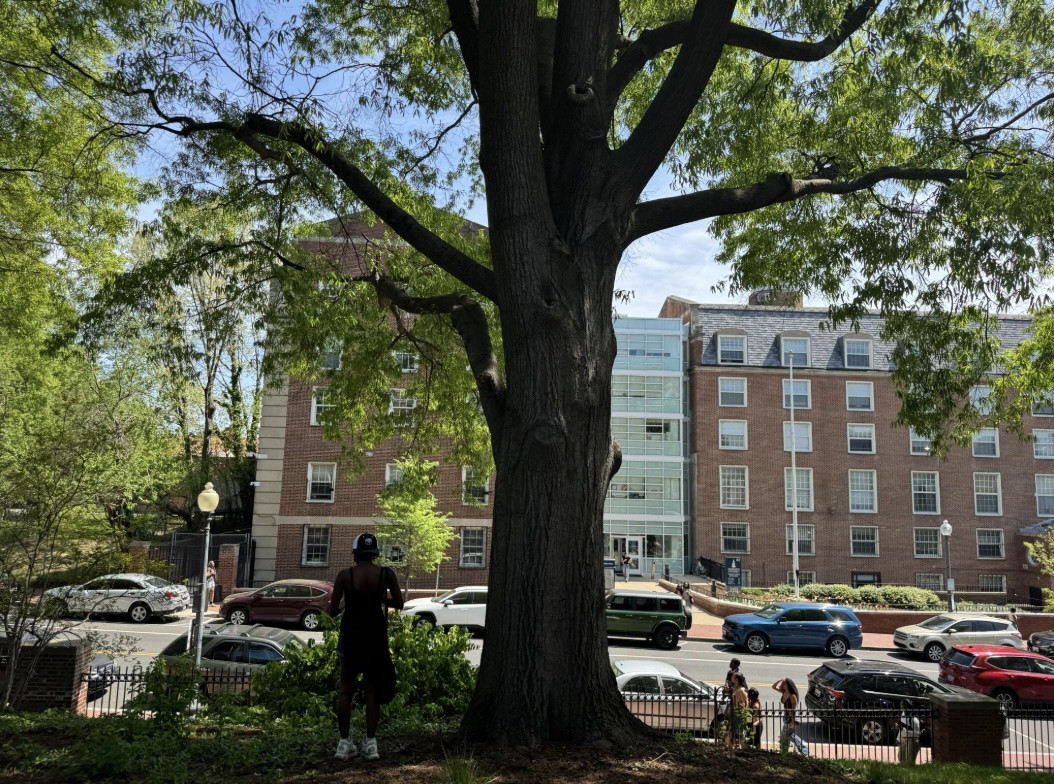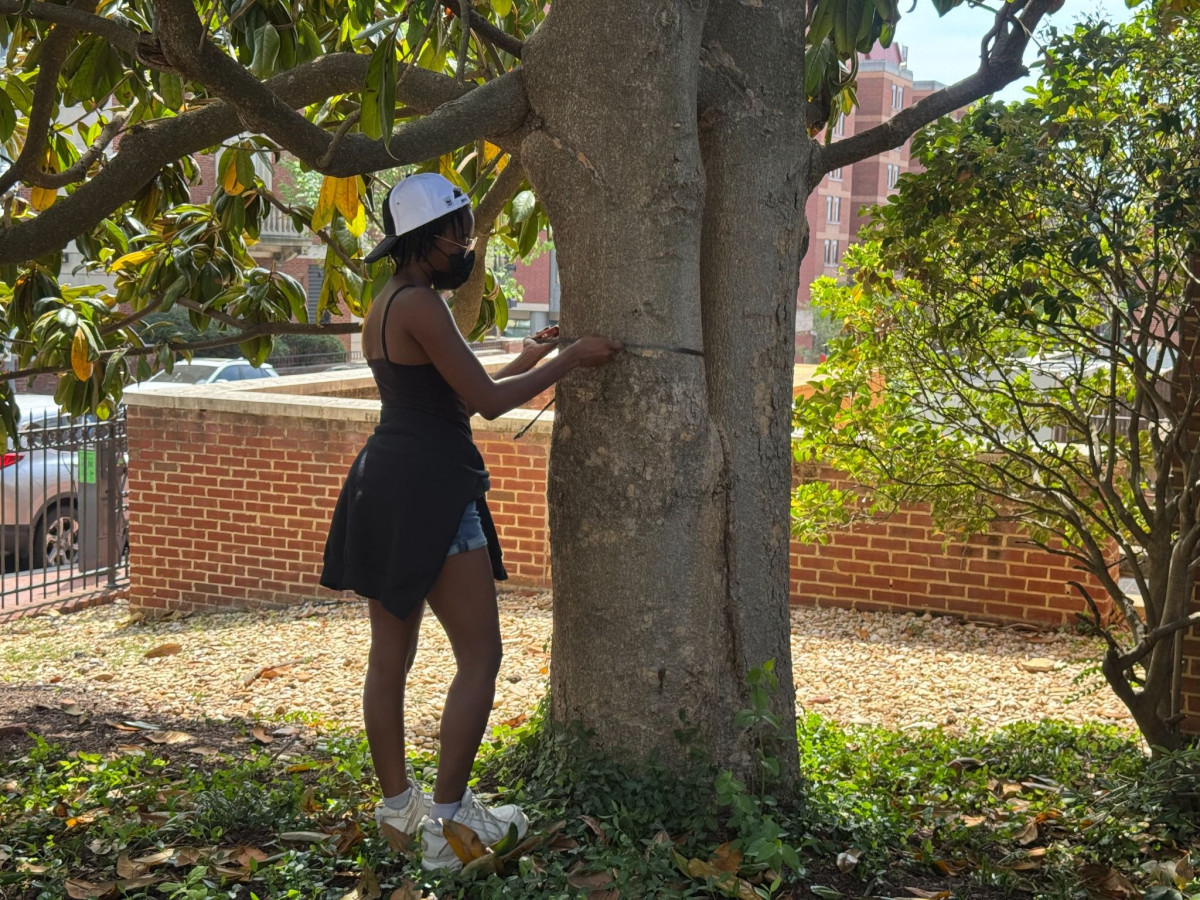
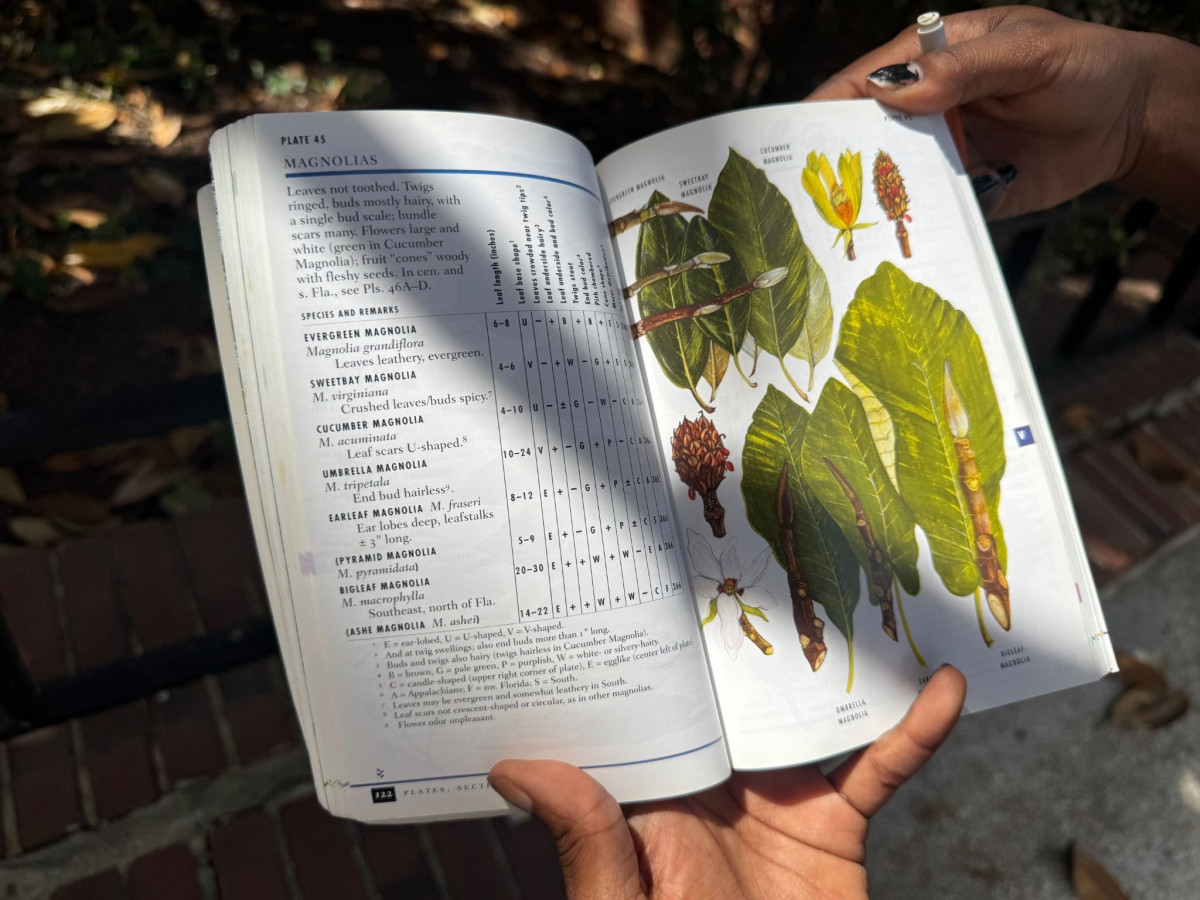
On a sunny spring day at Howard University, Kiera Hale, an honors environmental studies student, approached a tree in “The Valley,” home to the science buildings on campus. She did not have to observe the tree for long before determining it was an evergreen magnolia, but she pulled out a book, “A Field Guide to Eastern Trees,” to confirm.
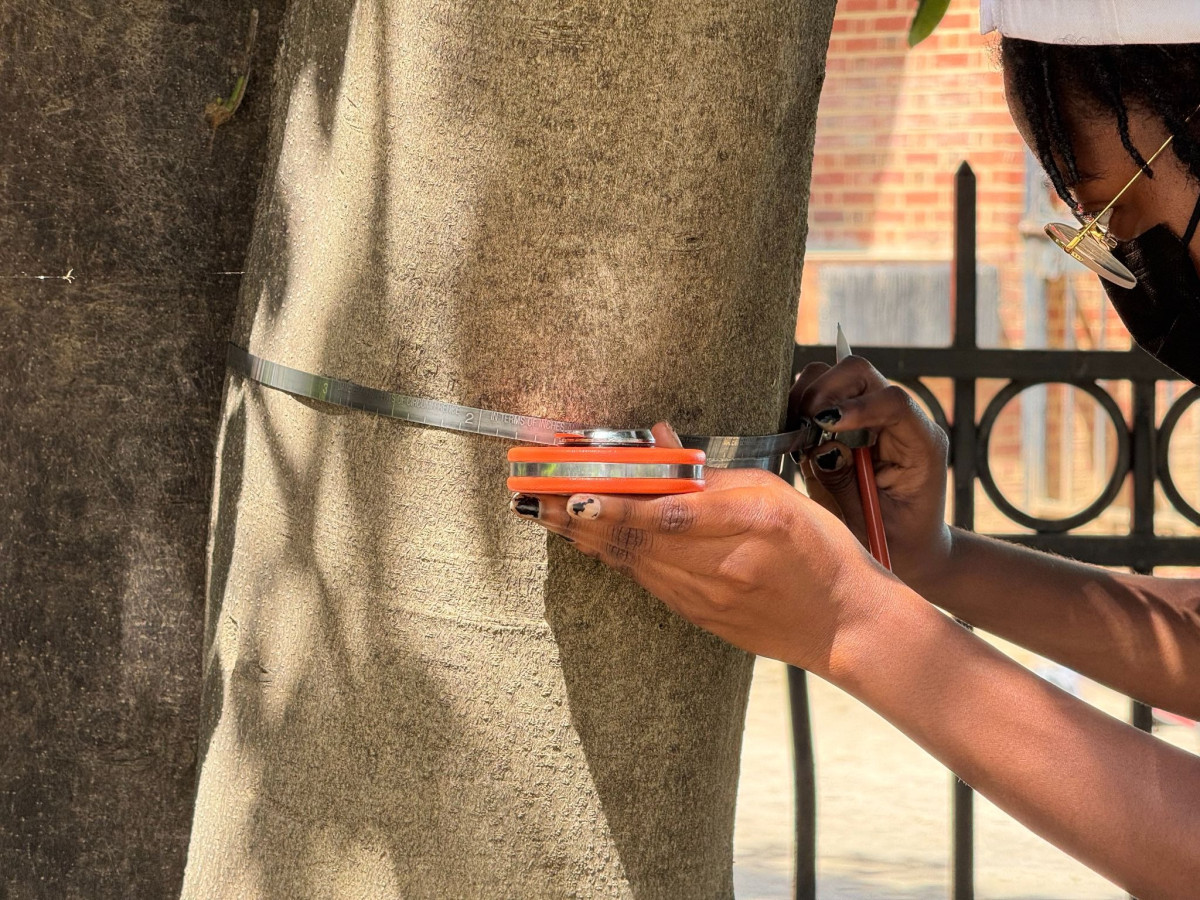
Then, she climbed over the small fence before her. Using a special tool called a DBH tape, she identified the tree’s Diameter at Breast Height (DBH), the standard measurement of a tree’s trunk diameter. She recorded this number in her field journal, along with the tree’s scientific name, “Magnolia Grandiflora.”
This marked the 142nd tree she logged in her honors thesis project, called the HU Tree Survey, cataloging all trees on Howard’s campus. This is called “geotagging,” collecting geographical data like longitude, latitude and, in this case, trees’ species and DBH. The data can eventually be mapped, analyzed and visualized in Geographic Information Systems (GIS).
“My goal with this part of the project is just to get that baseline information on what trees we have on campus,” Hale said. “Then by putting it into the GIS map, I’m hoping that it can become something that lives on. Other students can add onto it later, and they can also access it for research if they want to do that after I graduate.”
Hale belongs to the seventh cohort of the Karsh STEM Scholars Program. She started designing the project in October and started collecting data in late February. The idea came from similar projects and a gap she noticed with tree mapping in Washington, D.C.
“Schools like American University, Georgetown, George Washington, a lot of them have their trees mapped out already,” she said. “American University, they have an arboretum, so they have a research collection.”
Other schools, like George Washington University’s tree data, are included in broader efforts to map the city. Casey Trees, a nonprofit, mapped the majority of the trees in the District’s public spaces, including streets, parks and open campuses. However, the trees on Howard’s inner campus are excluded from this, as it is a private institution.
When she’s done collecting the data she hopes to include her findings in Casey Tree’s broader D.C. map as well as analyze it to better understand the campus ecosystem and biodiversity, specifically what they provide to students and the community.
“The broadest goal is to compare the ecosystem services that we get from our trees on campus, to the ecosystem services that other college campuses in the area get,” she said.
She uses distinguishing characteristics like leaves and fruits to identify tree types. It’s not always as easy as it was with the evergreen magnolia. Sometimes she turns to i-Naturalist, an app that helps with tree identification. Others, she requires assistance from Janelle Burke, Ph.D., who provides botanical expertise in surveying and databasing.
“Some of the largest and oldest trees are oak trees, as we saw, the willow oaks,” said Burke, interim chair of the Department of Earth, Environment and Equity (E3). “We have a neat diversity, too, of other native plants. This is an elm, for example. The Nupe’s tree is an elm,” a reference to the nickname for the Kappa Alpha Psi fraternity.
“This is called a bald cypress, which is a really common tree, very important for ecosystems more in the bayou in the south, around the Gulf of Mexico, but it’s thriving here.”
Some trees are marked with numbers, which Hale believes is connected to a historic survey someone conducted at Howard. She said the survey has transformed the way she views campus. One tree in particular, a crepe myrtle, she has identified frequently on campus, stood out to her for its bright pink flowers and multiple trunks.
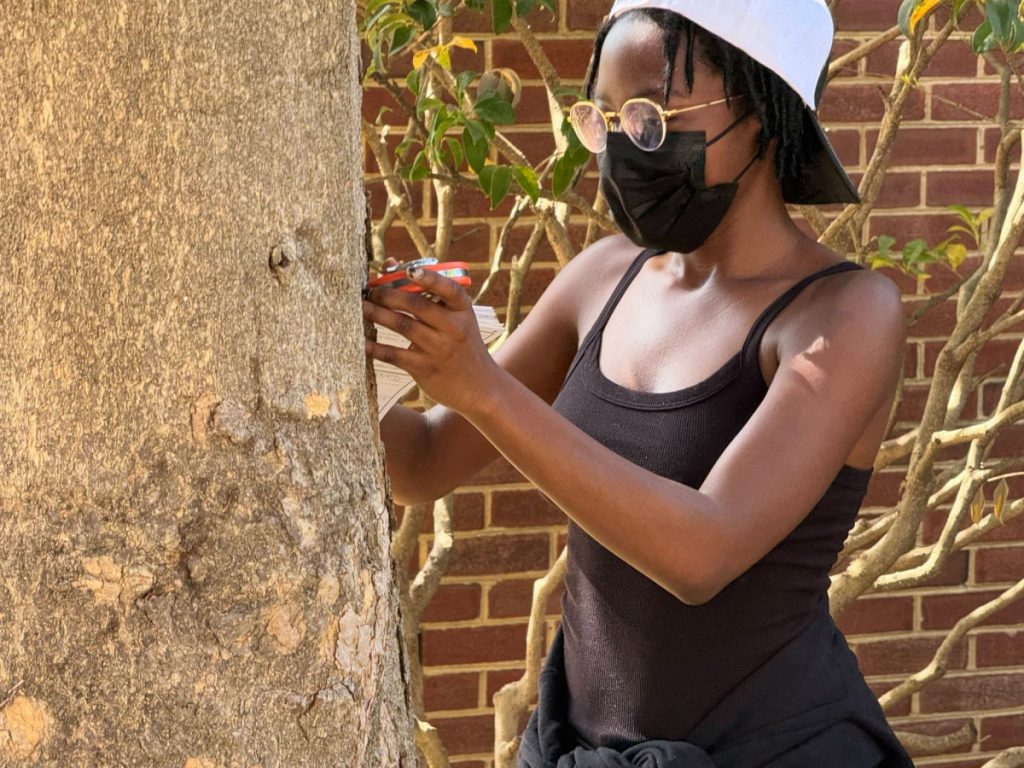
“The most fun thing about this has just been seeing campus in a new light.” — Kiera Hale
“I haven’t analyzed, so I don’t have any proper results yet, but there’s one tree that I saw a lot of that I just never really noticed before,” Hale said. “I feel that’s the most fun thing about this has just been seeing campus in a new light, because you notice so many little things when you’re doing a survey.”
The process has had a few challenges. Hale has had to come up with strategies for measuring trees with multiple trunks and is navigating the best way to approach the trees that belong to the Divine 9 sororities and fraternities on campus. Burke says that exemplifies why this work is important.
“I think what’s really great is when she publishes this research, she’s gonna talk about the cultural relevance, the significance about certain trees on HBCU campuses,” Burke said. “So, it’s not just a standard campus tree survey.”
Lemir Teron, Ph.D., who has expertise in urban forestry and assessing the value of green space for communities, is also advising Hale on the project. The project goes beyond science, with real implications for students, allowing them to engage with and understand the environment around them by making information accessible to them.
“When you’re sitting on The Yard, and you’re enjoying the shade of a tree, look up and think, ‘Oh, what is this tree? How long has it been here?’” Burke said. “And then you could find the answer to that, but also appreciate some of the services they’re providing, because the shade trees are very important for students actually being supported and cool on campus.”
Hale aims to work in forestry research after college, particularly the importance of trees in urban areas inhabited by marginalized communities. In May, she will present her progress at Yale University and then continue her work before analyzing for information and results.
Sydney Goitia-Doran, editor-in-chief of The Hilltop, is an environmental studies minor.