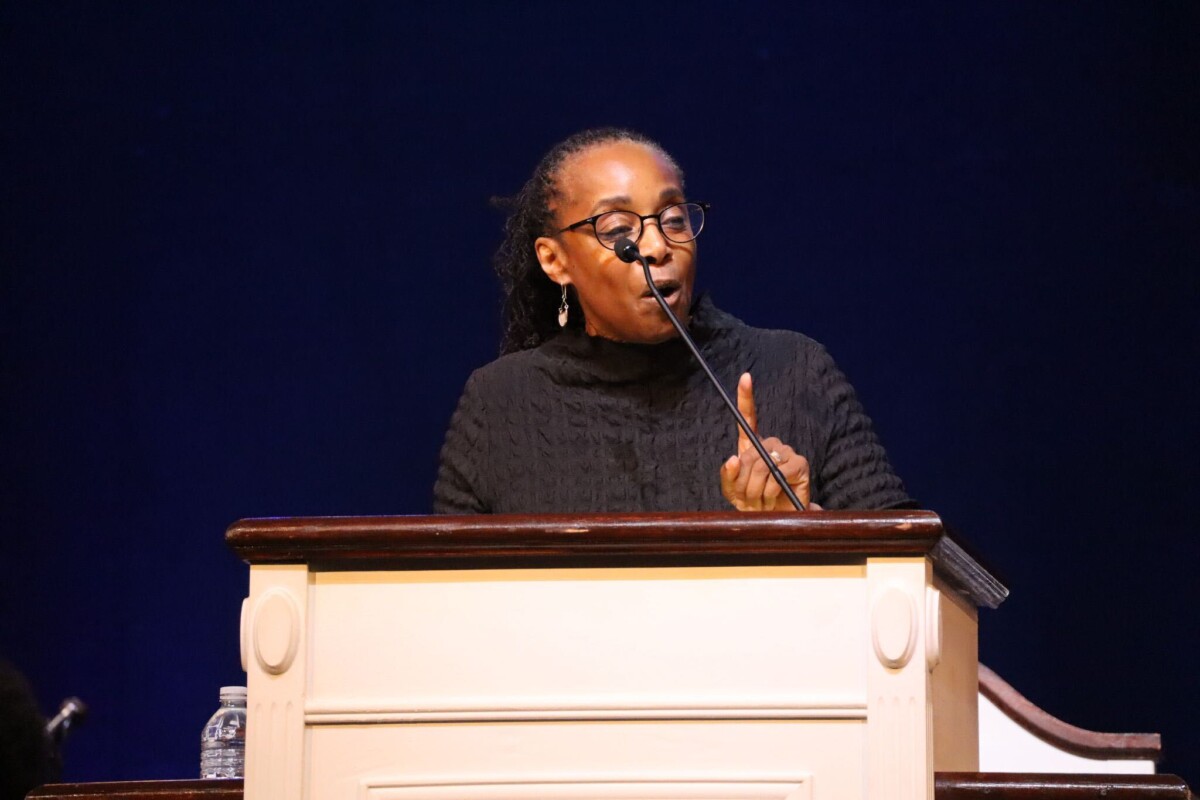
WASHINGTON (HUNS) – On the second Sunday service of the semester at the Andrew Rankin Memorial Chapel at Howard University, Rev. Judy Fentress-Williams, called on the Black church to be more steadfast in its efforts to elevate Black women to the pulpit.
On August 30, the renowned biblical scholar and senior teaching assistant of the Alfred Street Baptist Church in Alexandria, Virginia, spoke on the Biblical parable of the mustard seed with her sermon titled “Think Small”. Her sermon urged young people not to abandon their purpose in pursuit of accolades, but instead to pursue freedom and belonging without having to prove themselves to do so. This sentiment proves to be a difficult one for Black women who wish to become senior leaders.
“Because of the unique context that was Alfred Street Baptist Church, I didn’t get pushback because I was a woman,” Rev. Fentress-Williams said. “What I will say is that I think I was slow to answer my call to ministry, and that’s typical for many women. Many women hear a call to ministry and say, no, that’s called a teacher.”
Despite teaching for 20 years, her journey into ministry illustrates the lack of acceptance for women to fully pursue their calling.
According to the Pew Research Center, 73% of Black adults identify as Christians (65% being Protestant, 4% being Catholics, and the other 4% associated with the Church of Jesus Christ of Latter-day Saints and Jehovah’s Witnesses). However, Black women who make up 64% of congregations within the Protestant faith only account for 1% of senior leadership.
The disparity highlights how the Black church remains patriarchal in its authority. Rev. Kelly U. Farrow, founder of the Circle of Sacred Fire, a non-profit initiative that connects the 1% and dismantles those patriarchal beliefs.
Since 2018, the organization has curated teachings in sermon design and sisterhood for Black women. The organization has 58 circles nationwide, including collegiate chapters.
“[It] is critical because representation matters. We need to see every diversity, every gift, every voice, every shade, every age group in leadership at this time. Without representation, we are only singing and sharing half the song.” Rev. Farrow said.
Representation remains critical for younger generations already experiencing the pushback. Andrea Pool, president of Howard’s Community Gospel Choir, says being a young woman holding the highest position in the organization has made others question her ability to lead.
“I think coming to D.C. definitely just exposed me to a lot because with me being raised by people who were in the church, with my mom being a minister,” Pool said. “I didn’t realize there was another world out there that didn’t appreciate having females in leadership.”
The choir forges an acceptance of many Christian beliefs amongst members to stand on biblical principles. However, Pool is adamant about leaning on women leaders, like her mother, to remind her that identity and relationships alone are not what will make her a great leader.
“I think women in leadership can take younger generations, honestly, everywhere. I think in [the] church it is important to understand that men aren’t the only people who can lead. They aren’t the only people who can bring people to Christ.” Pool said.