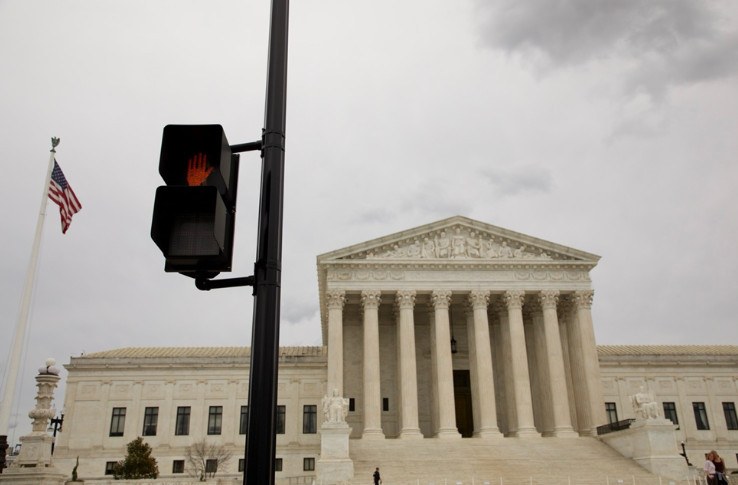
On Feb. 20, the U.S. Supreme Court ruled 6-3 in Learning Resources Inc. v. Trump that President Donald Trump was not authorized to impose sweeping tariffs under the International Emergency Economic Powers Act (IEEPA).
IEEPA, created in 1977, authorizes the president to act during a national emergency to regulate commerce, freeze assets or impose economic sanctions. Trump used the law, declaring national emergencies to bypass Congress and impose tariffs, sanction foreign entities and threaten economic action.
“The decision to…move very quickly to both impose tariffs and then increase those tariffs [has] injected new lines of uncertainty and a lack of predictability to markets…that doesn’t serve the United States economy or those market participants as well,” said Eric Morrissette, a senior fellow at the Joint Center for Political and Economic Studies
The ruling carries national significance, as it not only reshapes consumer prices and business costs but also redefines the limits of presidential authority over trade and signals a broader shift in United States economic and global policy.
On Feb. 24, Trump signed a proclamation under Section 122 of the Trade Act of 1974 to address “fundamental international payment problems.”
The proclamation imposes a 10% global import surcharge, implemented for 150 days.
Tariffs imposed under Section 122 require congressional approval to continue beyond 150 days, making them a temporary replacement for the invalidated IEEPA tariffs.
Approximately 90% of tariff costs were paid by businesses and consumers in the United States, not in foreign countries. Businesses that rely on imports saw input costs rise.
“At the end of the day…we all receive the repercussions behind their actions,” said Tony Barnes, co-owner of Oohh’s & Aahh’s.
After the IEEPA tariffs were struck down, companies can seek refunds totaling $130 billion to $175 billion.
On March 4, in Atmus Filtration v. US, the U.S. Court of International Trade (CIT) ordered U.S. Customs and Border Protection (CBP) to refund unlawful IEEPA tariffs.
CBP issues refunds electronically via Automated Clearing House (ACH).
Refunds are primarily available to importers of record that paid the tariffs and are registered in the Automated Commercial Environment (ACE) system.
For court-ordered refunds, CBP uses the Consolidated Administration and Processing of Entries (CAPE) system to manage, track, and process tariff refund claims.
The Supreme Court only struck down tariffs imposed under IEEPA.
Trump’s tariffs, including tariffs imposed under IEEPA before it was invalidated, have impacted businesses across the country, including Black-owned businesses.
Black-owned businesses are not able to handle rising costs and the economic uncertainty, like other businesses, because of their smaller size, limited financial resources and concentration in import-dependent and customer-facing industries.
According to the Center on Budget and Policy Priorities, tariffs increased input costs, leading Black-owned businesses to raise prices, cut staff or both.
Higher input costs disproportionately affect Black small businesses, as they often operate on narrower profit margins and have less access to capital than white-owned businesses.
Approximately 52% of Black-owned businesses experienced a decline in sales due to tariffs.
“The prices have changed…they’re going up,” said the manager of JC Lofton Tailors, who goes by Shoemaker to customers. “Then you have to go up on your customers, and you don’t want to lose them.”
Trump’s tariffs affected everyday people, with some populations being more vulnerable, such as the Black community.
“There are real people on the other side of this, who have both their life and their livelihoods tied into the decisions that are being made,” Morrissette said. “I think they all deserve the respect and the honor of being considered before a rush of action. Which seems to have been the case.”
Armani Durham is a reporter for HUNewsService.com