In Washington, D.C., where opportunity often depends on where you grow up, a coalition of nonprofits is working to change what the path from school to career looks like for young adults. For many students, the transition into adulthood is not a straight line. It is filled with uncertainty, limited guidance and systems that do not always connect.
The Talent for Tomorrow Alliance was created to address that gap by linking organizations that traditionally operate separately into a coordinated pipeline to employment.
The alliance brings together Spark the Journey, Year Up United, New Futures, Genesys Works and Per Scholas, each contributing a different piece of the workforce development process. Some focus on academic support or college access, others on technical training or internships, and others on policy or long-term career development.
Together, the goal is to move young people from high school into stable careers with fewer gaps in support along the way. The model was formed between 2018 and 2020, as leaders recognized that disconnected programs often left students to navigate complex systems alone.
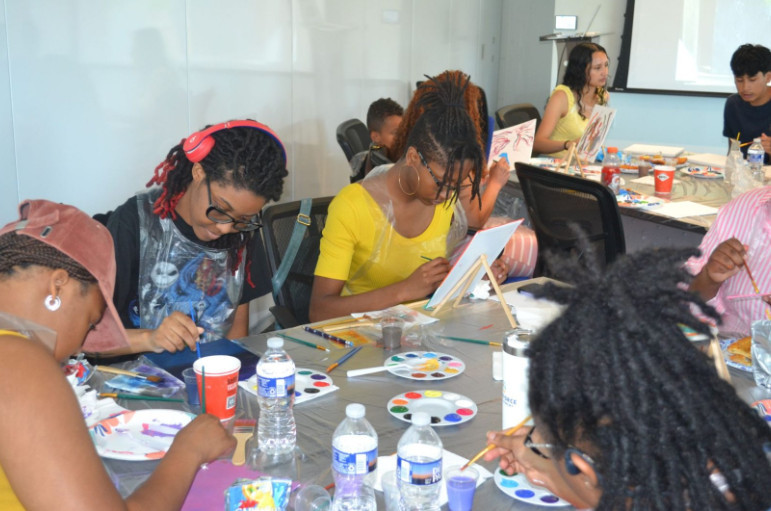
“Being first-generation and low-income, I had to figure everything out by myself. You don’t really know who to go to… it was challenging trying to figure out what education I needed and what I could afford,” said Jennifer Ventura, a former participant in the program who now works as a Program Manager at Spark the Journey.
At the center of the alliance is Spark the Journey, a mentoring organization that holds the core belief that relationships are often the difference between stagnation and mobility.
Rather than only focusing on job skills or academic achievement, Spark emphasizes social capital, meaning the networks, mentors and relationships that open doors to opportunity.
For Chief Executive Officer Dr. Brandon White, the challenge many young people face is not a lack of talent or ability. It is a lack of exposure and guidance.
“The biggest barrier tends to be not knowing really where to begin,” White said. “Or not having the support structure in place to know what it is that you need to do next.”
Spark the Journey pairs students with mentors as early as high school. Those mentors often remain in students’ lives through major transitions, including college enrollment, internships and early career experiences.
Unlike traditional workforce programs that focus primarily on short-term job placement or technical instruction, Spark’s model is built around long-term relationships.
“I wanted more one-on-one interaction. I wanted a space where I could ask specific questions and either get guided or at least be connected to someone who could help,” Ventura said.
The mentoring model becomes even more powerful within the Talent for Tomorrow Alliance. Instead of students having to navigate separate programs on their own, the alliance connects those programs into a more unified system.
Each organization contributes to a different stage of the journey. A student might begin with mentorship through Spark, move into career readiness or academic support through another partner and then enter technical training or an internship program through organizations like Year Up United or Per Scholas.
White describes Spark as the connective tissue that helps students move between key stages, including the transition from high school to college, from college into internships or workforce training programs, and from those early experiences into full-time careers, without losing support.
“The things that impede economic mobility are too great for any one organization to tackle alone,” White said. “We are better off recognizing our strengths and figuring out ways we can enrich one another’s work.”
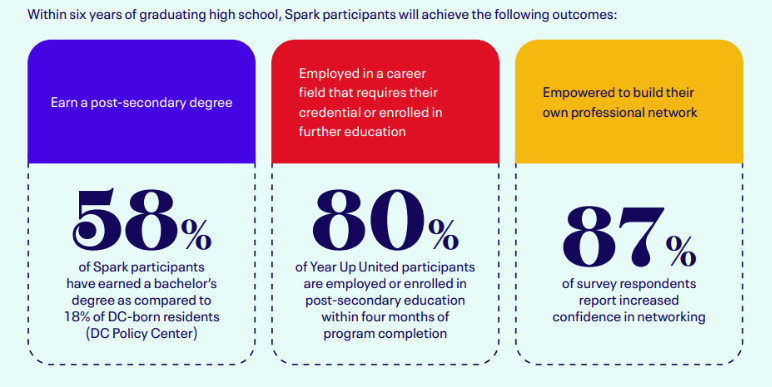
A student’s experience in the Talent for Tomorrow Alliance system of partner programs depends heavily on where they enter the pipeline. Some begin as high school students, unsure of their futures. Others enter later, after graduating, seeking job training or career direction.
In both cases, the transition points are critical. These moments, such as graduating high school, entering college or starting an internship, are often where young people are most likely to lose direction or fall behind.
Mentors in the Spark Your Journey model play a central role during student transitions, supporting career exploration, interview preparation, academic decision-making, and confidence-building in unfamiliar environments.
The support is not limited to academic or professional advice. It often includes personal encouragement and guidance during moments of stress or uncertainty.
“I had to transfer schools because of financial difficulties,” Ventura said. “My mentor told me we would pivot and figure it out, and helped me map everything in an Excel sheet with schools, scholarships and options.”
One of the most important aspects of the Spark model is trust. Mentors are not supervisors or employers. They are outside the formal systems that students interact with in school or work.
Because mentors are not supervisors or employers and operate outside of formal school or workplace systems, students are able to speak more openly about challenges they are facing without fear of judgment or professional consequences.
“If you do not have that baseline level of trust, you might not necessarily take that advice,” White said.
That trust becomes especially important when students enter internships or workplace environments for the first time. Many are navigating professional expectations, financial pressures and unfamiliar environments simultaneously. Mentors help them interpret those experiences and stay grounded as they adjust.
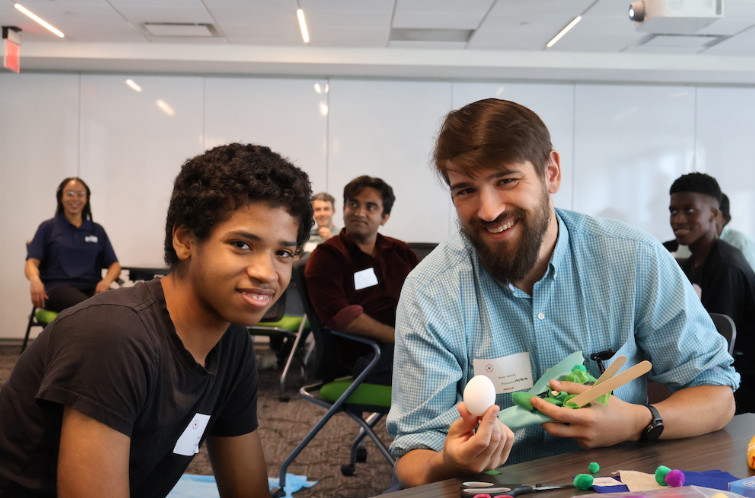
“It turns into more personal support, too. They’re like your big brother or big sister. That person you can go to no matter what,” Ventura said.
While exact outcomes vary by program, leaders point to persistence as one of the most important indicators of success.
White often describes Spark as operating in the “persistence business,” meaning the goal is not just to help students begin opportunities but to ensure they continue through them even when challenges arise.
That persistence can be the difference between a short-term job and a long-term career trajectory.
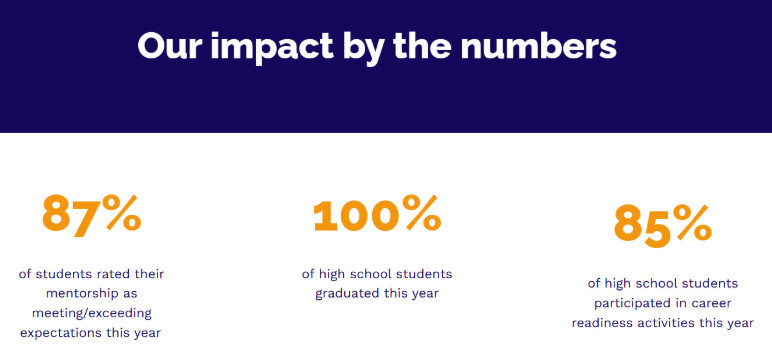
“I don’t think I would be in the career field I am in now if I hadn’t gone through this program,” Ventura said.
Despite its successes, the model is not without challenges. Because the system relies heavily on human relationships, it is difficult to standardize.
Mentors and staff often find themselves addressing issues that extend beyond education or employment, including transportation barriers, housing instability, family responsibilities or mental health challenges. These factors can disrupt progress even when students are highly motivated.
“There is very little opportunity for us to rinse and repeat,” White said. “Our young people are dealing with things. Our volunteers are dealing with things.”
This unpredictability is one of the ongoing limitations of mentorship-based systems. While they provide flexibility and emotional support, they also depend on consistent engagement from volunteers and staff, which can vary over time.
Additionally, while programs like Spark and the Talent for Tomorrow Alliance improve access to opportunity, they cannot fully eliminate broader structural issues such as economic inequality, housing insecurity or unequal educational resources.
“There were moments where I had to figure out school, money and life all at once. But I always had someone helping me think through it,” Ventura said.
Even with those challenges, leaders within the alliance see the model as a step toward a more connected and supportive workforce system.
Instead of expecting young people to navigate disconnected programs on their own, the alliance attempts to build a coordinated pipeline that follows students over time and across institutions.
Year Up United provides workforce training through classroom instruction and paid internships that prepare participants for corporate environments.
New Futures supports college access by offering scholarships, advising, and financial guidance to reduce barriers to higher education.
Genesys Works gives high school students early exposure to professional settings through skills training and internships, helping them build confidence and workplace readiness.
Per Scholas focuses on technology training, equipping participants with in-demand IT skills and industry certifications.
Together, these organizations align mentorship, education, training, and job placement to create a more structured and supported path into the workforce.
To expand that impact, Spark the Journey and its partners are continuing to build relationships with colleges, employers and community organizations.
The long-term vision is a fully integrated system where mentorship, training, financial support and job placement are aligned into one continuous pathway rather than separate experiences.
“I think everyone just needs someone to tell them they can do it. And that community changes everything,” Ventura said.
At its core, the Talent for Tomorrow Alliance highlights a central insight of workforce development. Success is not only determined by skills or credentials. It is also shaped by access to relationships, consistent guidance and support during moments of transition.
For many young people in Washington, D.C., that combination can mean the difference between uncertainty and opportunity.
Grant Roundtree is a reporter for HUNewsService.com