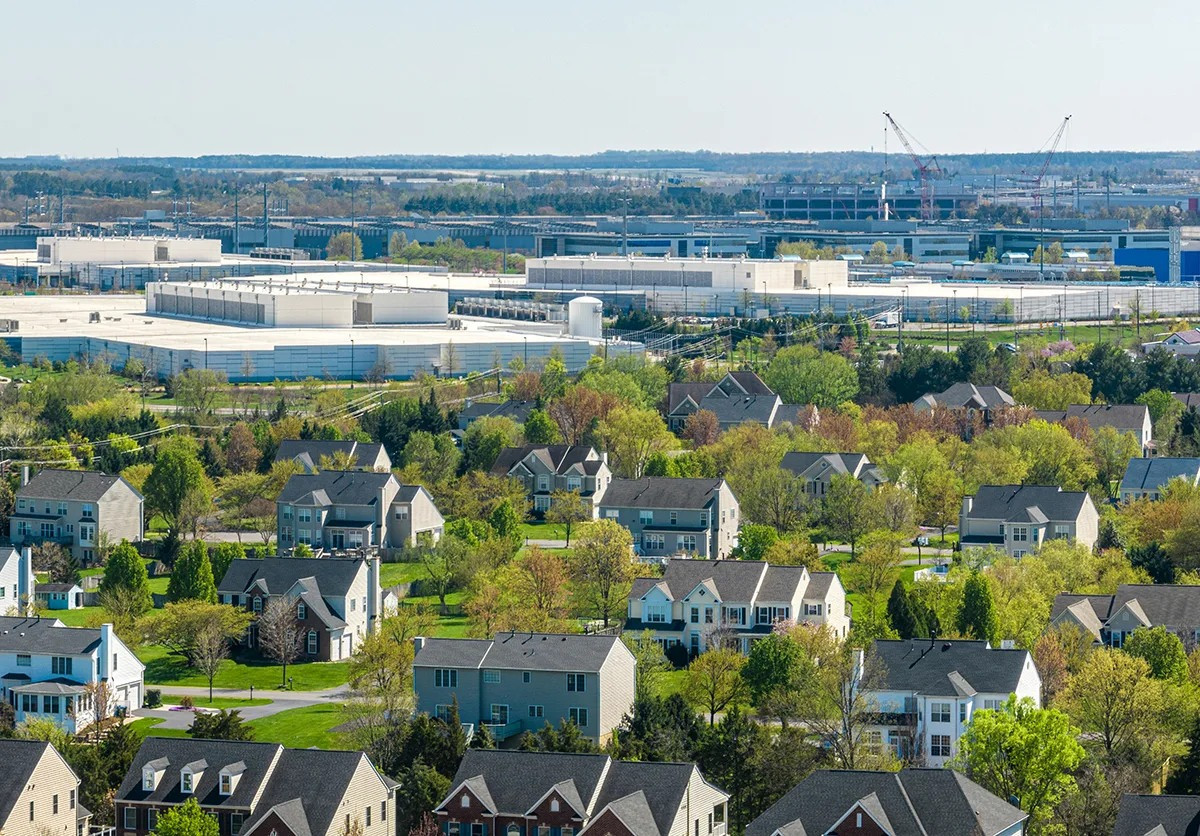
In neighborhoods across the country, massive, windowless buildings are quietly reshaping local economies and daily life. The structures house data centers that power everything from social media to artificial intelligence. But while these supercomputers promise innovation and economic growth, communities are beginning to question what that growth actually costs.
At their core, data centers are physical facilities that store and process digital information. Every time someone streams a video, sends a message or uses AI, that action is supported by servers inside these buildings. To keep those servers running continuously, data centers require constant electricity and cooling systems to prevent overheating.
That’s where the tension begins.
According to the U.S. Department of Energy, data centers already account for about 2% of total electricity consumption in the United States, and that number is expected to rise as demand for AI and cloud computing grows. Cooling these systems also requires significant water use, with some facilities consuming millions of gallons per day.
Despite these concerns, data centers can bring significant economic benefits. In places like Loudoun County, Virginia, often referred to as the “data center capital of the world,” local governments have seen major increases in tax revenue. According to Loudoun County government reports, data centers contribute heavily to the county’s tax base, in some cases helping reduce the overall tax burden on residents.
This creates a complicated trade-off. On one hand, communities can gain jobs, infrastructure investment and tax revenue. On the other, they may face environmental strain, increased utility bills and industrial development that shifts neighborhood character.
“People want economic growth,” said Kamren Cale, a junior at Howard University who studies housing patterns. “But they also want to feel like they still live in a community, not an industrial zone.”

Environmental Defense Fund

Southern Environmental Defense Fund
The placement of data centers also raises environmental justice concerns. “It really is going to be very impactful in black and brown communities, because you have a legacy of environmental harm and environmental degradation,” said Margot Brown, Ph.D., senior vice president of environmental justice and health equity at the Environmental Defense Fund (EDF).
Brown emphasized the importance of “radical listening,” centering the voices of communities most affected by environmental decisions. Her perspective highlights how large-scale developments can disproportionately impact communities when they are excluded from planning processes.
Amanda Garcia, a senior attorney and data center lead at the Southern Environmental Law Center, takes a similar stance. “A big component of SELC’s approach to data centers is community self-determination,” Garcia said. “We’ve just seen a stunning lack of transparency across our region.”