I almost sat in the empty front row.
It seemed strange that nearly every seat in the single-level Bowie Playhouse was filling while the entire first row remained untouched. Maybe it was reserved.
It wasn’t.
Just before the house lights dimmed, the row filled. Its occupants would quickly discover just how close they were to the action.
From the opening number of 2nd Star Productions’ “Pippin,” the Leading Player — part ringmaster, part seductress and part master manipulator — erased the comfortable boundary between audience and stage. The Players promised “sets, costumes, lights and magic,” while those seated closest to the stage quickly found themselves part of the performance.
The intimacy works particularly well inside Bowie Playhouse, where 2nd Star, an all-volunteer community theater in residence with the City of Bowie, stages its productions. The relatively small, single-level room puts the audience close enough to the action that breaking the fourth wall requires little elbow grease.
Director Rooster Sultan’s production centers on Pippin, played by Jonathan Hardin, a young prince convinced an ordinary life cannot possibly be enough. With a long, golden-hued bob and boyishly pink lips, Hardin looks almost painfully innocent.
As Pippin, he is a lost, lonely everyman wandering through a world populated by people far more certain about what they want. He searches for fulfillment in one identity after another — soldier, revolutionary, ruler, lover — only to discover that each promise of an extraordinary life disappoints him.
The pattern becomes almost rhythmic: desire, delusion, disenchantment.
But even as DeWitt’s Leading Player introduces Pippin as the story’s central character, there is little question about who commands the room.
DeWitt immediately dominates.
Funny, believably sassy, seductive and eventually menacing, she towers over the other Players in both stature and personality. A booming voice and sinister smirk make her difficult to look away from, but DeWitt’s strongest choice may be her restraint. In a role that practically invites excess, she does not exploit the full volume of her voice simply because she can. She deploys it selectively, making each eruption feel earned rather than expected.
That control becomes increasingly important because the Leading Player doesn’t merely narrate Pippin’s journey. As the musical progresses, she begins behaving like a director inside the show itself — interrupting scenes, correcting performers and pushing Pippin toward the next supposedly extraordinary chapter of his life.
The ensemble operates almost like a chorus of temptations, constantly reinforcing the idea that something bigger, brighter and more spectacular must be waiting just beyond the present.
That self-awareness produces some of the night’s funniest moments.
Characters break the fourth wall. Performers acknowledge theatrical mistakes. At one point, an ensemble member appears with a prop too early, only to be called out by the other Players. The production gives the audience enough clues to feel clever for recognizing that these characters know they are performing.
Just when it seems the trick has been figured out, “Pippin” reveals another one is coming.
All that knowing theatricality does little to restrain the spectacle.
War becomes spectacle. Murder becomes choreography. Robbie Dinsmore’s Charlemagne plots battle with an almost cartoonish cadence. Musical styles bounce between circus sounds, the smoky theatricality of “Chicago” and the psychedelic optimism of the flower-power era.
The entire cast sings beautifully together and alone. Even performers who step temporarily out of the ensemble seem perfectly at home in the spotlight.
Drea Julette does exactly that as Berthe, Pippin’s grandmother. What initially looks like another Player stepping briefly into a featured role becomes one of the production’s standout turns. Julette’s physical comedy and drunken-grandmother irreverence draw some of the night’s biggest laughs.
Berthe knows she has an audience and wastes little time recruiting it. Lyrics drop from above as she goads spectators into participation, turning her philosophy of living fully into a communal exercise.
Lisa Pellittiere’s choreography works in much the same spirit. It does not depend on technical virtuosity to impress. Instead, the movement is approachable, expressive and useful, carrying pieces of the story that words cannot. The Players shift fluidly between dancing, portraying characters and sometimes becoming pieces of the scenery themselves.
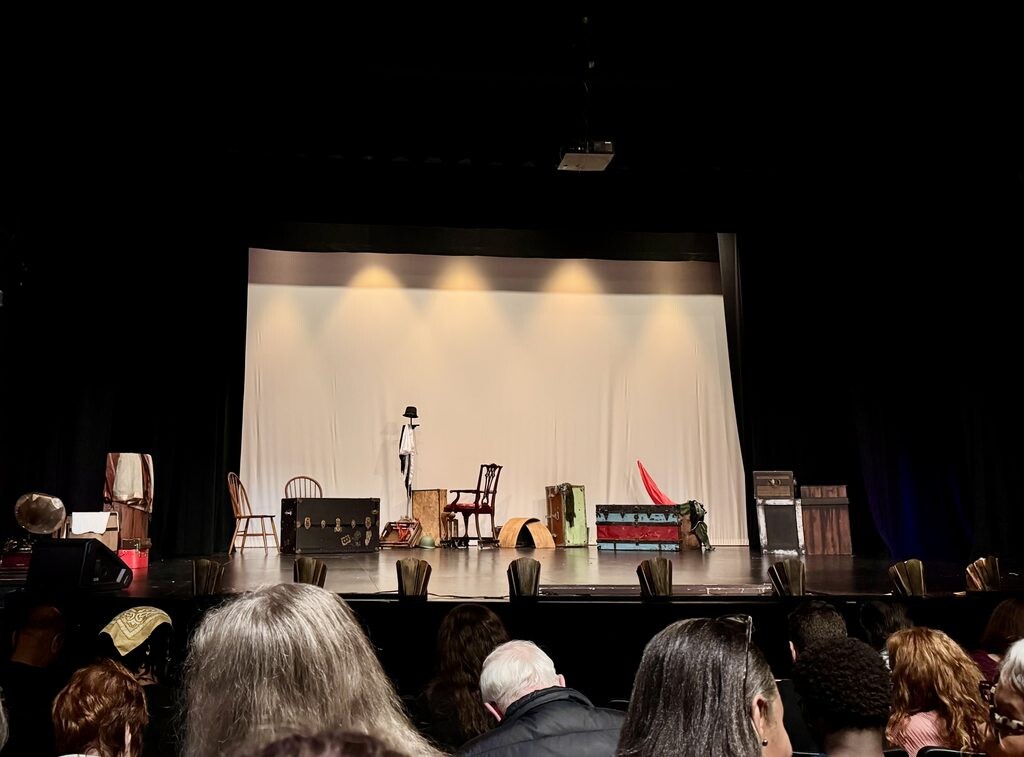
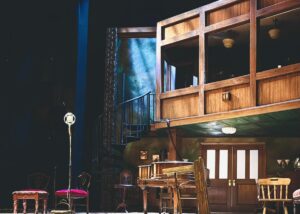
That fluidity suits Collin Griese’s set. Before the performance begins, mismatched trench coats, chairs, boxes and other theatrical odds and ends sit across the surprisingly deep stage, almost like pieces inside a diorama waiting to be rearranged.
The production rearranges and repurposes Pippin just as relentlessly.
Throughout the musical, he keeps mistaking intensity for meaning. He inflates every new possibility into the thing that will finally make his life extraordinary. Every time reality fails to match the fantasy, he abandons it and goes looking for another.
Eventually, the Players offer Pippin the ultimate extraordinary act: a “climax” they promise the audience will never forget.
The word lands first as another of the production’s winking sexual innuendos.
Then its second meaning becomes clear. The price is Pippin himself. It is the turn I didn’t see coming.
Suddenly, the fourth-wall breaking and theatrical manipulation stop being merely clever. The same Players who entertained, encouraged and supplied Pipin with endless possibilities now needed him to sacrifice himself to complete their show.
Pippin refuses.
And that’s when Sultan’s production makes one of the most effective choices.
The magic disappears.
Scenery is removed. Costumes are stripped down. Music vanishes. The theatrical world that promised Pippin significance abandons him when he refuses to perform the ending that was chosen for him.
Griese’s already-deep stage seems to grow deeper as the objects that once filled it disappear. The emptiness stretches behind Pippin, creating the peculiar sensation of feeling lonely in a crowded theater.
Even the Players’ opening promise is reversed. A company that entered offering sets, costumes, lights and magic leaves by ordering the remaining lights out and having the orchestra pack up.
The result is surprisingly intimate for a musical that spends so much time being deliberately loud, sexy, silly and excessive.
Pippin spends the evening searching for an extraordinary life. What remains when the extraordinary is stripped away is considerably less glamorous: love, responsibility, uncertainty and other people.
The ending doesn’t allow even that realization to remain entirely comfortable. Theo, played by Snowdenn Jackson, picks up what the Leading Player leaves behind, suggesting that the hunger for something extraordinary hasn’t disappeared. It has simply found someone new.
Watching that story unfold in a community theater feels fitting.
Outside Bowie Playhouse, two football games on fields across the parking lot competed with theatergoers for parking spaces, sending some cars onto the grass. Inside, the house filled until a staff member asked patrons to move inward and “get comfortable with your neighbor.”
The audience took the instruction almost literally.
The strangers beside me started conversations before curtain. To my left sat David Hurley, a returning Bowie Playhouse patron seeing “Pippin” for the first time. Hurley, who did technical theater at High Point High School, pointed out the orchestra tucked beneath the stage and the rigging overhead.
To my right sat the husband of Meredith Hansen, who plays Pippin’s scheming stepmother, Fastrada, accompanied by friends and flowers. His group’s reaction whenever Fastrada appeared gave her away.
Bouquets wrapped in cellophane appeared elsewhere in the audience, too.
That closeness is part of what distinguishes community theater from simply seeing a smaller version of a professional production. The person onstage may also be somebody’s wife, friend or neighbor. The stranger beside you might share his knowledge of the machinery above the stage unprompted because he once worked backstage himself. A request to get comfortable with your neighbor can actually end with you knowing who your neighbor is.
And in “Pippin,” a play where the characters who are “already in your head” leave you naked and alone, that intimacy becomes particularly appropriate.
2nd Star’s Players spend the evening tempting one young man with possibilities. But an all-volunteer company in Bowie creates the spectacle itself: performers changing identities, musicians beneath the stage, scenery moving around them and supporters rustling cellophane-wrapped bouquets in more than a few seats.
Then the musical strips almost all of it away.
For all its painted smiles, sexual jokes, carnival pageantry and promises of an unforgettable climax, “Pippin” ultimately asks what remains when the lights go out, the orchestra packs up and the promise of being extraordinary — or anything at all — disappears.
2nd Star’s answer isn’t particularly glamorous.
And maybe that’s the point.
La Tetra Metts-Owens is a senior reporter for HUNewsService.com. She covers theater and Prince George’s County.