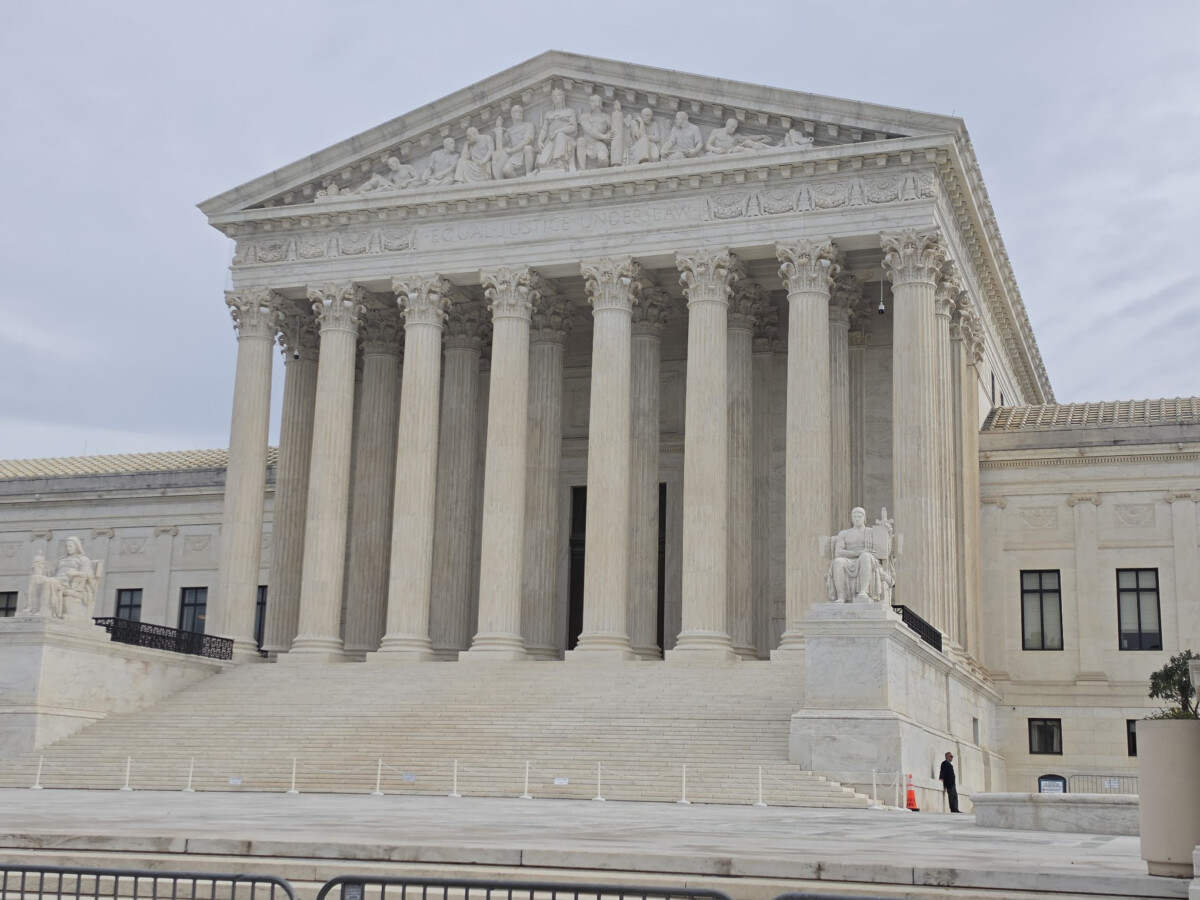
WASHINGTON (HUNS) — On Monday, the U.S. Supreme Court heard the case of Maxwell v. Dinis, which asks if incarcerated persons can file a habeas petition when their transfer to a halfway house or home confinement is not accelerated after successfully engaging in recidivism-reducing programs.
Habeas allows people who have been detained by the government to challenge their detention in court. It is often used when someone believes their imprisonment for a state crime violates federal law.
In 2014, William Maxwell was sentenced to 20 years in prison after being convicted of multiple counts relating to an unlawful takeover and looting of the mortgage company FirstPlus Financial Group. While incarcerated at the Federal Correctional Institution Beaumont Low in Texas, he has continuously worked as a cook or a law clerk in the prison library. He has not received any disciplinary infractions and received the lowest possible rating for risk of recidivism and violence.
He filed a habeas petition in 2022 requesting an accelerated release to a halfway house or to home confinement, partially based on the First Step Act (FSA), which was designed to incentivize rehabilitation by allowing federal inmates to earn credits to reduce their time in traditional prison facilities.
Maxwell alleges that Sandra Dinis, the acting warden, failed to accurately count some of his good-time credits, which contribute to his eligibility for the FSA.
From the start of the argument, some justices questioned the mootness of the case.
“Before we get to the merits, would you spend a few minutes on the…possible mootness problem that we face?” asked Associate Justice Clarence Thomas as one of the first questions of the hearing.
The justices asked if the case was something particularly worth their time given that Maxwell is expected to be out of prison and under supervised release come January.
Masha Hansford, Maxwell’s attorney, rejected this point and said the court’s decision could provide “some meaningful relief.”
“This case is currently not moot because Mr. Maxwell is in custody,” she said. “But in the event the government releases him before the opinion in this case issues, it also would not be moot.”
Hansford added that if the decision were to come after Maxwell’s release, with the restoration of his good-time credits, he could argue the length of his supervised release should be reduced.
The case made its way to the Supreme Court after the U.S. Court of Appeals for the Fifth Circuit dismissed the case partially on the grounds that habeas is for when someone seeks complete release from custody, which Maxwell is not.
Brian Barnes, the attorney appointed to defend the Fifth Circuit ruling to toss Maxwell’s lawsuit, said there is “no real change in custody at all because you would still be in a prison.”
Associate Justice Neil Gorsuch bantered with Barnes in response.
He gave the example of going from solitary confinement to moving to a medium-security prison and being able to work and get paid.
“I think a lot of prisoners would say that’s a big difference and a big step toward returning to the community,” Gorsuch said.
The justices had several questions regarding the scope of the case and how it could impact future use of habeas, including Associate Justice Ketanji Brown Jackson. She said the case is about whether a prisoner is being unlawfully detained because of entitlement to placement in a halfway house due to good-time credits.
“That seems to me to be a very narrow inquiry that doesn’t require us to have to explore all circumstances in which habeas might be available,” she said.
Hansford said they would be happy with a narrow ruling and that she does not think the Supreme Court needs to decide all future use cases at the time.
The Supreme Court could issue a ruling as soon as early next year, with a decision coming as late as the end of June 2027.
Myla S. Roundy is a senior reporter for HUNewsService.com covering Ward 5 and social issues. She is also the managing editor of The Hilltop at Howard University.